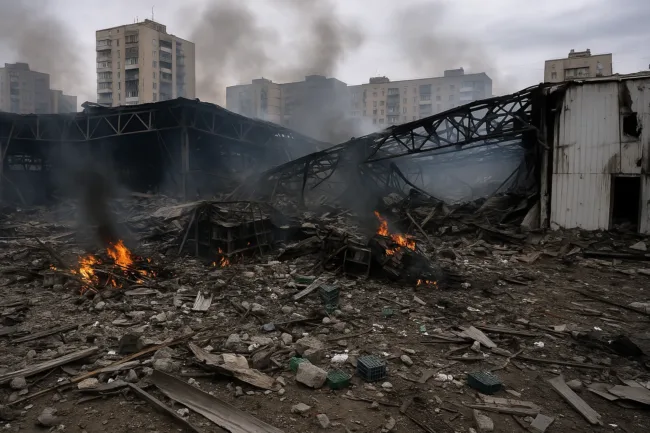
A Bombardier Challenger 600 carrying eight individuals crashed during takeoff from Bangor International Airport in Maine on the evening of Sunday, January 25, 2026, according to the Federal Aviation Administration. The incident occurred at approximately 7:45 p.m. local time. Officials confirmed that the jet was in the takeoff phase of its operation when the crash happened. The identities and conditions of the three crew members and five passengers onboard have not yet been released.
The aircraft is registered to a limited liability company based in Houston, Texas, according to federal aviation records. As of now, it is not clear whether the aircraft was on a business, personal, or chartered mission. The runway, identified as Runway 33, was being used for departure when controllers cleared the pilot for takeoff. Within two minutes of the clearance, a controller was heard urgently stopping all traffic on the field, followed by another transmission confirming that a passenger aircraft was upside down on the runway.
What are the official agencies saying and how is the investigation proceeding?
The Federal Aviation Administration and the National Transportation Safety Board are conducting a joint investigation into the crash. As per standard protocol, the National Transportation Safety Board is expected to lead the inquiry into the causes of the incident. Both agencies have stated that the current information is preliminary and subject to further verification as the investigation unfolds.
An Emergency Operations Center was activated at Bangor International Airport shortly after the crash. A formal media briefing was scheduled for 10:00 a.m. on Monday on the second floor of the Domestic Terminal to update the public and media on the situation. Airport authorities also confirmed that the airport had been closed and urged members of the public and press to avoid the area.
How are airline operations and passengers affected by the airport closure in Bangor?
Due to the crash, Bangor International Airport suspended all commercial and general aviation operations. Passengers scheduled to travel to or from Bangor are being advised to contact their respective airlines for updated information regarding delays, cancellations, and rerouting. Numerous diversions and cancellations have already been reported, although a full accounting of impacted flights has not been disclosed.
The crash occurred at a time of widespread travel disruption across the United States, with a severe winter storm affecting large parts of the Northeast and Midwest. More than 11,000 flights were canceled nationwide on Sunday alone, according to national aviation tracking services. The convergence of weather-related travel chaos and the Bangor incident has placed additional pressure on airline and ground operations.
What does the audio recording between air traffic control and the flight crew reveal?
According to an audio recording sourced from LiveATC.net and reported by CNN, controllers and pilots at Bangor International Airport were discussing low visibility and deicing requirements shortly before the incident. It remains unclear which transmissions were directed to which aircraft, but investigators will likely use this material to evaluate whether weather conditions or procedural miscommunication played any role in the crash.
The controller first cleared the flight for takeoff from Runway 33. Approximately two minutes later, another controller issued an urgent halt to all air traffic on the airfield, followed by the confirmation that a passenger aircraft was overturned. Emergency vehicles were immediately dispatched onto the runway as standard emergency response protocols were activated.
At one point, an air traffic controller reportedly relayed that there were three crew members and potentially five passengers on the aircraft, aligning with the initial estimate provided by the Federal Aviation Administration. This count remains unconfirmed, and the specific roles or affiliations of those on board have not been publicly disclosed.
How does this crash fit within the broader aviation safety and regulatory framework?
Bombardier Challenger 600 aircraft are widely used in private and business aviation, known for their range and cabin comfort. Like all civil aircraft registered in the United States, they fall under the operational oversight of the Federal Aviation Administration, which enforces regulatory standards for airworthiness, maintenance, and flight crew certification.
The National Transportation Safety Board typically conducts thorough accident investigations that can last from several weeks to more than a year, depending on the complexity of the incident. Investigators are expected to secure the crash site, examine flight data and cockpit voice recorders, review maintenance records, and conduct interviews with any witnesses, including air traffic controllers.
The current crash in Bangor will likely be scrutinized for any mechanical anomalies, pilot decision-making, runway surface conditions, visibility constraints, and possible icing. Deicing operations and visibility at the time of takeoff are particularly relevant, given the winter storm affecting the region.
Why is Bangor International Airport strategically significant in the region?
Bangor International Airport is a civil-military facility in Penobscot County, Maine, serving as a key gateway for both commercial and chartered operations. It is often used for transatlantic diversions, military refueling stops, and private jet activity due to its long runway and favorable geographic location.
While the airport is smaller than major Northeast hubs, its operational flexibility and role as an emergency diversion airport give it strategic relevance. A prolonged closure could affect not only local travel but also regional air logistics, especially under winter storm conditions when alternate airports are constrained.
As of Monday morning, no reopening timeline had been provided, and the status of ongoing operations remained unclear. Recovery of the aircraft wreckage and clearing of the runway will be contingent on investigative procedures and safety assessments.
What are the next steps for investigators and public authorities?
Authorities will focus on determining the aircraft’s point of origin, intended destination, fuel status, and any pre-flight anomalies or reported maintenance issues. If the aircraft was equipped with flight data and cockpit voice recorders, their recovery will be critical in reconstructing the sequence of events leading up to the crash.
Both the Federal Aviation Administration and the National Transportation Safety Board maintain established transparency practices, including public dockets and periodic investigative updates. However, official findings and conclusions are typically not released until a final report is issued.
Bangor city officials, state emergency agencies, and airport authorities are working with federal partners to coordinate the response. No additional press releases have been issued regarding whether next-of-kin notifications have been completed or if additional passenger details will be made public in the near term.
What the Bangor private jet crash means for airport operations, federal aviation oversight, and ongoing investigations
- A Bombardier Challenger 600 carrying eight people crashed during takeoff at Bangor International Airport in Maine on January 25, 2026.
- The Federal Aviation Administration and National Transportation Safety Board are conducting a joint investigation; the information remains preliminary.
- The airport is currently closed with emergency response operations underway; passengers are being advised to contact their airlines for updates.
- Air traffic control audio confirms takeoff clearance, emergency alerts, and reports of the aircraft being upside down on the runway.
- The crash occurred during a major winter storm impacting the Northeast, adding to widespread aviation disruption across the United States.
Discover more from Business-News-Today.com
Subscribe to get the latest posts sent to your email.