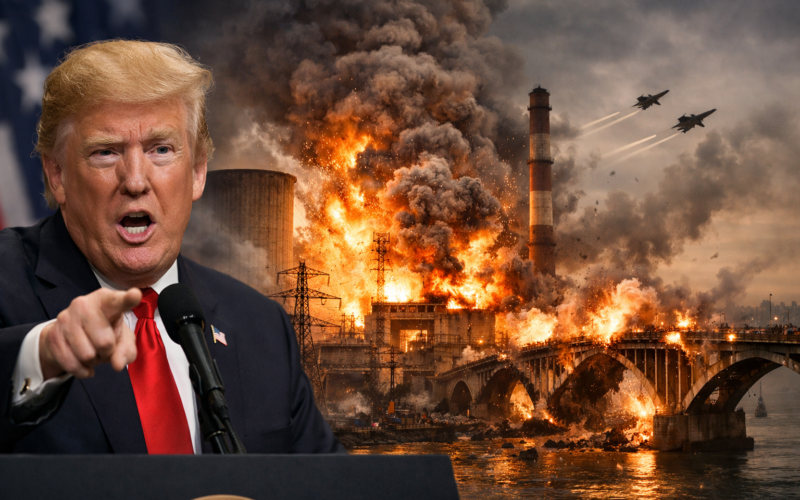
Iran on Monday rejected a 45-day ceasefire proposal from a coalition of mediating countries and countered with a ten-point set of demands for a permanent end to the war, as President Donald Trump escalated his public threats against the Islamic Republic and his Tuesday 8 p.m. Eastern Time deadline for Tehran to reopen the Strait of Hormuz drew closer.
Speaking at a White House press conference, Trump expanded his stated targets from specific infrastructure to the Iranian state in its entirety. “The entire country can be taken out in one night, and that night might be tomorrow night,” Trump said. He told reporters that every bridge in Iran would be “decimated” and every power plant would be “out of business, burning, exploding and never to be used again,” adding that such an outcome could unfold over four hours. Trump indicated the Tuesday deadline was final, stating he had given Iran sufficient extensions.
United States Defense Secretary Pete Hegseth said Monday’s strikes would be the largest in volume since the first day of the war, and that Tuesday would see even greater intensity. The United States and Israel launched the war against Iran on February 28, 2026, citing Iran’s military posture and its nuclear programme. The conflict has since widened through successive waves of strikes on Iranian military installations, energy infrastructure, and nuclear-adjacent sites, alongside Iranian missile and drone retaliation against Israel and Gulf Arab states.
How did Iran respond to the 45-day ceasefire proposal from Egypt, Pakistan and Turkey?
Egypt, Pakistan, and Turkey, acting as mediators, transmitted the ceasefire proposal to Iranian Foreign Minister Abbas Araghchi and United States Mideast envoy Steve Witkoff. The proposal called for a 45-day ceasefire and the reopening of the Strait of Hormuz, with the aim of creating a window for broader negotiations toward a permanent settlement.
Iran’s state news agency IRNA reported that Tehran’s rejection came through a ten-paragraph document emphasising the need for a permanent end to the war while respecting Iran’s national considerations. Iran’s stated demands include an end to all conflicts in the region, a protocol for safe passage through the Strait of Hormuz, reconstruction and reparations for war damages, and the lifting of United States sanctions.
Mojtaba Ferdousi Pour, head of Iran’s diplomatic mission in Cairo, told the Associated Press that Iran no longer trusts the Trump administration following what he described as two instances of United States military strikes during previous rounds of talks. “We only accept an end of the war with guarantees that we won’t be attacked again,” Ferdousi Pour said.
Iranian Foreign Ministry spokesperson Esmail Baghaei said a temporary ceasefire would only allow the United States and Israel to pause and prepare for the continuation of the war. “We are calling for an end to the war and for preventing its recurrence,” Baghaei was cited as saying by IRNA. Baghaei separately told journalists that negotiations are entirely incompatible with ultimatums, crimes, and threats of war crimes.
Iran’s Foreign Ministry stated that Iran is determined to defend its national security and sovereignty with all its capabilities. The Iranian Mission to the United Nations characterised Trump’s public statements as direct incitement against civilians and cited them as evidence of intent to commit war crimes under international law.

What did Trump say about Iran’s ceasefire response and the status of negotiations?
Trump acknowledged Iran’s response at the White House, describing it as “not good enough, but a very significant step.” He confirmed that negotiations with Iran were continuing despite Tehran’s rejection of the specific ceasefire framework. When asked whether the conflict was winding down or escalating, Trump said, “I can’t tell you. It depends on what they do.”
A regional official involved in the talks, speaking on condition of anonymity to discuss closed-door diplomacy, said mediation efforts had not collapsed. “We are still talking to both sides,” the official said. Trump has issued ultimatums to Iran previously during the course of the conflict and subsequently found grounds to extend timelines, though officials close to Monday’s press conference indicated his language this time was more explicit regarding follow-through.
Oman’s Foreign Ministry confirmed that its representatives had engaged with Iranian diplomats on options for ensuring smooth passage through the Strait of Hormuz, with both sides presenting proposals that would be studied by their respective governments.
Anwar Gargash, a senior policy adviser to the United Arab Emirates leadership, told NPR that the United Arab Emirates wants a resolution to the conflict but not one that creates continuous instability in the region. Gargash warned against a ceasefire that fails to address what he described as the main issues underlying the conflict.
Why is the Strait of Hormuz at the centre of United States demands and Iran’s position?
The Strait of Hormuz is the narrow maritime passage between the Persian Gulf and the Gulf of Oman through which approximately one-fifth of global oil and liquefied natural gas supplies transit in peacetime. Iran has effectively closed the strait to United States and Israeli-flagged vessels since the early weeks of the war that began February 28, 2026. The closure has disrupted an estimated 20 percent of global oil and liquefied natural gas supplies, contributing to fuel price increases of between 20 and 30 percent across the United States and Europe.
Brent crude oil rose to approximately $109 per barrel in early Monday trading, roughly 50 percent higher than at the start of the conflict. United States benchmark West Texas Intermediate climbed to $115.48 per barrel, a rise of 3.5 percent on the day. The sustained disruption to Strait of Hormuz transit has forced global energy markets to adjust supply chains and has placed pressure on economies in Europe and Asia that are heavily dependent on Gulf energy exports.
What role has Israel played in the latest round of military escalation against Iran?
Israel intensified pressure on Iran on Monday by attacking a major petrochemical plant in the South Pars natural gas field complex. Israel said the attack was aimed at eliminating a major source of revenue for the Islamic Revolutionary Guard Corps. The South Pars field is the world’s largest natural gas field and is shared between Iran and Qatar. It serves as Iran’s single largest source of domestic energy, supplying an estimated 70 percent of Iran’s total gas production.
Iran confirmed the killing of Maj. Gen. Majid Khademi, identified as the intelligence chief of the Islamic Revolutionary Guard Corps, during this period of intensified strikes. The South Pars gas field was first struck by Israel on March 18, 2026, a development that triggered Iranian retaliatory strikes on energy infrastructure across Qatar, Saudi Arabia, and Kuwait, and sent global oil and gas prices sharply higher at that time.
What has the IAEA said about military activity near Iran’s Bushehr nuclear power plant?
The nuclear dimension of the conflict has drawn escalating international concern. The International Atomic Energy Agency stated on Monday that ongoing military activity near Iran’s Bushehr nuclear power plant could cause a severe radiological accident with potential consequences extending beyond Iran’s borders.
International Atomic Energy Agency Director General Rafael Grossi reiterated his call for maximum military restraint to avoid the risk of a nuclear accident, emphasising that nuclear power plant sites and areas near them must never be attacked. No increase in radiation levels was reported following the most recent incident near the Bushehr facility.
Iranian Foreign Minister Abbas Araghchi, in a letter to United Nations Secretary-General Antonio Guterres, warned that strikes near the Bushehr nuclear power plant constitute an intolerable escalation and expose the entire region to radioactive contamination with severe humanitarian and environmental consequences. He described the Bushehr facility as operating exclusively for peaceful purposes under the International Atomic Energy Agency’s comprehensive safeguards regime.
Russia’s state-owned nuclear energy company Rosatom evacuated 198 personnel from the Bushehr nuclear power plant following the most recent strike near the facility. The Bushehr nuclear power plant is Iran’s only operational nuclear facility and was constructed with Russian technical and engineering assistance.
What did the United Nations say about threats to attack civilian infrastructure in Iran?
United Nations spokesperson Stephane Dujarric told journalists on Monday that any attack on civilian infrastructure is a violation of international law and a very clear one. The United Nations statement came in direct response to Trump’s explicit threats to destroy power plants and bridges across Iran. International legal frameworks governing armed conflict, including the Geneva Conventions and their additional protocols, prohibit attacks on civilian objects and infrastructure indispensable to the survival of the civilian population.
Key takeaways on what this development means for Iran, the United States, Israel, and global security
- Global energy markets remained under severe pressure, with Brent crude approximately 50 percent above pre-war levels, reflecting continued closure of the Strait of Hormuz and escalating strikes on energy infrastructure across the region.
- Iran formally rejected the 45-day ceasefire proposed by Egypt, Pakistan, and Turkey, and instead presented a ten-point counter-proposal demanding a permanent end to the war, lifting of United States sanctions, war reparations, and a Strait of Hormuz safe passage protocol.
- President Donald Trump set a firm Tuesday 8 p.m. Eastern Time deadline for Iran to reopen the Strait of Hormuz and threatened to destroy all of Iran’s power plants and bridges if the deadline passes without agreement, with Defense Secretary Pete Hegseth confirming a further intensification of strikes was underway.
- Mediation involving Egypt, Pakistan, Turkey, Oman, and regional officials remained active as of Monday evening, with a regional official confirming that talks with both sides were ongoing despite the ceasefire rejection.
- International Atomic Energy Agency Director General Rafael Grossi and United Nations Secretary-General Antonio Guterres received formal warnings about the risk of radiological catastrophe from strikes near Iran’s Bushehr nuclear power plant, with Russia’s Rosatom completing the evacuation of 198 personnel from the facility.
Discover more from Business-News-Today.com
Subscribe to get the latest posts sent to your email.