



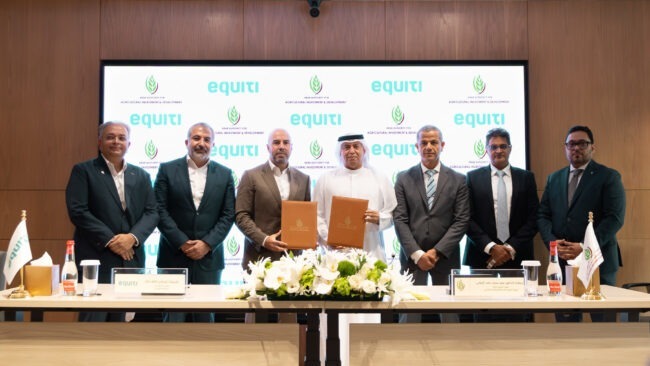
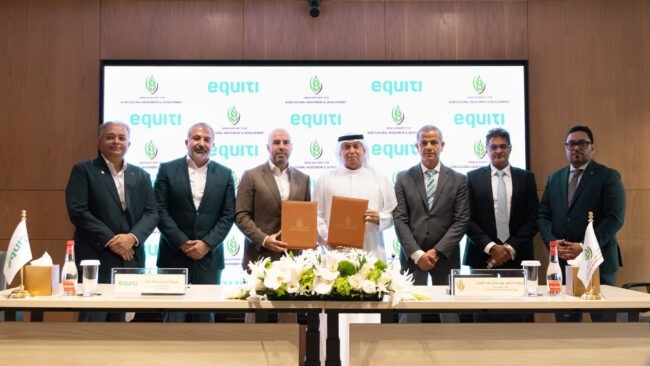
The Arab Authority for Agricultural Investment and Development (AAAID) and Equiti Group have signed a strategic memorandum of understanding that lays the groundwork for digitally transforming how food security investments are evaluated, funded, and monitored across the Arab world. The MoU, signed on December 16, 2025, brings together AAAID’s sovereign agriculture investment mandate with Equiti Group’s financial technology capabilities, aiming to launch a blockchain and AI-enabled platform that improves investor access and project transparency in the agriculture sector.
The agreement marks an inflection point for agri-finance in the Middle East and North Africa. It suggests that sovereign institutions are beginning to explore fintech architecture not just for capital markets and payments, but as infrastructure for managing the long-term economics of food resilience and sustainable agriculture.
How could a blockchain-based investment platform change agri-finance in the MENA region?
The Arab Authority for Agricultural Investment and Development was established in 1976 to mobilize investment across 21 member countries to support agricultural self-sufficiency and food system resilience. Until now, its interventions have typically involved direct equity stakes in agri-enterprises, concessional financing for agricultural development, and co-investment in infrastructure such as irrigation, logistics, and processing. These approaches, while effective in some cases, have often been hampered by slow capital deployment, opaque reporting frameworks, and limited investor participation beyond government-backed stakeholders.
The memorandum with Equiti Group signals a clear pivot toward fintech-enabled capital infrastructure. By proposing to build a digital platform underpinned by distributed ledger technology, the two parties aim to enable secure and transparent project tracking, automate investment flows through smart contracts, and expand the pool of accredited investors who can access AAAID’s portfolio. The inclusion of artificial intelligence tools for analytics, feasibility modeling, and operational planning suggests the platform is intended not just as a marketplace, but as a decision-making accelerator for stakeholders across the agri-investment value chain.
If implemented as envisioned, the platform could allow a diversified investor base to participate in tokenized agricultural projects with enhanced traceability, verifiable key performance indicators, and predictive risk scoring. This would effectively bring agriculture into the category of infrastructure-grade investment products, a transition that could change how capital markets interact with one of the most traditionally undercapitalized sectors in the region.
Why is Equiti Group entering the food security and agriculture space?
Equiti Group, headquartered in Dubai, operates across Africa, Asia, Europe, and the Middle East as a financial technology company with core strengths in trading systems, payment software, and asset management infrastructure. While its expertise has traditionally centered on virtual assets, capital markets, and institutional trading, the company has increasingly moved into adjacent segments that require secure, scalable digital platforms capable of handling regulated financial flows.
The partnership with the Arab Authority for Agricultural Investment and Development opens a new application area for Equiti Group: sovereign development finance. By embedding its technologies into AAAID’s investment processes, Equiti Group gains a direct entry into public-sector-aligned capital projects with long duration, strategic national importance, and built-in policy support. This move mirrors a broader trend of fintech firms seeking relevance beyond consumer finance and digital banking by offering infrastructure tools for mission-critical sectors.
Equiti Group’s ability to deliver regulatory-compliant digital rails across multiple jurisdictions will be tested as it attempts to support AAAID’s efforts in markets with varying levels of digital maturity and financial oversight. However, the high-level support signaled by this agreement suggests both parties view digital transformation as essential to modernizing agricultural investment ecosystems in the Arab world.
What specific use cases are envisioned for blockchain and AI in AAAID’s agri-investment model?
The planned digital platform would likely integrate multiple core functionalities, each designed to address persistent barriers in agricultural project finance.
First, distributed ledger technology can provide immutable records of project milestones, disbursements, and compliance events. This would reduce friction in multi-party transactions involving local developers, institutional funders, and regional authorities. Smart contracts could enforce capital disbursement conditions, link tranche releases to verified construction or planting progress, and automate yield-based revenue-sharing arrangements.
Second, artificial intelligence tools would support feasibility studies by processing historical agricultural data, climate risk models, satellite imagery, and economic indicators to build more accurate project forecasts. Machine learning algorithms could also flag underperforming assets or identify optimal locations for infrastructure investment.
Third, tokenization of agri-projects may enable partial ownership structures, allowing sovereign wealth funds, banks, and even diaspora investors to buy into project tranches based on risk appetite and desired exposure. This modularization could unlock new forms of blended finance in which development institutions provide first-loss guarantees while private capital funds higher-return slices.
Finally, a secure, investor-facing interface could offer real-time dashboards, ESG compliance reporting, and integration with national agricultural databases, offering an unprecedented level of visibility across AAAID’s portfolio.
What challenges could slow the adoption of fintech in food and agriculture development?
Despite the ambition behind the agreement, execution risk remains high. Agriculture as a sector has historically lagged behind in technology adoption, particularly when it comes to investment-grade digital platforms. Unlike financial markets where regulatory frameworks for digital assets are maturing, agriculture in many AAAID countries lacks harmonized data governance, financial transparency, and infrastructure digitization.
Sovereign regulatory regimes may pose additional challenges. Equiti Group must navigate different capital control laws, data localization requirements, and financial licensing rules across the 21 member countries AAAID operates in. Not all member states have the legal architecture to support smart contracts, blockchain-based asset registries, or even digital signatures in cross-border investment contexts.
Moreover, investor trust in AI-driven risk assessments and automated capital deployment remains fragile. In sectors like agriculture, where geopolitical, climate, and commodity market shocks can have rapid and nonlinear effects, over-reliance on predictive models may be viewed skeptically unless fully auditable and stress-tested.
There is also the user experience factor. A platform designed for sovereign capital and institutional investors may need to incorporate retail-like simplicity in order to reach regional banks, cooperatives, and family offices that traditionally play an informal but critical role in financing food and farming ecosystems.
How does this MoU reflect wider regional momentum toward digital investment infrastructure?
The timing of the MoU aligns with a broader pattern in the Middle East and North Africa, where sovereign entities are increasingly seeking digital rails to modernize national development agendas. Food security, particularly after the disruptions caused by COVID-19 and the war in Ukraine, has returned to the top of policy priorities. Several Arab countries are exploring technology-enabled solutions that enhance agricultural independence, reduce import exposure, and foster green innovation.
In this context, the collaboration between Equiti Group and the Arab Authority for Agricultural Investment and Development could serve as a pilot for how fintech infrastructure might support strategic sectors beyond financial services. If successful, the model could be replicated in energy, water, and logistics infrastructure domains, each with their own unique capital challenges but similar digital coordination needs.
This also positions the Arab region as a potential innovation zone for sovereign-fintech collaboration. With governments actively supporting sandboxes, blockchain pilots, and AI regulation initiatives, entities like AAAID are increasingly being incentivized to build scalable, tech-native ecosystems that can withstand supply chain shocks and climate volatility.
Could this partnership reshape how institutional investors view food security as an asset class?
One of the most potentially transformative outcomes of this partnership is the reframing of food and agriculture projects from policy-led interventions to investable asset classes. For institutional capital to flow into agri-infrastructure at scale, three elements are essential: risk-adjusted return profiles, performance transparency, and exit visibility. Fintech platforms offer the tools to construct, monitor, and syndicate such assets in real time.
AAAID’s imprimatur brings credibility, while Equiti Group provides the technical mechanism to deliver bankable projects at pace. If this collaboration succeeds in creating tokenized project structures with traceable cash flows and standardized reporting, it could bring agri-investment in the Arab world closer to how investors currently approach toll roads, ports, or renewable energy assets.
This shift could also open new blended finance structures, with development finance institutions providing catalytic capital and fintech platforms enabling flexible structuring, real-time oversight, and tiered investor participation. For countries seeking to localize food production while balancing fiscal constraints, this hybrid model may offer an attractive way forward.
Key takeaways on what the Equiti–AAAID MoU signals for agri-fintech and food security investment
- Equiti Group and AAAID will co-develop a digital platform to facilitate food security investments using blockchain and AI tools.
- The partnership aims to improve capital mobilization, investor access, and operational visibility across AAAID’s agricultural project pipeline.
- Tokenized investment structures and smart contracts could make agri-project financing more efficient, transparent, and scalable.
- The platform targets accredited investors, sovereign capital, and potentially retail participants looking for ESG-aligned real asset exposure.
- Equiti’s fintech expertise complements AAAID’s strategic mandate across 21 Arab countries but faces regulatory harmonization hurdles.
- Execution risks include digital trust issues, legal fragmentation, and adapting fintech UX to agri-sector complexity.
- The initiative reflects a broader MENA trend of merging sovereign development agendas with fintech architecture.
- If successful, the platform could redefine agri-tech as an investable infrastructure-grade asset class across emerging markets.
Discover more from Business-News-Today.com
Subscribe to get the latest posts sent to your email.

