

Equinor ASA (NYSE: EQNR) delivered fourth quarter 2025 earnings that showcased operational strength but also revealed the underlying strain from declining liquids prices and offshore wind headwinds. The company reported USD 6.20 billion in adjusted operating income and USD 1.55 billion in adjusted after-tax income. Net operating income stood at USD 5.49 billion, with adjusted net income at USD 2.04 billion and earnings per share at USD 0.81. These results were supported by record oil and gas production but tempered by lower realised liquids pricing and impairment charges across parts of the renewables and international portfolios.
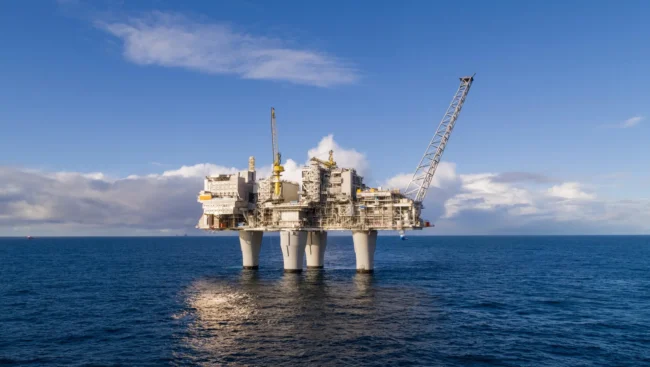
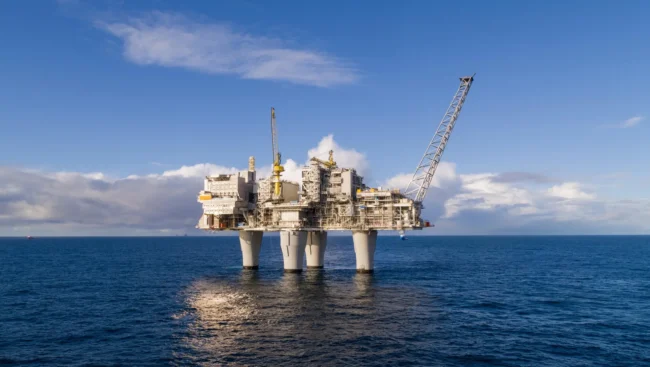
Total production hit a quarterly high of 2,198 thousand barrels of oil equivalent per day, representing a 6 percent increase over the same period in 2024. For the full year, output rose 3.4 percent to 2,137 thousand barrels per day, setting a new annual record. This was led by new volumes from fields like Johan Castberg and Halten East on the Norwegian Continental Shelf, as well as additional onshore gas output from Equinor’s expanded U.S. portfolio.
Yet, despite strong operational momentum, Equinor faced weaker pricing dynamics. The average Brent oil price fell 15 percent year-over-year in Q4 to USD 63.70 per barrel, while Equinor’s realised liquids price dropped to USD 58.60 per barrel. Net income declined to USD 1.31 billion for the quarter, compared to USD 1.99 billion a year earlier. Full-year net income fell 43 percent to USD 5.06 billion, reflecting both lower commodity prices and nearly USD 2.5 billion in impairments, mainly related to offshore wind and asset sales.
How is Equinor redefining capital efficiency while reducing exposure to underperforming assets?
Chief Executive Officer Anders Opedal and Chief Financial Officer Torgrim Reitan jointly reinforced Equinor’s evolving strategy: to focus on high-return barrels, cost discipline, and selective power investment rather than scaling renewables at any cost. The company reduced its 2026 and 2027 organic capital expenditure outlook by USD 4 billion, primarily within its Power and Low Carbon Solutions segments. This brings expected capex for 2026 to USD 13 billion and for 2027 to USD 9 billion, reflecting greater selectivity in project execution. Oil and gas spending will remain at approximately USD 10 billion annually, preserving core production capacity.
Equinor has also targeted a 10 percent reduction in adjusted operating expenses in 2026. These savings will come from a mix of portfolio high-grading, operational efficiencies, and curtailed business development in renewables. The updated net carbon intensity ambition now ranges between 5 to 15 percent by 2030 and 15 to 30 percent by 2035, indicating a tempered approach toward aggressive decarbonisation pathways.
Cash flow from operations after taxes paid reached USD 3.31 billion in the fourth quarter and USD 17.98 billion for the full year. The full-year net cash outflow was USD 5.12 billion, down from the USD 12.85 billion outflow in 2024. This was driven by reduced extraordinary dividends and more balanced buyback activity, which totaled USD 5 billion for 2025. The board approved a cash dividend of USD 0.39 per share for the fourth quarter, up from USD 0.37 in the third quarter, with plans to maintain that level across the first three quarters of 2026.
What are the competitive and structural implications of the Adura JV and offshore divestments?
Equinor’s reshaping of its international oil and gas portfolio continued in 2025 with notable exits and joint ventures. The divestment of a 40 percent interest in Brazil’s Peregrino field and the full exit from Azerbaijan and Nigeria are part of a broader high-grading strategy. In their place, the company established Adura, a joint venture with Shell in the United Kingdom. Adura will operate key projects including Rosebank, and is designed as a fully self-funded platform with a mandate to distribute more than 50 percent of its cash flow from operations beginning in 2026.
Equinor also completed the sale of its onshore Argentina assets for USD 1.1 billion, receiving USD 550 million in upfront cash. These transactions are expected to enhance free cash flow and reduce capital strain, especially in lower-margin or politically volatile regions. The proceeds from the divestments are already being earmarked to fund newer projects with higher cash generation potential and lower breakevens.
Despite the reduced global footprint, Equinor added 14 new discoveries in 2025, mostly near existing infrastructure on the Norwegian Continental Shelf. The company plans to drill 30 exploration wells in 2026 and has expanded its acreage in Norway, Brazil, and Angola. This underscores a shift toward infrastructure-led exploration, minimizing cost while maximizing value addition.
How is Empire Wind shaping investor expectations for Equinor’s U.S. renewables posture?
The Empire Wind project in the United States, though more than 60 percent complete, remains under intense scrutiny. After facing a second stop-work order in Q4 2025, operations resumed in January 2026 following a preliminary injunction. Equinor has now invested approximately USD 4.5 billion in the project, with about USD 3 billion in capex still remaining. Execution remains strong, but tariff exposure and regulatory complexity continue to pose risk to returns.
The project benefits from a 25-year fixed offtake contract at USD 155 per megawatt hour and is eligible for an estimated USD 2.5 billion in Investment Tax Credits. Equinor anticipates approximately USD 600 million in post-tax free cash flow from the project between 2027 and 2028. Importantly, the remaining capex is expected to be covered entirely by the tax credit and internal cash flows, which limits additional capital exposure. Nevertheless, Equinor’s renewables segment posted a USD 26 million operating loss in Q4, with impairments reflecting downward revisions in U.S. offshore wind synergies.
The company’s new Power segment, effective January 2026, aims to integrate renewables with flexible assets like battery storage. This includes the recent commissioning of Equinor’s first commercial battery project in Texas and the hybrid wind-solar complex in Brazil.
What signals are emerging from Equinor’s reserve and return metrics?
Equinor reported a return on average capital employed of 14.5 percent for the 12-month period ending December 2025. This is down from 20.6 percent in 2024 but still reflects competitive profitability in a lower pricing environment. The company’s unit production cost target for 2026 stands at USD 6 per barrel of oil equivalent, with NCS pipeline gas and transport costs below USD 2 per MMBtu, both remaining in the top quartile of the global peer group.
However, the reserve replacement ratio for 2025 came in at just 48 percent, with the organic RRR at 61 percent. These levels are down sharply from 2024, when both metrics were well above 100 percent. Equinor attributed the shortfall to higher entitlement production, divestments, and reduced reserves additions in offshore wind and international oil and gas. Still, the three-year average RRR remained at 100 percent, offering a measure of long-term consistency.
Absolute scope 1 and 2 greenhouse gas emissions declined to 10.2 million tonnes of CO2 equivalent, a 7 percent reduction year-over-year, driven by asset sales, electrification efforts, and operational turnarounds at Mongstad and Hammerfest. Equinor’s upstream carbon intensity stood at 6.3 kilograms of CO2 per barrel of oil equivalent in 2025.
Outlook: What happens next as Equinor leans into disciplined growth?
For 2026, Equinor expects around 3 percent production growth, driven by contributions from Bacalhau and Johan Castberg. Capital spending will remain focused on core hydrocarbon development, with renewables undergoing a recalibration. Interim cash dividends for Q1 through Q3 2026 are expected to remain at USD 0.39 per share, with a USD 1.5 billion buyback program already announced for the year, subject to market conditions.
While Equinor is not retreating from renewables, it is clearly being more surgical in its approach. High-grading across oil and gas, a self-funded model for power investments, and continued optimization of marketing and midstream operations are all aimed at bolstering free cash flow resiliency in a structurally lower price environment.
With most European energy peers still navigating post-transition volatility, Equinor’s narrative is shifting from growth-at-all-costs to disciplined, modular energy resilience. Whether investors reward that pivot will depend on continued execution across exploration, power integration, and capital returns.
Key takeaways on what Equinor ASA’s Q4 and full-year 2025 results signal for strategy, investors, and the energy sector
- Equinor ASA delivered record oil and gas production in 2025, confirming that recent field startups and U.S. portfolio additions are offsetting natural decline and divestments despite a weaker commodity price environment.
- Lower realised liquids prices and offshore wind impairments compressed earnings, reinforcing that operational outperformance alone is no longer sufficient to protect margins without tighter capital discipline.
- Management’s decision to cut organic capital expenditure by USD 4 billion across 2026 and 2027 marks a clear pivot away from volume-driven renewable expansion toward cash-return-focused investment.
- Oil and gas remains the financial backbone of Equinor’s strategy, with annual upstream spending held near USD 10 billion and unit production costs targeted at top-quartile levels globally.
- The establishment of the Adura joint venture with Shell in the United Kingdom introduces a capital-light, self-funded offshore development model that could influence how European majors structure future projects.
- Empire Wind remains strategically important but financially sensitive, with regulatory uncertainty and tariff exposure continuing to weigh on investor confidence despite strong construction progress and long-term offtake security.
- Shareholder returns are being prioritized through a higher quarterly cash dividend of USD 0.39 per share and a USD 1.5 billion share buyback program for 2026, signaling confidence in free cash flow durability.
- The decline in Equinor’s 2025 reserve replacement ratio highlights an emerging tension between portfolio high-grading and long-term reserve sustainability that will require renewed exploration success.
- Return on average capital employed remains solid at mid-teens levels, supporting Equinor’s positioning as a relatively defensive European energy major in a lower price cycle.
- Overall, Equinor’s 2025 results suggest a strategic shift toward resilience and capital efficiency, with future valuation hinging on disciplined execution, renewables selectivity, and sustained cash generation rather than growth alone.
Discover more from Business-News-Today.com
Subscribe to get the latest posts sent to your email.