



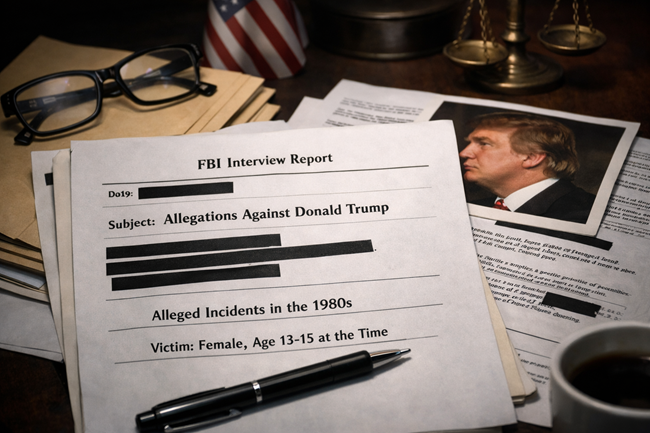
The United States Department of Justice on Thursday released three previously withheld Federal Bureau of Investigation interview reports from 2019 containing uncorroborated sexual abuse allegations made by an unidentified woman against President Donald Trump. The woman, whose identity remains redacted in all published records, alleged that she was abused by Trump in the 1980s when she was between the ages of 13 and 15 years old.
The interview summaries, known within the Federal Bureau of Investigation as 302 reports, were initially withheld from the January 2026 release of millions of pages of Department of Justice documents related to convicted sex offender Jeffrey Epstein. The Department of Justice said in a statement published on social media that the reports had been believed to be duplicative of other documents already made public.
The Department of Justice published the records on Thursday following reporting by several media outlets that the documents were not among the vast trove released under the Epstein Files Transparency Act.
In a statement published on the social media platform X, the Department of Justice said it had reviewed public allegations that Federal Bureau of Investigation 302 documents originally produced to Ghislaine Maxwell in discovery of her criminal case were missing from its published library of materials. After conducting what it described as an extensive review, the department said 15 documents had been incorrectly coded as duplicative. The statement did not explain why, beyond possible human error, the records had been classified in that way.
What is the Epstein Files Transparency Act and how did the document release come about?
The Epstein Files Transparency Act was passed overwhelmingly by the United States House of Representatives and unanimously by the United States Senate in November 2025. President Donald Trump signed the legislation into law the following day. The Act compelled the Department of Justice to release all documents in its possession related to Jeffrey Epstein within 30 days of enactment. The law permits the Department of Justice to withhold records that contain victim information, child sexual abuse materials, or information that could jeopardise an ongoing federal investigation or prosecution.
The legislation followed years of public and political pressure to make available the full body of evidence gathered by federal investigators in connection with the criminal cases against Epstein and his associate Ghislaine Maxwell. Maxwell was convicted by a federal jury in New York in December 2021 on multiple charges including sex trafficking of a minor and conspiracy. She is currently serving a 20-year sentence at a federal correctional institution in Florida.
What did the unidentified woman allege about Epstein and Trump across four FBI interviews in 2019?
The unidentified woman first contacted federal law enforcement shortly after Epstein’s arrest in July 2019. She described to agents how she alleged Epstein had sexually assaulted her on Hilton Head Island, South Carolina, when she was approximately 13 years old in or around 1984. She told agents she had not known the identity of the man at the time, but concluded decades later that he was Epstein after a friend sent her a photograph from a news story.
According to the FBI 302 reports released on Thursday, the Federal Bureau of Investigation conducted four interviews with the woman between July and October 2019. During each of these interviews, she made allegations of abuse against Epstein. In her second interview with federal investigators, she claimed that Epstein had taken her to either New York or New Jersey and introduced her to Trump when she was between the ages of 13 and 15. She alleged that Trump sexually assaulted her during that visit.
In further interviews, the woman alleged that Epstein had also schemed to have her mother imprisoned, subjected her to physical beatings, and arranged sexual encounters with other men. She said Epstein drove her and/or flew her to a building she described as very tall with large rooms, where the alleged encounter with Trump took place. She indicated she had two additional interactions with Trump but declined to elaborate, and it is unclear whether she ever disclosed the details of those interactions to law enforcement.
During her third FBI interview, agents recorded that the woman described receiving threatening telephone calls she believed were connected to Epstein or Trump, as well as several incidents in which she said she was nearly forced off the road by other vehicles. Her fourth interview, conducted approximately two months after the third, took place without an attorney present. She told agents she was uncomfortable being recorded and questioned the purpose of providing information when the statute of limitations had in all likelihood already passed. The agents noted they encouraged her to take whatever time she needed to consider speaking with them further.
The 302 reports do not contain corroborating evidence or assessments of credibility by Federal Bureau of Investigation agents. The outcome of any federal investigation into the woman’s claims remains unclear from the published documents. The woman, referenced as “Jane Doe 4” in certain case materials, was deemed ineligible to receive compensation from the Epstein Victims’ Compensation Program, according to a court record dated May 2021. She voluntarily dismissed a lawsuit against Epstein’s estate in December 2021, and her lawyer subsequently told The Post and Courier newspaper that she had received a financial settlement from the estate.
How did the White House and the Department of Justice respond to the publication of the previously withheld FBI reports?
White House Press Secretary Karoline Leavitt characterised the claims contained in the FBI interview summaries as completely baseless accusations backed by no credible evidence. Leavitt also questioned the credibility of the accuser, citing her criminal record, and noted that the Department of Justice under the previous administration had been aware of the allegations for four years and had taken no legal action. Leavitt stated that the total absence of action by the prior Department of Justice itself supported the position that the allegations lacked merit.
The White House also referenced a statement issued by the Department of Justice in January 2026, at the time the majority of the Epstein files were released. That statement warned that the production might include fake or falsely submitted images, documents, or videos, and that some documents contained untrue and sensationalist claims against President Trump that had been submitted to the Federal Bureau of Investigation in the period before the 2020 presidential election.
The Department of Justice stated at that time that the claims were unfounded and false. The Department of Justice and federal authorities have not accused President Trump of any wrongdoing in connection with Jeffrey Epstein or his criminal activities.
Trump has maintained he had no knowledge of Epstein’s sexual abuse. Trump has stated his association with Epstein ended before Epstein was first publicly accused of sexual misconduct in 2006, though conflicting accounts have emerged over the circumstances of that separation.
Why did members of both parties in Congress demand full disclosure of these particular Epstein-related records?
The publication of the additional records came one day after a majority of members of the House Oversight Committee voted to subpoena Attorney General Pam Bondi to testify about her department’s management of the Epstein files release. Five Republican members of the committee joined Democrats in supporting the motion put forward by Representative Nancy Mace of South Carolina. Mace stated publicly that Attorney General Bondi’s assertion that all responsive Epstein files had been released was contradicted by the available record.
Prior to Thursday’s release, Congressional Democrats had accused the Department of Justice of unlawfully withholding documents in order to protect the president. Representative Robert Garcia of California, the ranking Democrat on the House Oversight Committee, described the withholding as unconscionable and illegal and called on Attorney General Bondi and the president to account for the missing files.
An investigation conducted by National Public Radio identified what appeared to be more than 50 pages of Federal Bureau of Investigation interview documents and notes missing from the public Epstein database.
The investigation involved a review of multiple sets of unique serial numbers stamped onto documents in the Epstein files database, FBI case records, emails, and discovery document logs. After the 16 pages released on Thursday were published, approximately 37 pages of records remained absent from the public database, including interview notes, a law enforcement report, and licence records.
A separate review by CNN identified dozens of witness interview summaries missing from the online archive of Epstein-related evidence. NBC News independently identified the missing interviews through an evidence catalogue in the case against Ghislaine Maxwell. A review of that catalogue indicated that well over 100 other files remained unavailable on the Department of Justice website.
What is the background to Epstein’s 2008 plea agreement and the federal prosecution that never proceeded?
Among the additional records released on Thursday were multiple versions of internal memos from 2007 written by a Florida federal prosecutor outlining the case for charging Epstein to her superiors in the United States Attorney’s Office in Miami. The Department of Justice said five of those memos, initially withheld as privileged communications, could be released while still protecting privileged materials.
The indictment proposed by the Florida federal prosecutor was never presented to a grand jury. Epstein’s legal team engaged in extended negotiations with federal prosecutors that resulted in an agreement forgoing federal prosecution entirely. This arrangement allowed Epstein to plead guilty to comparatively lesser charges in state court in Florida in 2008. That agreement, sometimes referred to in legal proceedings as a non-prosecution agreement, was signed by then-United States Attorney Alexander Acosta. A federal judge ruled in 2019 that the agreement had been unlawfully concealed from Epstein’s identified victims in violation of the Crime Victims’ Rights Act, a ruling that drew renewed scrutiny of Acosta, who resigned as United States Secretary of Labor following that judicial finding.
Epstein was convicted on state charges in Florida in 2008 that included solicitation of prostitution with a minor. He served more than one year of his sentence and died in a federal correctional facility in New York City in August 2019 at the age of 66 while awaiting federal trial on sex trafficking charges. The medical examiner ruled his death a suicide by hanging, though the finding has been contested by Epstein’s legal representatives and other parties.
What the release of the withheld FBI 302 reports means for the United States Congress, the Department of Justice, and the ongoing Epstein files transparency process
- The Department of Justice released three previously withheld FBI 302 interview reports on Thursday describing uncorroborated allegations made by an unidentified woman that President Donald Trump sexually abused her in the 1980s when she was between 13 and 15 years old; the records had been omitted from the January 2026 release and classified as duplicative by the department.
- The Department of Justice attributed the omission to a coding error affecting 15 documents, while providing no further explanation for why the records related specifically to allegations against the sitting president were among those mislabelled.
- Approximately 37 pages of records connected to the woman’s interviews remain absent from the public Epstein files database, including interview notes and a law enforcement report, following the partial Thursday release.
- The House Oversight Committee voted a day before the release to subpoena Attorney General Pam Bondi over the department’s handling of the Epstein files, with five Republican members joining Democrats to support the measure.
- President Trump and the White House have denied all allegations contained in the released records, and federal authorities have not accused Trump of any wrongdoing in connection with Jeffrey Epstein or his criminal conduct.
Discover more from Business-News-Today.com
Subscribe to get the latest posts sent to your email.