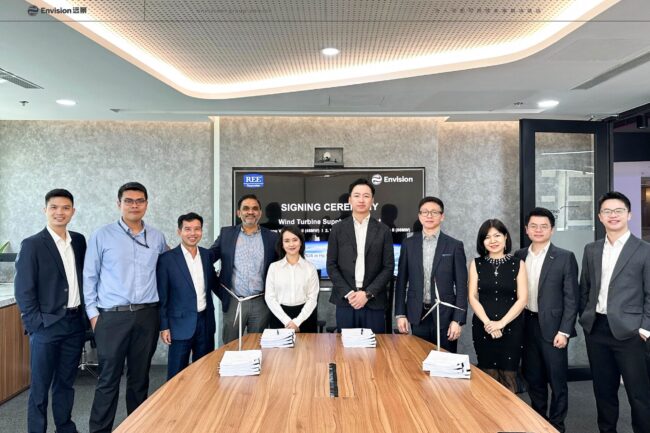
Envision Energy has entered into a strategic turbine supply agreement with Vietnam’s REE Group to deliver 128 megawatts of wind capacity across two nearshore projects in Vinh Long Province. The deal will see Envision Energy’s EN-226/8.X MW turbines deployed on the V1-3 Phase II and V1-5&6 Phase II projects, targeting grid connection by October 2026. The contract reinforces both firms’ expansion strategies amid Vietnam’s Power Development Plan VIII wind acceleration.
How does this turbine agreement advance Vietnam’s nearshore wind buildout and why does it matter now?
This 128 megawatt turbine supply agreement marks a significant scale-up in Vietnam’s nearshore wind trajectory. By selecting the EN-226 turbine platform, REE Group is opting for one of the most powerful nearshore-suited turbines in Asia, enabling fewer turbines to deliver more output. Each EN-226 unit offers over 8 megawatts of rated capacity and features an ultra-large rotor diameter, tailored for complex near-coastal wind regimes like the Mekong Delta.
This configuration is particularly relevant as Vietnam seeks to optimize limited marine space and mitigate transmission bottlenecks near rapidly industrializing regions. The project’s combined footprint — 48 megawatts at V1-3 Phase II and 80 megawatts at V1-5&6 Phase II — represents one of the largest single-supplier nearshore turbine deployments in Southeast Asia to date.
From an execution standpoint, the use of larger, fewer turbines reduces civil works, foundation requirements, and maintenance overhead. It also shortens the timeline to commercial operation, a factor that aligns closely with PDP VIII’s revised targets for wind onboarding between 2025 and 2030.

What does the Envision–REE partnership signal about the shifting competitive dynamics in Southeast Asian renewables?
The decision by REE Group to partner with Envision Energy rather than traditional turbine manufacturers like Siemens Gamesa or Vestas suggests a growing openness to Chinese-origin platforms across ASEAN energy markets. While geopolitical risk and project bankability remain key considerations, Vietnamese developers are increasingly focused on near-term performance metrics, total cost of ownership, and localization opportunities.
Envision Energy has leaned into this trend by establishing collaborative procurement frameworks and engineering support tailored to Vietnam’s regulatory and logistical landscape. Notably, the company is working with local tower manufacturers and fabrication yards to address structural challenges associated with high hub-height designs in shallow coastal waters.
This approach gives Envision a cost and delivery advantage in nearshore segments where domestic EPC contractors are active and foreign players may struggle with import logistics or grid code alignment. The REE deal could thus foreshadow broader adoption of non-Western turbine platforms in mid-scale projects, especially where high capacity density is prioritized over legacy OEM standardization.
How does this fit into Vietnam’s PDP VIII targets and grid readiness plans?
Vietnam’s Power Development Plan VIII, ratified in 2023, set ambitious targets for renewable integration with a particular emphasis on wind power. The plan envisions 27 gigawatts of onshore and nearshore wind by 2030, rising to over 60 gigawatts by 2050. Nearshore wind is expected to play a critical transitional role due to its faster permitting timeline and lower infrastructure complexity compared to full offshore deployments.
The Envision–REE project is strategically located in Vinh Long Province, a key node in Vietnam’s Southern power corridor where energy demand is growing and solar saturation has already stressed grid capacity. By delivering grid-stable wind output during monsoon and evening periods, these turbines will help balance seasonal load and reduce fossil fuel reliance in an economically vital zone.
Envision confirmed that the turbine supply contract includes advanced digital integration with Vietnam’s dispatch systems. The company is also working with local partners on pre-construction surveys, logistics, and assembly to ensure the project adheres to Vietnam’s growing grid code requirements and local content regulations.
What are the technical and operational implications of using the EN-226 turbine platform?
Envision’s EN-226/8.X MW turbine is engineered for high-capacity factors in variable-speed wind conditions, with a rotor diameter of 226 meters and a rated capacity exceeding 8 megawatts per unit. This allows fewer turbines to generate the same energy yield as legacy multi-machine configurations.
The EN-226 series has seen growing adoption across Asia and Latin America and has logged more than 2.5 gigawatts in signed contracts globally. The platform includes modular components optimized for maritime transport, hub-height customization, and predictive maintenance via Envision’s proprietary digital operating system.
For REE Group, the turbine selection translates into improved land-use efficiency, reduced operations and maintenance (O&M) costs, and simplified project phasing. By investing in a larger-capacity turbine class early, REE may be positioning itself as a frontrunner for future PDP VIII tenders where turbine size and output density are likely to be major scoring criteria.
What are the execution and integration risks for this project?
While the technology choice and partnership model strengthen the project’s feasibility, several execution risks remain. First, nearshore wind sites in the Mekong Delta can experience soil instability and tidal variation, requiring advanced foundation engineering. Second, Vietnam’s evolving regulatory environment and land acquisition challenges may delay balance-of-plant readiness even if turbine supply is on schedule.
Logistics and local fabrication capacity could also be stretched, especially for towers and blades exceeding 80 meters. While Envision and REE have indicated collaboration with domestic suppliers, the ability to deliver large components to shallow-water staging sites could be a bottleneck without port upgrades or specialized transport vessels.
Moreover, with grid connection targeted for Q4 2026, any slippage in permitting, weather-related construction delays, or supply chain constraints could compress the commissioning window. Vietnam’s state utility, EVN, has recently flagged concerns over curtailment and substations nearing capacity, suggesting that timely interconnection agreements will be essential.
How could this deal influence future wind procurement and technology choices in Southeast Asia?
The Envision–REE agreement could set a precedent for mid-sized developers in Vietnam and neighboring markets like the Philippines and Thailand to consider large single-supplier turbine packages. The project’s visibility, technical ambition, and timeline align closely with ASEAN nations’ clean energy roadmaps and may catalyze more aggressive turbine class selection in future auctions.
It also offers an alternative commercial model: rather than relying on full turnkey EPC contracts with Western OEMs, developers can increasingly mix-and-match technology providers with local EPCs to manage cost and customization. Envision’s ability to support this hybrid approach with local training, digital integration, and post-commissioning services may make it more attractive in markets that prioritize rapid scalability over brand legacy.
Depending on project performance and cost-per-kilowatt outcomes, Vietnamese regulators may consider updating PDP VIII scoring to incentivize high-capacity turbines, integrated digital O&M platforms, and grid-responsive designs, further benefiting players like Envision.
What are the key takeaways on what this turbine supply deal means for REE Group, Envision Energy, and Vietnam’s wind sector?
- Envision Energy will supply 16 EN-226/8.X MW turbines to REE Group’s V1-3 and V1-5&6 nearshore projects, totaling 128 megawatts.
- The turbines will be deployed in Vinh Long Province with a targeted grid connection by October 2026, aligning with PDP VIII priorities.
- REE’s adoption of high-capacity turbines signals a pivot to greater energy density and faster commercialization timelines in nearshore segments.
- Envision’s collaboration with local tower suppliers and its digital integration suite enhances cost control and compliance with grid codes.
- This marks one of the largest single-platform nearshore turbine deployments in Southeast Asia and may shift procurement patterns regionally.
- Vietnam’s evolving regulatory posture could favor platforms that optimize for local content, grid responsiveness, and lifecycle efficiency.
- Execution risks include shallow-water logistics, port infrastructure constraints, and curtailment exposure tied to EVN interconnection schedules.
- The deal reflects REE Group’s broader ambition to scale its renewable portfolio using tier-one, digitally managed wind assets.
- Envision is leveraging its success in Latin America and China to expand into the ASEAN market with customizable turbine configurations.
- Success of this project may influence turbine selection criteria in upcoming PDP VIII auctions, especially where fewer, larger machines are favored.
Discover more from Business-News-Today.com
Subscribe to get the latest posts sent to your email.