

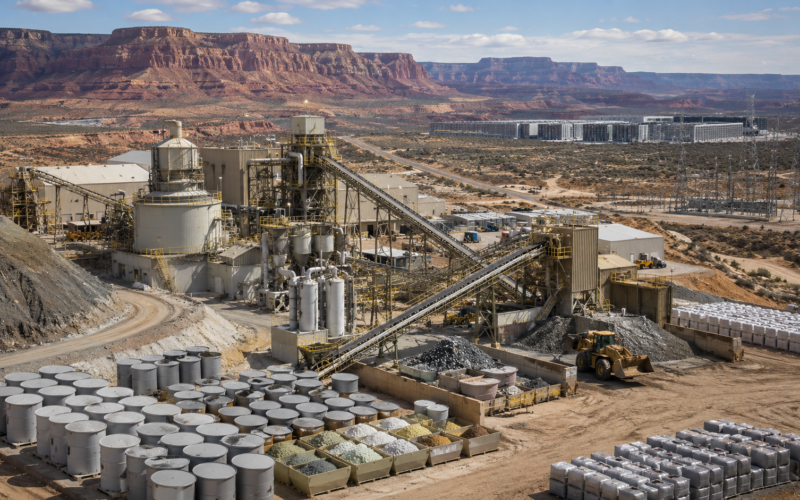
Energy Fuels Inc. (NYSE American: UUUU) (TSX: EFR), the leading United States producer of uranium and rare earth elements, gained about 4.5 percent on June 11 after announcing it expects to reach roughly 1.6 million pounds of finished uranium oxide by June 30, hitting the lower portion of its full-year 2026 guidance range of 1.5 to 2.5 million pounds in just six months. The production comes from the company’s wholly owned White Mesa Mill in Utah, the only fully licensed conventional uranium mill operating in the country, processing ore from its Pinyon Plain mine in Arizona and La Sal Complex in Utah at an average pace exceeding 265,000 pounds per month. Management emphasized historically low costs, with uranium processing at White Mesa running between $9 and $12 per pound and mine-level costs at Pinyon Plain between $23 and $30 per pound, supporting falling cost of sales through 2026. The company also detailed plans to begin modifying its rare earth circuits in July to enable commercial production of heavy rare earths alongside its existing neodymium-praseodymium output. The update matters because Energy Fuels sits at the center of two strategically critical supply chains, nuclear fuel and rare earths, at a moment when both are tied to energy security and the surging power demands of artificial intelligence.
Why did Energy Fuels stock rise after hitting its full-year uranium guidance in just six months?
The market rewarded operational execution and the optionality it creates. Producing the bulk of full-year guidance in half the year demonstrates that Energy Fuels’ mines and mill are running ahead of schedule, and front-loading production gives the company flexibility to manage inventory, sales timing, and capacity for other uses. Beating the implied production cadence is a clear positive operational signal.
The competitive context is that Energy Fuels is reinforcing its claim as the clear leading United States uranium producer. With domestic nuclear fuel supply a national priority and most uranium historically sourced from abroad, a low-cost domestic producer hitting targets early strengthens its strategic position and its appeal to utilities seeking secure, domestic supply. Reliable execution is a differentiator in a sector where many peers are still pre-production.
The second-order driver is what the early completion enables. By finishing the current processing campaign ahead of schedule, the company frees up the White Mesa Mill for rebuilding ore stockpiles and, critically, for a potential rare earth processing campaign, turning a single asset into a flexible, multi-product facility. The stock reaction reflects appreciation for both the uranium beat and the strategic flexibility it unlocks.
What do Energy Fuels’ historically low production costs mean for its margins as it sells into contracts?
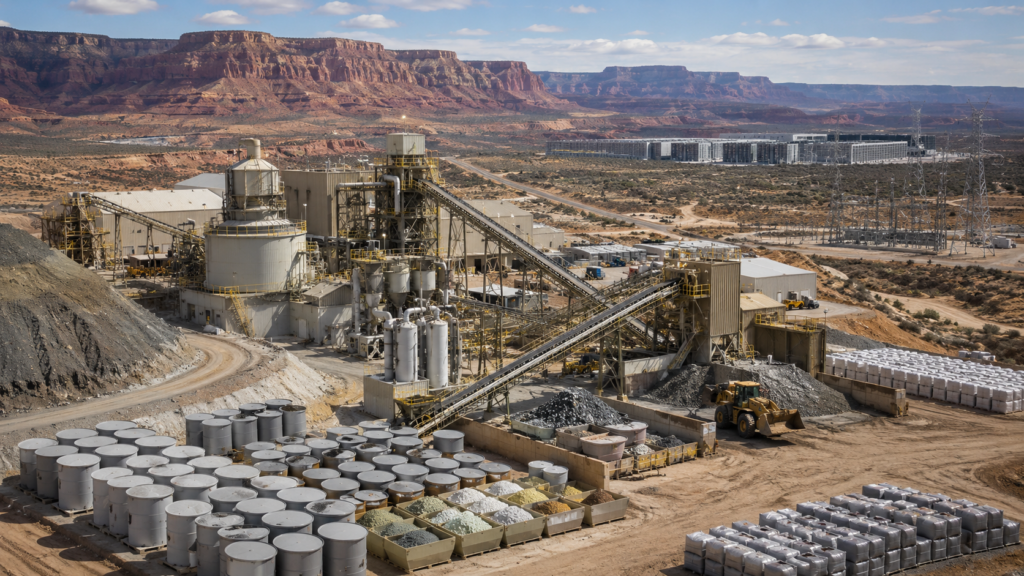
Cost leadership is the foundation of the investment case. Processing costs at White Mesa running between $9 and $12 per pound sit near historic lows, and mine-level costs at Pinyon Plain between $23 and $30 per pound are competitive, which together position Energy Fuels to generate healthy margins against prevailing uranium prices. Low costs are the durable advantage in a commodity business.
The competitive implication is expanding profitability as the company sells into its contract book. Management indicated cost of sales is expected to continue declining in 2026 as more sales are made under long-term agreements, suggesting margins should improve through the year, and a low-cost producer benefits disproportionately if uranium prices remain firm. The combination of secured contracts and falling unit costs is a favorable setup.
The risk is commodity price and concentration exposure. Uranium prices are cyclical and can move on supply announcements, reactor demand shifts, and geopolitics, and Energy Fuels remains dependent on a single operating mill and a handful of mines, so any operational disruption would be material. The cost advantage is real, but it operates within the volatility inherent to a commodity producer with concentrated assets.
How does the rare earth circuit expansion at White Mesa position Energy Fuels in critical minerals supply?
The rare earths strategy is what differentiates Energy Fuels from a pure uranium miner. The company already produces commercial quantities of separated neodymium-praseodymium at White Mesa, and starting in July it plans to modify its existing Phase 1 circuits to also produce heavy rare earths such as dysprosium, terbium, samarium, europium, and gadolinium, materials essential to magnets, defense systems, and electronics. Adding heavy rare earths meaningfully broadens its critical-minerals footprint.
The strategic context is intense Western focus on reducing dependence on Chinese rare earth supply. Heavy rare earths in particular are dominated by Chinese processing, and a domestic producer capable of separating them addresses a recognized national-security vulnerability, which aligns Energy Fuels with government priorities and potential policy support. The company is also advancing mineral-sands and rare earth projects internationally and a planned acquisition to expand that capability.
The risk is execution and capital intensity in a difficult market. Building rare earth separation capacity is technically demanding and capital-hungry, rare earth pricing has been volatile and at times depressed, and commercial-scale heavy rare earth production is a new undertaking, so the payoff is uncertain and multi-year. The strategic logic is compelling, but the rare earths business must prove it can be both technically successful and economically viable.
What does the planned pause and Q4 restart of ore processing reveal about Energy Fuels’ strategy?
The decision to pause processing reflects disciplined inventory and asset management. By completing the current uranium campaign in June to rebuild ore stockpiles and resuming in the fourth quarter, Energy Fuels is matching milling to its mining cadence and market conditions rather than running continuously regardless of inputs. That discipline preserves resource value and avoids drawing down stockpiles uneconomically.
The strategic implication is that the mill is being managed as a shared, flexible resource. The pause explicitly creates room for a potential rare earth processing campaign, illustrating how Energy Fuels toggles White Mesa between uranium and rare earths to maximize the value of a single licensed facility. That flexibility is a structural advantage few competitors possess.
The risk is that the pause introduces variability into uranium output and revenue timing. Conditioning the Q4 restart on continued strong mining, uranium market conditions, and rare earth plans means production is not on autopilot, and investors must accept lumpier quarterly results in exchange for strategic optionality. The approach is sensible, but it trades steady output for flexibility, which can complicate near-term forecasting.
What should investors weigh on Energy Fuels given a stock up over 150 percent but below its January high?
For Energy Fuels itself, the agenda is sustaining low-cost uranium production, executing the rare earth circuit upgrades, and advancing its international projects and planned acquisition. The company is delivering operationally, and the next milestones are proving commercial-scale heavy rare earth production and converting its strategic positioning into diversified, durable revenue.
For the uranium and rare earth sectors, Energy Fuels’ update underscores rising momentum behind domestic critical-minerals supply, driven by nuclear power’s resurgence amid AI-related electricity demand and Western efforts to secure rare earth independence. As a rare producer active in both, it is a bellwether for investor appetite toward the broader energy-security and critical-minerals theme.
For investors, the stock is a high-beta play on powerful but volatile themes. Shares have surged more than 150 percent over the past year yet trade down about 13 percent year to date and roughly half their January record high, near a $3.6 billion market capitalization, reflecting both enthusiasm and the sharp swings typical of commodity and critical-minerals names. The prudent stance is to weigh Energy Fuels’ genuine cost leadership, strategic positioning, and operational execution against commodity price volatility, the capital intensity of rare earths, and asset concentration, recognizing it as a strategic but speculative holding.
Key takeaways on what Energy Fuels’ mid-year update means for the company, the US uranium and rare earth sectors, and investors
- Energy Fuels expects to hit roughly 1.6 million pounds of uranium by June 30, reaching full-year guidance in just six months, and the stock rose about 4.5 percent.
- Producing at the only fully licensed conventional uranium mill in the United States strengthens its position as the clear domestic leader.
- Processing costs of $9 to $12 per pound and mine costs of $23 to $30 per pound sit near historic lows, supporting expanding margins.
- Cost of sales is expected to keep falling in 2026 as more sales are made under long-term contracts.
- Completing the uranium campaign early frees the White Mesa Mill for stockpile rebuilding and a potential rare earth processing campaign.
- From July, the company will modify its circuits to produce heavy rare earths like dysprosium and terbium alongside existing NdPr output.
- The heavy rare earths push directly addresses Western dependence on Chinese processing, aligning with energy-security priorities.
- The planned pause and Q4 restart reflect disciplined asset management but introduce lumpier quarterly production and revenue.
- The themes of nuclear power for AI demand and critical-minerals independence underpin the strategic bull case.
- The stock is up over 150 percent in a year but down 13 percent year to date, a high-beta, speculative play on volatile themes.
Discover more from Business-News-Today.com
Subscribe to get the latest posts sent to your email.