



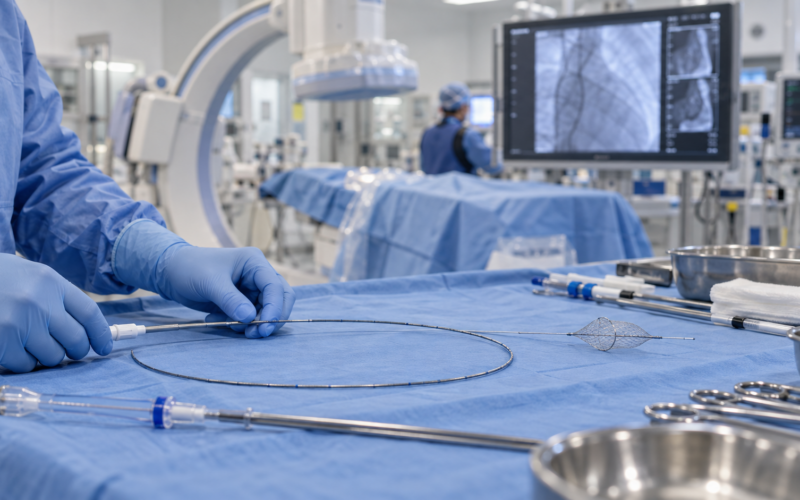
Emboline, Inc. has received U.S. Food and Drug Administration (FDA) 510(k) clearance for the Emboliner Embolic Protection System, allowing the privately held medtech company to begin U.S. sales after completing a 500-patient head-to-head pivotal trial against Boston Scientific Corporation’s Sentinel system. Emboliner is indicated to capture and remove embolic material during transcatheter aortic valve replacement and is designed to provide both cerebral and systemic protection rather than protecting only vessels supplying the brain. The September 8 clearance follows pivotal evidence showing Emboliner was non-inferior to Sentinel on 30-day safety and stroke endpoints while capturing more procedural debris and producing higher technical and procedural success rates. Emboline is consequently entering commercialization with differentiation that is mechanically intuitive, but it still has to prove that capturing more material translates into enough clinical and economic value to change routine TAVR practice.
The company prepared financially for this moment earlier in 2026 when Trinity Capital committed $20 million of growth capital specifically to support commercialization. That financing gives Emboline resources for manufacturing, field support and launch activities without requiring another regulatory milestone first. The company says the device is now available for sale in the United States, moving the story immediately from clinical development into hospital procurement and physician adoption.
Why is embolic protection important during transcatheter aortic valve replacement?
TAVR replaces a diseased aortic valve through catheters rather than conventional open-heart surgery, but manipulating calcified valves and large cardiovascular devices can dislodge tissue, calcium and thrombotic material into the bloodstream. Embolic debris can travel to the brain and contribute to stroke, while material reaching other organs may potentially affect systemic circulation. Protection systems are designed to capture some of that debris before it leaves the aortic arch or reaches vulnerable organs. Emboline’s proposition is that protection should extend beyond cerebral vessels and cover a broader section of the circulation during the procedure.
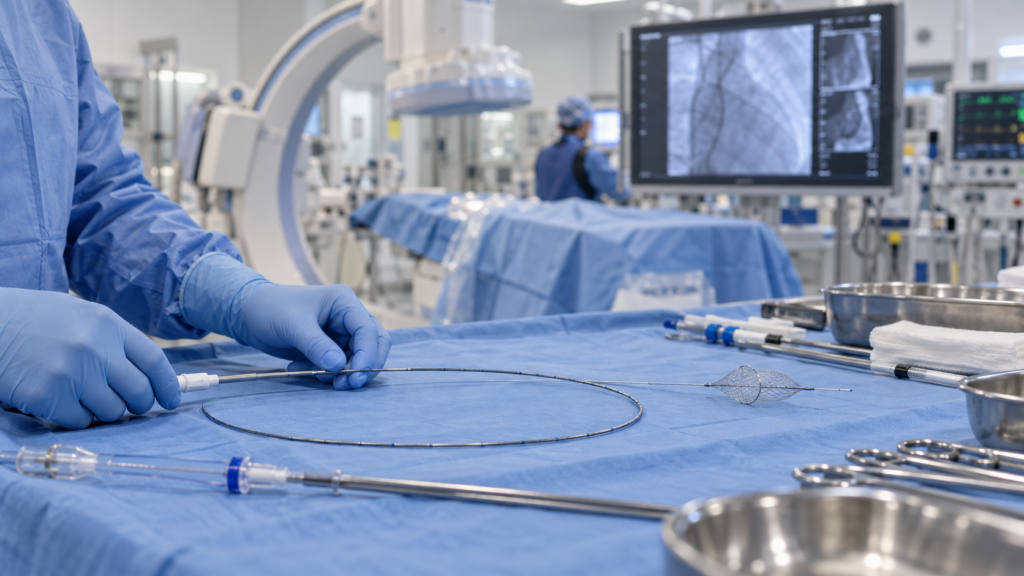
That design differentiates Emboliner from Sentinel, the incumbent against which Emboline conducted its pivotal trial. Sentinel has established the concept of embolic protection in TAVR but focuses principally on cerebral circulation, while Emboliner uses a circumferential mesh intended to capture material moving toward both cerebral and systemic arteries. A broader protection field is intuitively attractive, but hospitals ultimately purchase devices based on clinical outcomes, workflow complexity, reimbursement and incremental procedural cost rather than engineering elegance alone. Emboline therefore needs commercial evidence showing that its additional coverage provides sufficient value beyond existing options.
What did the 500-patient PROTECT H2H pivotal trial show?
PROTECT H2H was a prospective, randomized, open-label, multicenter study enrolling 500 patients undergoing TAVR and directly comparing Emboliner with Boston Scientific’s Sentinel Cerebral Protection System. Emboline reported that Emboliner was non-inferior on the composite 30-day major adverse cardiac and cerebrovascular endpoint covering death, stroke and stage-three acute kidney injury, and was also non-inferior for all stroke at 30 days. The trial did not therefore demonstrate statistically superior stroke outcomes, an important distinction when evaluating claims around broader embolic coverage.
Where Emboliner did differentiate was procedural performance and debris capture. Emboline reported superiority to Sentinel in the amount of debris captured, alongside higher technical and procedural success despite investigators having greater historical familiarity with the incumbent device. Bleeding and vascular-complication rates were not significantly different between the groups, helping support the safety case used for the 510(k) submission. Those results provide a commercial narrative around completeness of protection, but hospitals may still ask whether greater captured debris predicts clinically meaningful reductions in neurological or organ injury.
Why does Emboline now have to compete on workflow and economics rather than regulatory novelty?
FDA clearance removes the largest barrier to U.S. sale, but embolic protection is an additional procedural step layered onto TAVR rather than the core valve replacement itself. Every added catheter can increase equipment cost, require training and potentially add procedural complexity, which means interventional cardiologists need confidence that the benefit justifies another device. Emboliner’s ability to integrate into existing workflows without meaningfully prolonging procedures will therefore be as important commercially as its mesh geometry.
The head-to-head design gives Emboline a useful advantage because hospitals can evaluate the system against a familiar competitor rather than against historical controls. A higher technical-success rate may support early adoption, particularly at TAVR centers already comfortable using protection routinely. On the other hand, the absence of demonstrated stroke superiority means Emboline may need additional real-world data to convince centers that full-body capture creates meaningful incremental outcomes. The post-launch evidence strategy could become one of the most important determinants of market share.
How significant is the $20 million Trinity Capital financing for commercialization?
Trinity Capital committed $20 million to Emboline in March specifically as growth capital while the company was approaching regulatory review and commercialization. For a privately held medtech business, such debt or structured-growth financing can reduce immediate equity dilution while providing capital needed for inventory, manufacturing scale-up and a field organization. The transaction also came after completion of PROTECT H2H enrollment, meaning Trinity was financing a company with pivotal data approaching rather than an early engineering project.
The financing still needs to generate commercial traction because medtech launches can consume cash quickly. Structural-heart products require physician education, clinical support during cases, inventory management and strong hospital-contracting capabilities, while competing against a large incumbent such as Boston Scientific raises the sales-resource requirement further. Emboline’s success will therefore be visible not simply in systems shipped but in recurring utilization across TAVR procedures. Private-company financial results are not disclosed, leaving procedure adoption and account wins as the more useful early indicators of launch progress.
Could Emboliner become useful beyond TAVR?
Emboline has developed the platform around the broader premise that catheter-based heart procedures can release clinically significant embolic debris. TAVR provides the clearest initial commercial market because procedural volumes are large and stroke is a well-recognized complication, but structural-heart interventions are continuing to expand into increasingly complex anatomies and patient populations. A protection platform capable of covering more of the circulation could therefore have applications beyond its first labeled indication if supported by appropriate clinical and regulatory evidence.
That expansion is not automatic because each new procedural indication can create different catheter requirements, anatomy and regulatory obligations. Emboline first needs to establish that U.S. TAVR operators adopt Emboliner consistently and that comprehensive debris capture delivers enough value to defend pricing against an established competitor. FDA clearance has turned a clinical-stage technology into a saleable product. The next competitive battle will happen inside cath labs rather than regulatory filings.
Discover more from Business-News-Today.com
Subscribe to get the latest posts sent to your email.