




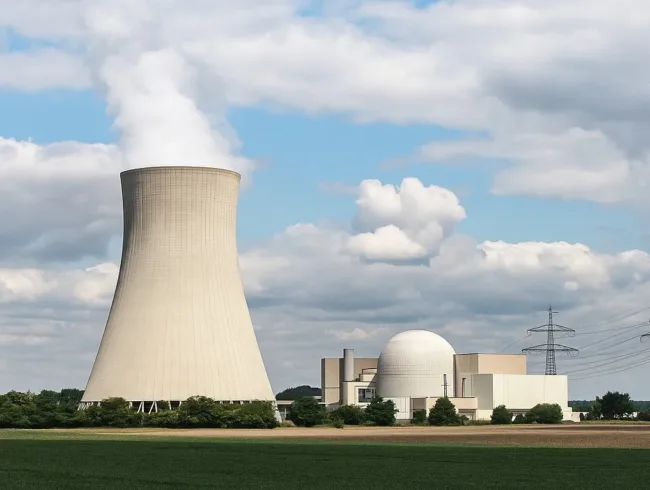
The European Commission (EC) has launched an in-depth investigation into Czechia’s proposed public support package for two new nuclear reactors at Dukovany, questioning whether the aid complies with European Union State aid rules. The decision comes after Czechia notified a plan to fund Elektrárna Dukovany II with a combination of low-interest loans, a 40-year contract-for-difference, and policy risk protections for the twin units slated to begin operation in 2036 and 2037.
The Commission said that while the project appears aligned with EU decarbonization goals and may improve regional energy security, it has concerns about the proportionality of the aid, possible overcompensation, and the structure of the revenue mechanisms involved.
Why has the European Commission launched a deeper probe into the Dukovany II nuclear aid package?
At the heart of the Commission’s inquiry is a €23 billion to €30 billion repayable state loan and a long-term two-way contract-for-difference (CfD), both designed to support Elektrárna Dukovany II, a company 80% owned by the Czech government and 20% by ČEZ, the country’s sole nuclear operator. Czechia argues that these measures are essential to replace ageing coal capacity, ensure energy security, and meet long-term decarbonization commitments.
However, the Commission has identified multiple areas where the aid package could breach European Union competition rules, particularly regarding whether the assistance exceeds what is strictly necessary to mobilize the investment. The CfD’s 40-year term and unspecified design elements raise concerns that incentives for operational efficiency could be blunted and risk-transfer too heavily skewed toward the state. Furthermore, the Commission is examining whether the structure may unfairly strengthen ČEZ’s already significant market power.
How do the aid instruments—loan, CfD, and risk shield—raise proportionality and competition questions?
The package under review is one of the largest nuclear support frameworks ever scrutinized by the European Commission. The loan alone is projected to cover 100% of construction costs, with interest rates well below market norms. Although designed as a repayable facility, such favourable terms could represent hidden subsidies unless carefully calibrated.
The 40-year CfD further complicates the assessment. While such mechanisms can stabilize revenues for capital-intensive projects, their design must include checks to avoid overcompensating the operator. The Commission noted that key design features, including cost pass-through limitations, clawbacks, or benchmarking adjustments, remain insufficiently specified, preventing a full evaluation of whether efficient operational behavior is maintained over decades.
Additionally, a bespoke mechanism to shield the project from policy or regulatory changes over its lifespan adds another layer of complexity. While such protections may be justified for nuclear projects with 60–80 year lifespans, they could mute incentives to adapt to evolving market or environmental conditions.
What is the role of ČEZ and how does its market position complicate the Commission’s assessment?
ČEZ, which owns 20% of the project entity Elektrárna Dukovany II, is the dominant player in Czechia’s electricity sector and the only nuclear operator in the country. The Commission emphasized that it has not received sufficient assurances that the aid would not indirectly reinforce ČEZ’s market power, particularly if revenues from the CfD or other safeguards benefit ČEZ’s broader portfolio.
The fact that the project is state-majority owned does not eliminate these concerns. Rather, it creates a scenario in which policy, regulatory, and commercial interests are deeply entwined—raising flags about how public and private incentives might blur over time. The Commission is likely to focus on whether operational and financing terms provide enough ring-fencing to prevent market distortion or preferential treatment.
How do recent EU electricity market reforms shape the legal backdrop for the investigation?
Since July 2024, all two-way CfDs in the energy sector must comply with Regulation 2024/1747, part of the European Union’s redesigned electricity market framework. These rules require CfDs to be transparent, competitive, and aligned with Article 19d(2) of the Electricity Regulation, which mandates that such contracts not unduly interfere with price formation or market integration.
The Commission flagged potential issues with Czechia’s compliance with these newer regulatory expectations. Specifically, it questioned whether the proposed CfD structure meets the design principles necessary to ensure that producers continue to behave like market actors rather than cost-plus utilities underwritten by the state.
Moreover, the project’s long duration and scale raise institutional concerns about precedent-setting. Other member states pursuing similar low-carbon baseload capacity—such as Poland or Bulgaria—may look to this case as a template. The Commission’s stance here could influence how future nuclear support programs are structured across the EU.
What happens next, and how might this affect the project’s timeline and investor confidence?
The opening of a formal in-depth investigation does not imply that the project will ultimately be blocked, but it does signal that clearance will not be automatic. The process allows Czechia and third parties to submit comments and provide additional documentation, with no fixed timeline for resolution.
This uncertainty could complicate financial closure or vendor contracting. While the state loan is domestic, the CfD’s structure and regulatory backing are critical for derisking the project to attract supply chain participants, EPC contractors, and downstream off-takers. Any perception of prolonged regulatory ambiguity may deter private participation or inflate risk premiums.
For institutional investors, the Commission’s decision highlights how nuclear financing—even for strategic, decarbonizing assets—remains entangled with state aid law and long-term policy confidence. That Czechia is pursuing such a high-risk bet in an era of soaring renewables investment and volatile power prices shows the high strategic value it places on dispatchable baseload generation.
Key takeaways on what the European Commission’s investigation means for Czechia, ČEZ, and the EU nuclear sector
- The European Commission has opened a formal probe into Czechia’s €23B–€30B nuclear aid package for two new Dukovany reactors, citing compliance and competition concerns.
- The aid consists of a full-cost state loan, a 40-year contract-for-difference, and policy-change protections—raising questions about excessive de-risking.
- Regulators are especially concerned about whether the measures maintain efficiency incentives and avoid reinforcing ČEZ’s dominant market position.
- The probe will assess compliance with post-2024 electricity market reforms requiring stricter CfD design standards under Regulation 2024/1747.
- ČEZ’s dual role as minority shareholder and national operator adds complexity to the aid’s potential market impact and long-term neutrality.
- The Commission emphasized that opening the inquiry does not prejudge its outcome, but delays could affect contracting, financing, and investor confidence.
- The case could set an important precedent for nuclear State aid across the EU as more countries revisit baseload options in their energy transition plans.
- If cleared with conditions, the Dukovany II model may become a reference case for balancing national energy priorities with EU competition law.
Discover more from Business-News-Today.com
Subscribe to get the latest posts sent to your email.