




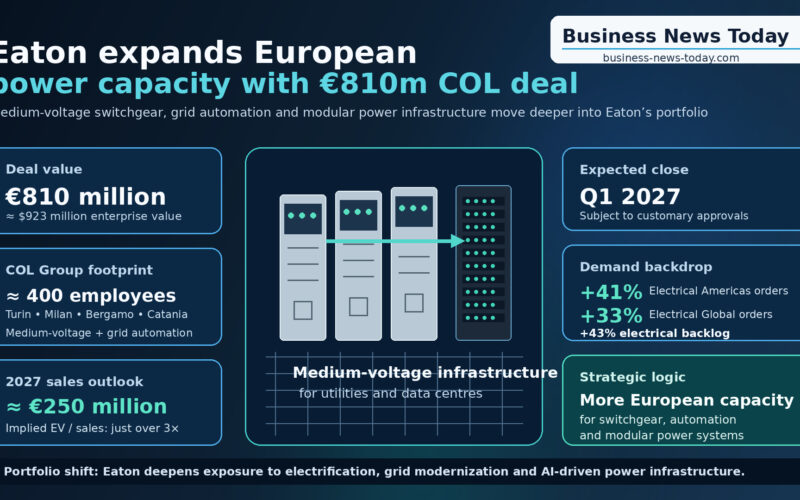
Eaton Corporation plc (NYSE: ETN) has agreed to acquire Italy’s COL Group from Oaktree Capital Management’s Power Opportunities strategy for an enterprise value of €810 million, equivalent to roughly $923 million. The transaction will expand Eaton’s European manufacturing capacity in medium-voltage electrical distribution equipment at a time when utilities and artificial-intelligence data centres are increasing demand for switchgear, automation and modular power infrastructure.
COL Group employs approximately 400 people and operates facilities in Turin, Milan, Bergamo and Catania. The company develops medium-voltage switchgear, grid-automation systems and modular power solutions and expects approximately €250 million of sales during 2027. Eaton expects the acquisition to close during the first quarter of 2027, subject to customary approvals and conditions.
Why does Eaton need more medium-voltage manufacturing capacity in Europe?
Electricity demand is expanding at the same time that power systems are becoming more complicated. Utilities must connect renewable generation, electric vehicles, batteries and new industrial loads, while data centres require extremely reliable power systems capable of distributing enormous loads safely.
Medium-voltage equipment sits between high-voltage transmission infrastructure and lower-voltage systems closer to individual machines and buildings. Switchgear protects circuits and allows operators to isolate equipment, while grid automation helps utilities manage electricity flows as networks become increasingly decentralized.
Demand is already visible across Eaton’s order book. The company reported that its twelve-month rolling average orders increased 41% year over year in Electrical Americas and 33% in Electrical Global during the second quarter of 2026, while electrical-sector backlog increased 43%. Eaton consequently raised its organic growth outlook.
The COL acquisition gives Eaton additional European manufacturing capacity rather than requiring the company to build every factory and customer relationship from scratch.
How does COL Group strengthen Eaton’s position in the AI data-centre boom?
Data centres require far more than servers and semiconductor accelerators. Electricity must pass through transformers, switchgear, busways, backup generation, power-distribution systems and other equipment before reaching high-density computing racks.
That has turned electrical manufacturers into indirect beneficiaries of AI capital expenditure. Each additional hyperscale campus creates demand for physical power equipment whose production cannot be expanded as quickly as software.
Eaton has already been investing aggressively to address those bottlenecks. Earlier in September, the company announced more than $242 million for a new Arkansas manufacturing facility that will double U.S. capacity for customized modular electrical enclosures used by data centres, utilities and industrial customers. The project is expected to create roughly 1,200 jobs.
COL provides a European complement to that strategy. Instead of depending primarily on imported equipment or greenfield construction, Eaton gains established engineering teams and factories positioned within one of the world’s largest industrial and data-centre markets.
Is Eaton paying a high valuation for COL Group’s projected €250 million sales?
An €810 million enterprise value against approximately €250 million of projected 2027 sales implies a little more than three times forward revenue before considering debt, margins, growth rates or expected synergies.
Whether that valuation proves attractive will depend heavily on COL’s profitability and Eaton’s ability to increase output. Electrical-equipment manufacturers are currently benefiting from unusually strong demand, which can support premium valuations for businesses possessing scarce capacity.
Eaton also has strategic reasons to pay for speed. Building a new plant involves acquiring land, securing permits, installing equipment, hiring skilled workers and qualifying products with customers. Acquiring a functioning supplier can bring capacity online far sooner.
The potential risk is that Eaton purchases assets at peak-cycle valuations just as data-centre investment slows. Present indicators have not shown that slowdown, but infrastructure suppliers increasingly need investors to believe current AI capital spending will persist long enough to justify aggressive expansion.
How does the COL purchase fit Eaton’s broader portfolio transformation?
Eaton is deliberately becoming more concentrated around electrical infrastructure and aerospace while reducing exposure to slower-growth mobility businesses. In June, the company agreed to combine its Mobility Group with Dana Incorporated through a Reverse Morris Trust transaction valuing the combined company above $10 billion and Eaton’s contributed mobility business at approximately $5.1 billion.
Eaton expects the separation to improve its organic growth profile and margins because Electrical and Aerospace have stronger secular demand. The company is essentially exchanging automotive exposure for deeper participation in grid modernization, electrification and data-centre investment.
Its second-quarter numbers show why. Sales increased 21%, organic revenue rose 14%, electrical orders accelerated and segment margins reached 23.1%. Eaton expects full-year 2026 adjusted earnings of $13.40 to $13.60 per share.
COL therefore represents more than a bolt-on acquisition. It reinforces the direction in which Eaton is deliberately moving its entire portfolio.
Why are switchgear and grid automation becoming strategic bottlenecks?
Electricity infrastructure historically operated on long replacement cycles, meaning manufacturers sized capacity around relatively predictable utility demand. AI data centres have introduced enormous concentrated electricity loads with much shorter development timelines.
Utilities can approve a large data centre only to discover that transformers or switchgear needed to connect it carry multi-year lead times. That turns relatively unglamorous electrical equipment into one of the constraints determining how quickly computing facilities can begin operating.
Renewable energy creates another source of demand because grids designed around large centralized fossil-fuel plants must increasingly manage distributed solar, wind and battery installations. Automated switching and monitoring become more valuable as electricity flows grow less predictable.
COL operates directly inside those categories. Its medium-voltage distribution and grid-automation capabilities therefore connect two of the strongest investment themes in power infrastructure: digital computing growth and modernization of ageing electricity networks.
What will determine whether Eaton’s €810 million acquisition creates value?
Integration and utilization will matter more than the headline purchase price. Eaton needs to keep COL’s skilled workforce, maintain customer relationships and increase factory output without undermining quality or margins.
European data-centre development will also determine the speed of returns. Markets including Germany, Italy, Spain, the Nordics, Ireland and the United Kingdom are attracting large computing investments, but power constraints and community resistance can delay projects.
Utility expenditure may provide a more durable second leg. Even if AI construction moderates, Europe still needs enormous grid investment to connect renewable generation, replace ageing assets and support electrification.
That diversified demand makes the transaction strategically attractive. Eaton is not buying a company dependent on one AI customer; it is acquiring manufacturing capacity positioned between two long-duration infrastructure investment cycles.
Discover more from Business-News-Today.com
Subscribe to get the latest posts sent to your email.


