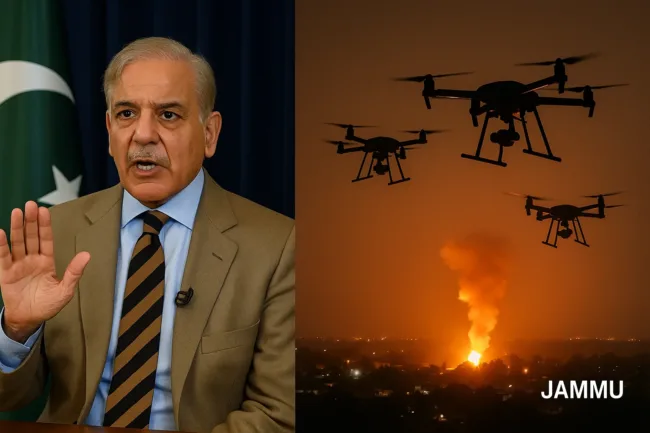
France’s defence forces initiated a high-alert counter-drone operation on December 5, 2025, after at least five unmanned aerial vehicles were detected flying above the country’s most sensitive military site—the Île Longue base in Brittany, home to France’s nuclear-armed ballistic missile submarines. The incident has triggered a judicial investigation, reignited concerns over European airspace vulnerability, and raised the spectre of hybrid threats from hostile actors.
How serious was the drone overflight above France’s nuclear deterrent hub?
At approximately 18:30 GMT on Thursday evening, five drones were detected flying over the Île Longue peninsula, which hosts France’s entire fleet of nuclear-powered ballistic missile submarines: Le Triomphant, Le Téméraire, Le Vigilant, and Le Terrible. The submarines form the backbone of France’s strategic nuclear deterrence, with at least one vessel continuously deployed at sea. The breach prompted immediate military response procedures from the marine battalion guarding the base.
French Defence Minister Catherine Vautrin acknowledged the breach in a public statement and praised military personnel at the Île Longue installation for successfully intercepting the drones. While no damage to the facility was reported, the incident is being treated with utmost seriousness given the base’s national security importance.
What counter-drone actions did France deploy in response to the threat?
According to a source familiar with the incident who spoke to Agence France-Presse, the French military launched an anti-drone and search operation shortly after detection. The Atlantic Maritime Prefecture confirmed the operation but withheld details on whether countermeasures included electronic jamming systems or kinetic response such as small arms or drone-specific weaponry.
The complexity of drone neutralisation at a high-security naval site such as Île Longue poses unique challenges. Detection and jamming systems can be effective but are not always foolproof. The risk of falling debris, collateral electronic disruption, or accidental targeting of civilian aircraft are key concerns that French forces reportedly weighed during the response.
Why is the Île Longue submarine base considered a critical asset in Europe’s defence posture?
Located on the Crozon peninsula in northwestern France, the Île Longue base has housed France’s strategic sea-based nuclear deterrent since 1971. The facility supports four SNLE-class (Sous-marin Nucléaire Lanceur d’Engins) submarines equipped with M51 intercontinental ballistic missiles. These missiles can carry multiple nuclear warheads and are designed for second-strike capability, ensuring France’s retaliatory capacity in the event of a nuclear attack.
The base employs around 2,000 personnel, including 1,500 civilians responsible for submarine maintenance and logistical operations. Security is managed by approximately 120 maritime police officers, in coordination with naval and defence staff. Airspace above Île Longue and large portions of the Brest harbour is restricted, with all drone flights explicitly banned in the area.
Was the drone incursion part of a wider pattern of surveillance activity across France and Europe?
Thursday’s incident follows a series of unexplained drone sightings in recent weeks that have alarmed security officials across Europe. In mid-November, authorities logged an unidentified drone over the Crozon peninsula, although that flight did not directly target military assets. Last month, French police opened an investigation after a drone was seen flying over a police station and a military train carrying battle tanks in Mulhouse, near the German border.
On the same day as the Île Longue breach, Irish police launched a separate investigation into several unidentified drones spotted over Dublin airspace as Ukrainian President Volodymyr Zelensky landed in the city. While authorities have not established any direct connection between the incidents, the timing has deepened concerns about regional patterns of intelligence-gathering or psychological operations designed to sow public anxiety.
What are French officials saying about the motive and possible origin of the drones?
Guillaume Le Rasle, spokesperson for the Atlantic Maritime Prefecture, said the overflight was “intended to cause concern among the population,” although it was too early to determine the origin or affiliation of the drones. He reiterated that no sensitive infrastructure had been damaged, but confirmed that a formal judicial investigation had been initiated by the military prosecutor’s office in Rennes.
Defence Minister Catherine Vautrin also confirmed that a complaint had been filed and stated the investigation would determine whether the incident was a form of espionage, disruption, or a broader tactic aligned with foreign adversary interests. She noted that overflights of military installations are strictly prohibited in France and reaffirmed the state’s commitment to prosecuting violations of its territorial airspace.
Could Russia be behind the drone activity near critical French and European infrastructure?
While the origin of the drones remains officially undetermined, European defence circles have raised concerns that these incursions may be aligned with hybrid warfare tactics allegedly employed by the Russian Federation. More than three years into its war in Ukraine, Russia continues to be scrutinised for the use of non-conventional intelligence and disruption techniques, including cyberattacks and the use of unmanned aerial systems for surveillance and psychological pressure.
France and the United Kingdom are the only two European countries with independent nuclear weapons programs. The targeting of nuclear or military transport infrastructure by unidentified drones could signal an effort to test response times, measure operational readiness, or provoke institutional disquiet, even if hard evidence of state sponsorship is elusive.
What broader institutional responses are underway to strengthen drone security in France?
France’s military and internal security apparatus have been progressively expanding anti-drone capabilities over the past decade. These include electromagnetic jamming systems, radar-based detection arrays, and radiofrequency tracking systems. However, as drone technology becomes more commercially accessible and harder to trace, enforcement has become increasingly complex.
The French government has encouraged coordination between the military, police, and aviation authorities to monitor restricted zones using both ground-based and airborne assets. Civilian penalties for drone operation in restricted zones have been tightened, and surveillance of strategic infrastructure has been expanded through AI-powered monitoring networks and sensor fusion technology.
Still, security officials acknowledge the ongoing asymmetry between the low-cost nature of commercial drones and the high-investment demands of effective counter-UAV systems. This has led to calls for a unified European drone defence strategy that combines military intelligence sharing with civilian airspace management reforms.
How are the French public and media responding to the security breach?
Public reaction to the incident has been marked by concern and growing scrutiny over critical infrastructure protection. French media outlets including TF1 and France 24 covered the story prominently, with analysts warning that breaches over sites like Île Longue could pose cascading risks beyond the immediate military context. The drone overflight has also reignited political debates about internal security, technology regulation, and foreign interference.
In the absence of confirmed attribution, media commentary has largely focused on the systemic gaps that enabled the drones to access the restricted zone, as well as the implications for France’s nuclear readiness and deterrent credibility.
Key takeaways from France’s drone interception over the Île Longue nuclear submarine base
- France detected and intercepted at least five drones flying over the Île Longue nuclear ballistic submarine base in Brittany
- The overflight triggered an immediate anti drone and search operation by the marine battalion guarding the base
- Authorities have not disclosed whether countermeasures involved jamming systems or kinetic neutralisation
- A formal judicial investigation has been opened by the military prosecutor’s office in Rennes
- Sensitive infrastructure at the submarine base was not damaged or compromised during the incident
- Officials stated the drone flights appeared intended to cause public concern, though motives remain unclear
- Defence Minister Catherine Vautrin commended base personnel and reaffirmed France’s ban on military installation overflights
- The incident adds to a recent pattern of unexplained drone sightings over military and industrial sites in France and Europe
- Security agencies remain cautious about the possibility of hybrid or adversarial tactics but have made no attribution
- The base houses France’s four ballistic missile submarines, making it one of the most protected defence assets in Europe
Discover more from Business-News-Today.com
Subscribe to get the latest posts sent to your email.