

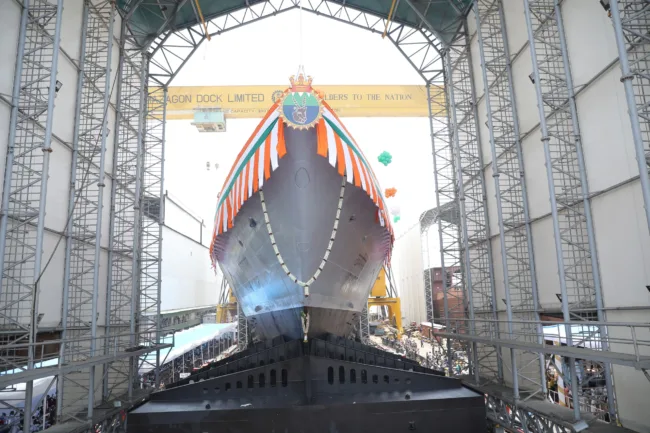
Why is the simultaneous commissioning of Udaygiri and Himgiri a first for Indian shipbuilding?
For the first time in the history of India’s naval shipbuilding program, two major frontline surface combatants from different shipyards will be commissioned on the same day. On 26 August 2025, the Indian Navy will formally induct Udaygiri (F35), built by Mazagon Dock Shipbuilders Limited (MDL) in Mumbai, and Himgiri (F34), constructed by Garden Reach Shipbuilders & Engineers (GRSE) in Kolkata. The ceremony will take place in Visakhapatnam, home to the Navy’s Eastern Command.
This simultaneous commissioning reflects a new level of maturity in India’s shipbuilding capacity, indicating that both public sector shipyards can deliver sophisticated warships within aligned timelines. Defence analysts see this as a benchmark for future parallel builds, reducing induction cycles for critical naval assets. It also comes at a time when the Navy is accelerating its modernisation drive, seeking to bolster maritime security in an increasingly contested Indo-Pacific environment.

How do Udaygiri and Himgiri advance the capabilities of India’s Project 17A stealth frigate program?
Both vessels are part of the Project 17A stealth frigate class, which builds upon the earlier Shivalik-class but introduces significant advancements in stealth shaping, automation, and combat systems integration. Displacing around 6,700 tons, they are about five percent larger than their predecessors, yet achieve a lower radar cross section thanks to improved hull lines, superstructure shaping, and radar-absorbent materials.
Propelled by a Combined Diesel or Gas (CODOG) system, each ship uses a pair of diesel engines for economical cruising and gas turbines for high-speed operations. Controllable-pitch propellers enhance manoeuvrability, while an Integrated Platform Management System (IPMS) allows centralised monitoring of propulsion, power generation, and auxiliary systems.
The combat package is formidable. It includes supersonic Surface-to-Surface Missiles for anti-ship warfare, Medium Range Surface-to-Air Missiles for area defence, a 76 mm medium-range gun, close-in weapon systems in both 30 mm and 12.7 mm calibres, and comprehensive anti-submarine warfare (ASW) suites including towed sonar, rocket launchers, and torpedo tubes. The integration of these systems offers multi-domain lethality—surface, sub-surface, and aerial—on a single hull.
What makes the commissioning of Udaygiri and Himgiri a symbolic win for the Make in India and Aatmanirbhar Bharat missions?
Udaygiri and Himgiri are both designed by the Indian Navy’s Warship Design Bureau, with Udaygiri marking its 100th ship design. The indigenous content in the Project 17A class has grown significantly compared to earlier builds, with over 200 Indian MSMEs contributing to their construction. This ecosystem supports approximately 4,000 direct jobs and more than 10,000 indirect jobs across the country.
By sourcing propulsion components, sensors, electronics, and weapon subsystems domestically—while still integrating select foreign technologies—the program strikes a balance between self-reliance and capability optimisation. For policymakers, this commissioning is tangible evidence that India’s defence industrial base can deliver high-technology platforms at scale, without being entirely dependent on imports.
How do these frigates fit into India’s broader maritime force structure and strategic posture?
With China’s naval presence expanding in the Indian Ocean Region and other regional security challenges emerging, the Indian Navy is focused on expanding its blue-water capabilities. The P17A frigates are intended to serve as versatile workhorses, capable of independent deployment for anti-piracy, maritime interdiction, and surveillance, as well as integration into carrier and amphibious task forces for high-intensity conflict.
Udaygiri will operate primarily with the Western Fleet, while Himgiri is expected to join the Eastern Fleet, reinforcing the Navy’s ability to maintain balanced maritime coverage. Together, they will enhance fleet rotation cycles, allowing older vessels to undergo refits without compromising operational readiness.
How have recent indigenous naval commissions set the stage for this milestone?
2025 has already been a record-setting year for indigenous ship inductions. The Navy has commissioned the destroyer INS Surat, the frigate INS Nilgiri, the submarine INS Vaghsheer, the ASW Shallow Water Craft INS Arnala, and the Diving Support Vessel INS Nistar. Each of these has passed rigorous sea trials to validate performance in propulsion, weapons integration, damage control, and mission systems.
This rapid induction tempo suggests the Navy has not only scaled up production but also streamlined its testing and acceptance processes. The commissioning of Udaygiri and Himgiri continues this momentum, further narrowing the gap between fleet modernisation goals and actual deployments.
What is the expected operational impact once these stealth frigates join the fleet?
The P17A frigates are designed for a 30-year service life with modular upgrades, ensuring they remain operationally relevant well into the future. Their induction will significantly enhance the Navy’s ability to sustain multiple task groups across dispersed maritime theatres, providing the flexibility needed for simultaneous operations in different regions. They will also strengthen anti-submarine warfare capabilities, a critical advantage as submarine activity increases in the Indian Ocean. In addition, their versatility will enable rapid deployment for both high-intensity combat operations and constabulary missions, including humanitarian assistance and disaster relief, making them valuable assets in maintaining maritime security and projecting naval presence.
The versatility and endurance of these ships mean they will be key enablers in maintaining India’s maritime domain awareness and strategic deterrence posture for decades.
How the dual commissioning of Udaygiri and Himgiri could shape institutional confidence and future growth in India’s naval shipbuilding industry
From an institutional standpoint, the successful parallel commissioning of Udaygiri and Himgiri strengthens confidence in India’s defence manufacturing roadmap. Defence analysts note that such milestones could boost the case for exporting similar-class vessels to friendly navies in Southeast Asia, Africa, and the Middle East. This aligns with the government’s stated ambition to make India a net security provider in the region.
For shipyards like MDL and GRSE, the achievement may also improve order book visibility, paving the way for further P17A orders or next-generation follow-on programs. Institutional investors in India’s listed defence companies could view this as a sign that naval contracts will remain a growth driver, especially as the government maintains high capital expenditure in the maritime domain.
What defence analysts say about India’s shipbuilding trajectory
Defence industry experts have observed that building two major warships concurrently at separate shipyards without delays is a rare feat globally. They point out that the P17A program demonstrates how Indian shipyards can adopt modular construction, digital design tools, and networked supply chains to compress build times while maintaining quality.
Naval strategists also stress that such capabilities are crucial if India is to meet its long-term maritime force level goals, which include a 200-ship Navy by the mid-2030s. The commissioning of Udaygiri and Himgiri is therefore seen not just as an operational gain, but as a validation of India’s strategic industrial capacity.
Why this commissioning is more than a ceremonial event
When Udaygiri and Himgiri raise their commissioning pennants in Visakhapatnam on 26 August, the event will be both a celebration and a statement. It will signal that India’s ship design and manufacturing ecosystem has reached a new level of efficiency, capability, and self-reliance.
From a purely naval perspective, the addition of two stealth-equipped, multi-role frigates will expand the fleet’s versatility and deterrence profile. From a national perspective, it will showcase the success of the Make in India and Aatmanirbhar Bharat initiatives in delivering complex, high-value defence assets indigenously. And for the defence industrial base, it will stand as proof that simultaneous multi-yard production is now an achievable and repeatable standard for India.
Discover more from Business-News-Today.com
Subscribe to get the latest posts sent to your email.