


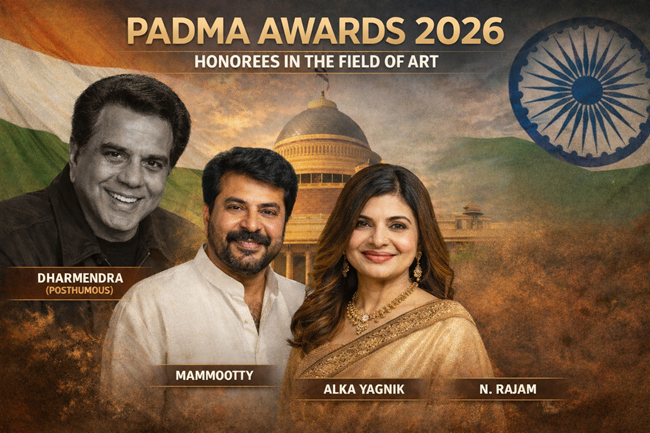
Veteran actor Dharmendra Singh Deol is being honoured posthumously with the Padma Vibhushan in 2026, as the Government of India confers its annual civilian awards to distinguished individuals across disciplines. Malayalam cinema icon Mammootty and Bollywood playback legend Alka Yagnik have also been named among the awardees, both receiving the Padma Bhushan. Hindustani classical violinist N. Rajam is the second recipient of the Padma Vibhushan in the field of art, recognised for her pioneering contribution to Indian classical music. These high-profile recognitions headline a broader list of over 30 individuals from across India and abroad who are being conferred the Padma Awards this Republic Day in recognition of their contributions to Indian art, including classical, folk, cinematic, theatrical, and literary traditions.
The Padma Awards are announced each year on January 25 by the Ministry of Home Affairs and conferred by the President of India on January 26. The three award categories—Padma Vibhushan, Padma Bhushan, and Padma Shri—acknowledge achievements that involve public service and national contribution across a wide spectrum of fields. In 2026, the art category continues to reflect the government’s stated emphasis on inclusive recognition, cultural preservation, and expanded regional participation in India’s civil honours system.
Who is being honoured with the highest Padma Awards in the field of art in 2026?
Dharmendra Singh Deol, who passed away in 2025, is being recognised with the Padma Vibhushan for his exceptional contribution to Indian cinema. A leading figure in the golden era of Hindi film, his career spans multiple decades and includes iconic performances in films such as Sholay, Phool Aur Patthar, and Chupke Chupke. The Government of India is recognising his legacy as a symbol of cinematic excellence and cultural influence.
N. Rajam, who is also being awarded the Padma Vibhushan, is known for transforming the violin into a vehicle for vocal-style performance in the Hindustani tradition. Her Gayaki Ang style has been widely credited with expanding the emotional depth and accessibility of instrumental classical music. A revered teacher and performer, she has influenced generations of musicians in India and abroad.
Mammootty, a towering presence in Malayalam cinema, is being conferred the Padma Bhushan for his wide-ranging body of work that spans over 400 films across multiple Indian languages. His career, which has garnered both commercial success and critical acclaim, reflects the evolution of regional cinema and its national impact. Alka Yagnik, one of the most recorded playback singers in Indian history, is also receiving the Padma Bhushan for her prolific contribution to Hindi film music. Her voice has defined several decades of Indian pop culture, particularly during the 1990s and early 2000s.
Also receiving the Padma Bhushan posthumously is Piyush Pandey, the former executive chairman of Ogilvy India, who is being recognised for his role in transforming the Indian advertising landscape. Known for campaigns such as Mile Sur Mera Tumhara and Har Ek Friend Zaroori Hota Hai, Pandey played a pivotal role in shaping brand communication and public messaging in post-liberalisation India. Shatavadhani R. Ganesh, a multilingual scholar and practitioner of classical Indian performance forms, is the fifth Padma Bhushan awardee in the art category this year.
How does the Padma Shri list reflect India’s push toward grassroots and regional cultural recognition?
The Padma Shri list in the field of art includes over 25 names, many of whom represent regional, tribal, and folk traditions. This aligns with the Government of India’s broader policy emphasis on decentralising national recognition and promoting cultural diversity. Among the awardees are performers, musicians, and dramatists from across the country, representing both classical excellence and underrepresented artistic communities.
Anil Kumar Rastogi and Arvind Vaidya are being recognised for their contributions to Hindi and Gujarati theatre respectively. Maganti Murali Mohan and Prosenjit Chatterjee, two widely known actors from Andhra Pradesh and West Bengal, are receiving the Padma Shri for their work in regional cinema. Kumar Bose, a maestro of the tabla, and Thiruvaarur Bakthavathsalam, known for his mastery of the mridangam, are being honoured for their long-standing contributions to Indian classical percussion.
The Government of India is also honouring several artists posthumously. These include Garimella Balakrishna Prasad, a Carnatic music exponent known for devotional compositions; Satish Shah, a veteran of Indian television and film; and R. Krishnan, a traditional music educator. Other posthumous recipients include Hari Madhab Mukhopadhyay and Bishwa Bandhu, whose contributions spanned folk and literary domains.
Several honorees represent tribal and regional performance traditions, including Gafruddin Mewati Jogi, Chiranji Lal Yadav, Gambir Singh Yonzone, Simanchal Patro, Taga Ram Bheel, and Sangyusang S. Pongener. Their recognition reflects a deliberate effort to valorise folk traditions that have often remained outside mainstream platforms. The inclusion of artists such as Bhiklya Ladakya Dhinda and Bishwa Bandhu further underscores this commitment.
Kuchipudi dancer Deepika Reddy and Hindustani vocalist Tripti Mukherjee represent continued recognition of India’s classical dance and music systems. Gayatri Balasubramanian and Ranjani Balasubramanian have been recognised for their joint contribution to Bharatanatyam and choreography. Other classical and contemporary contributors include Pokhila Lekthepi from Arunachal Pradesh and Mir Hajibhai Kasambhai from Gujarat, both of whom have worked extensively in regional dance and performance.
What does the inclusion of a foreign recipient signal in 2026?
Among the Padma Shri recipients is Professor Lars-Christian Koch, an ethnomusicologist from Germany who has contributed to the documentation and dissemination of Indian classical music through archival and academic work. He is the Director of the Ethnological Museum and the Museum of Asian Art in Berlin and has been involved in curating and preserving Indian musical instruments and traditions in European institutions. His inclusion in the 2026 honours list demonstrates India’s continued engagement with foreign scholars and the importance of global platforms in cultural preservation and diplomacy.
How do the 2026 awards reflect broader trends in India’s cultural policy and recognition strategy?
The 2026 Padma Awards in art demonstrate a dual emphasis on elite excellence and grassroots inclusion. The presence of icons such as Dharmendra Singh Deol, Mammootty, and Alka Yagnik signals the state’s acknowledgment of long-term popular impact, while the inclusion of tribal and regional artists reflects a deliberate move toward de-elitising national honours. The award list appears to align with the Government of India’s broader cultural strategy under initiatives such as Azadi Ka Amrit Mahotsav and Ek Bharat Shreshtha Bharat, both of which seek to bridge regional identities into a national cultural narrative.
The recurrence of posthumous awards, including those given to Satish Shah, Garimella Balakrishna Prasad, R. Krishnan, and Piyush Pandey, also suggests an effort to formally recognise legacy contributions that may have been overlooked during recipients’ lifetimes. This form of retrospective recognition is increasingly common in the annual Padma lists.
The Padma Awards continue to be a tool of both cultural legitimation and state diplomacy. By recognising a broad range of figures from across geography, discipline, and institution type, the awards reflect a calibrated approach to cultural soft power, domestic cohesion, and international engagement.
What the Padma Awards 2026 reveal about India’s cultural recognition priorities and global outreach
- The Government of India is honouring Dharmendra Singh Deol (posthumous), N. Rajam, Mammootty, and Alka Yagnik with the Padma Vibhushan and Padma Bhushan awards in 2026 for their contributions to Indian cinema and classical music.
- The 2026 Padma Shri recipients reflect a broad cultural spectrum, including artists from theatre, folk performance, classical dance, devotional music, and tribal traditions, highlighting India’s regional diversity.
- The inclusion of German musicologist Lars-Christian Koch underscores India’s cultural diplomacy efforts and recognition of international academic contributions to Indian heritage.
- Posthumous awards to Piyush Pandey, Satish Shah, Garimella Balakrishna Prasad, and others signal a renewed institutional focus on legacy recognition across artistic fields.
- The Padma Awards remain a strategic instrument of national recognition and global cultural outreach, bridging elite and grassroots voices in India’s evolving arts ecosystem.
Discover more from Business-News-Today.com
Subscribe to get the latest posts sent to your email.