


Denison Mines Corp. (TSX: DML; NYSE American: DNN) has declared its flagship Phoenix in-situ recovery uranium project construction-ready, pending final regulatory approvals. The company now anticipates a final investment decision by the end of Q1 2026 and estimates initial capital costs at $600 million, reflecting a 20% inflation-adjusted increase over its 2023 feasibility study.
This milestone positions Denison Mines Corp. to build the first large-scale uranium mine in Canada since Cigar Lake, with first production targeted for mid-2028. The readiness update comes after the conclusion of federal hearings and key provincial approvals, with engineering 87% complete and procurement of long-lead items already in motion.
How does the Phoenix ISR project fit into Canada’s uranium revival strategy through 2028?
Denison Mines Corp.’s Phoenix ISR development could serve as a strategic keystone for Canada’s uranium sector, particularly as global energy security concerns and nuclear-friendly policies converge. With an anticipated construction launch in early 2026, the Phoenix project is uniquely timed to take advantage of a uranium supply-demand tightening expected before the decade’s end.
Unlike conventional underground or open-pit mining, in-situ recovery (ISR) represents a low-impact extraction method that is aligned with Canada’s broader push for environmentally responsible resource development. This factor, combined with its two-year construction timeline and proximity to Denison’s existing assets in the Athabasca Basin, could make Phoenix a bellwether project for the next generation of Canadian uranium developments.
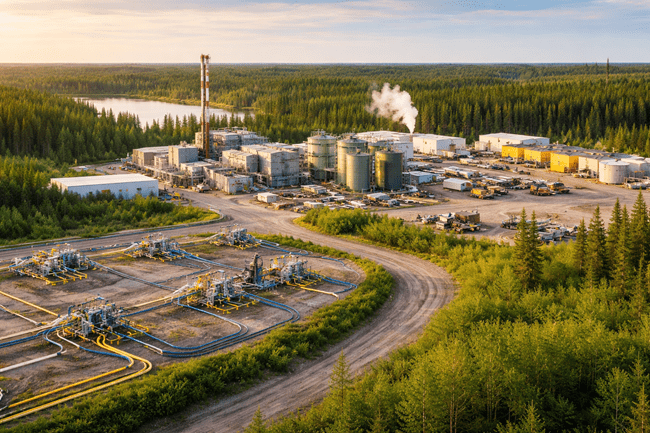
Phoenix’s regulatory journey is nearing its final phase. The Canadian Nuclear Safety Commission completed its public hearing in December 2025, and Denison is awaiting final federal decisions on its Environmental Assessment and site preparation license. The Province of Saskatchewan has already granted EA approval and initial earthworks permits, allowing for activities such as vegetation clearing and drainage.
What’s driving the 20 percent increase in capital cost—and what stays unchanged?
The $600 million capital cost estimate now in place for Phoenix represents a 20 percent inflation-adjusted increase from the 2023 feasibility study’s Class 3 estimate of $419.4 million in 2022 dollars. However, Denison’s control budget, built from a Class 2 estimate based on actual bids and procurement progress, is more precise and grounded in real-time market dynamics.
Notably, about 75 percent of equipment and material costs are backed by committed contracts or near-final bid evaluations, while 50 percent of construction-related costs are in advanced negotiation stages. This level of definition reduces scope creep and capital execution risk, which often plagues greenfield mining projects during transition from planning to build-out.
Much of the increase stems from two drivers: inflationary inputs from Canada’s industrial building sector between 2022 and 2025, and a shift in wellfield design. In a strategic move, Denison opted to install large-diameter wells throughout the Phase 1 mining zone, giving each well the flexibility to act as either an injector or a recovery unit. This configuration improves operational responsiveness and could support faster and more consistent recovery rates, even though it adds to upfront capital intensity.
Despite the higher capital outlay, the project’s core economics remain robust. Denison’s adjusted base-case post-tax net present value (NPV) remains essentially unchanged at $1.57 billion, thanks to an uptick in uranium price assumptions. The project still boasts a post-tax IRR of 73 percent and an estimated 12-month payback period from the start of uranium production.
What market conditions are influencing Denison’s uranium economics?
The uranium price backdrop has shifted meaningfully since mid-2023. Denison’s base-case uranium pricing model, based on UxC’s “Composite Midpoint” scenario, now reflects a range of US$68.89 to US$78.36 per pound as of Q4 2025. This compares favorably to the US$66.53 to US$70.11 per pound assumed in the 2023 feasibility study.
In parallel, UxC’s long-term price estimate rose sharply from US$56.00/lb to US$86.00/lb between 2023 and year-end 2025, pointing to stronger forward contract market dynamics. These pricing trends not only preserve the project’s economic integrity despite cost escalations but also improve visibility into offtake viability and long-term revenue streams.
Denison’s post-FID scenario models suggest NPV8% figures climbing as high as $3.78 billion if spot prices reach US$150/lb. At that price level, the project IRR would soar to 128 percent with a payback period of just 7 months. This convexity to price is notable, especially as global demand for new uranium supply is expected to intensify on the back of nuclear energy expansion commitments across Asia, Europe, and North America.
Is Denison’s balance sheet strong enough to fund the $600 million capex without equity dilution?
Denison reported a liquidity position exceeding $700 million as of September 30, 2025, including cash, physical uranium inventory, and investment holdings. This gives the company the rare ability to fund a significant portion, if not all, of its initial capital from internal resources, reducing the need for near-term equity raises or debt issuance.
Moreover, Denison has already deployed approximately $100 million in pre-final investment decision expenditures, including $47 million incurred up to November 30, 2025, and an additional $53 million earmarked for long-lead procurement, design finalization, and contractor mobilization. This early spend has de-risked many of the project’s execution bottlenecks and supports a rapid transition to physical construction once licenses are in hand.
Importantly, Denison’s proactive procurement strategy, combined with its control budget discipline, has helped the company hold its two-year construction timeline. If all approvals are received by the end of Q1 2026, Denison anticipates first production by mid-2028, maintaining its positioning as one of the few new uranium sources expected to enter production this decade.
What does the Phoenix ISR project mean for competitors and Canadian uranium leadership?
If Phoenix progresses as planned, Denison Mines Corp. could reassert Canada’s role as a premier jurisdiction for next-generation uranium projects. Unlike legacy high-grade underground mines, Phoenix offers a scalable ISR model that could reshape perceptions of economic and environmental feasibility in the Athabasca Basin.
The implications extend beyond Denison. Rival developers with ISR ambitions, both in Canada and abroad, will closely track Phoenix as a template for licensing, design, and execution. It also raises the competitive bar for incumbents like Cameco Corporation, which may have to accelerate their own pipeline projects to retain market share as demand accelerates and utilities diversify their supply base.
Strategically, Denison’s broader footprint, including its stakes in McClean Lake, the Midwest Joint Venture, and the Waterbury Lake property, gives it multiple levers to scale ISR operations or integrate with conventional assets. Its leadership in transitioning from feasibility to field-ready construction could turn Denison into the Canadian benchmark for uranium development efficiency.
What are the key takeaways from Denison’s Phoenix construction readiness update and capital cost revision?
- Denison Mines Corp. is positioned to begin construction of its Phoenix ISR uranium project in early 2026, pending final federal approvals.
- Initial capital costs have been revised to $600 million, a 20% inflation-adjusted increase from the 2023 feasibility study.
- Nearly 75% of procurement and 50% of construction costs are already supported by contracts or near-final bids, reducing budget risk.
- First production remains on track for mid-2028, maintaining Phoenix’s status as a rare new supply source before decade-end.
- Adjusted post-tax project NPV remains strong at $1.57 billion with a 73% IRR, supported by rising uranium price expectations.
- Denison holds over $700 million in cash, uranium, and investments, enabling project financing with minimal dilution risk.
- The company has already spent or committed ~$100 million pre-FID, accelerating construction readiness and reducing execution delays.
- Phoenix’s successful launch could redefine ISR feasibility standards in Canada and force incumbents and challengers to adapt.
Discover more from Business-News-Today.com
Subscribe to get the latest posts sent to your email.