



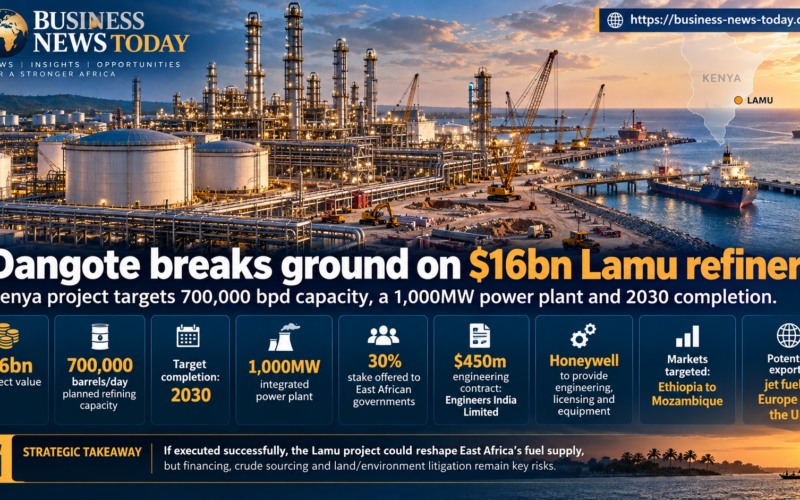
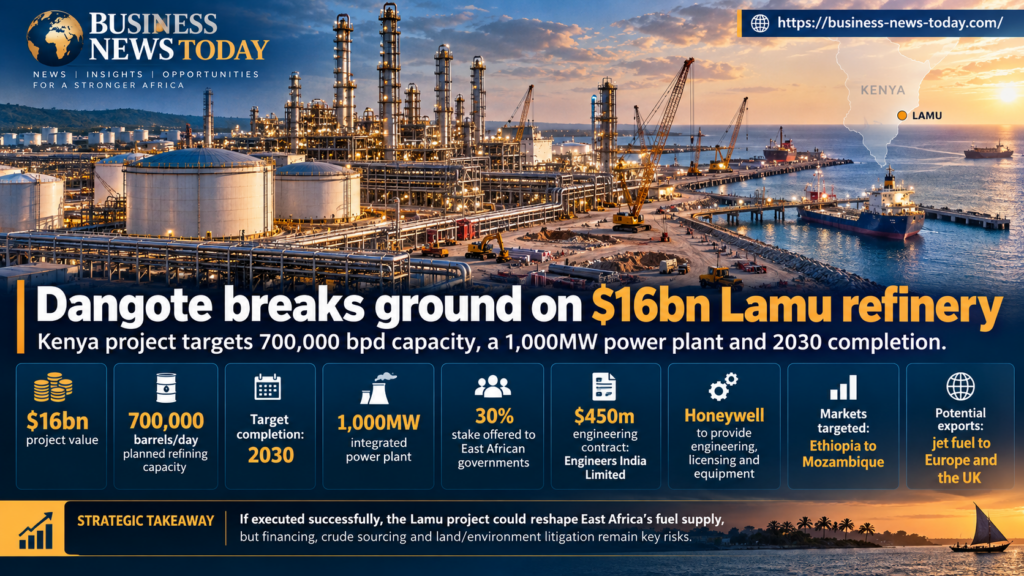
Aliko Dangote and Kenyan President William Ruto have broken ground on a $16 billion oil refinery at Lamu, formally moving one of Africa’s largest proposed industrial projects into the construction phase. The planned refinery will have capacity of 700,000 barrels per day, is targeted for completion in 2030 and will sit within a wider industrial complex that includes a 1,000-megawatt power plant as well as planned petrochemical and related manufacturing facilities.
Dangote has offered East African governments a combined 30% stake in the project and intends eventually to list shares in the refinery on the Nairobi securities market. Engineers India Limited has secured a $450 million project-engineering contract, while Honeywell Technologies will provide engineering services, licensing and equipment. The project is intended to serve markets stretching from Ethiopia toward Mozambique and could eventually export jet fuel to Europe and the United Kingdom.
Why does East Africa need a 700,000-barrel-per-day refinery in Kenya?
East Africa consumes large volumes of petrol, diesel, jet fuel and industrial petroleum products but remains heavily dependent on imported refined fuels. Ruto’s chief economic adviser David Ndii estimated regional petroleum-product demand at between 20 million and 30 million metric tons annually, while an industry financier cited by Reuters said meeting the region’s needs would require more than 1 million barrels per day of refining capacity.
A large refinery could substitute locally produced fuels for imports, reducing the foreign currency Kenya and neighbouring economies need to spend on finished petroleum products. That argument has become particularly important during the Iran conflict because rising global fuel costs have contributed to economic and political pressure across East Africa.
Dangote is attempting to replicate the industrial logic of his Nigerian refinery, which helped move Nigeria from dependence on imported fuels toward increasing domestic production and exports. Whether the Kenyan project can reproduce that outcome will depend on crude supply, financing, operating efficiency and regional infrastructure.
Why was Lamu chosen for the Dangote refinery?
Lamu Port is central to Kenya’s LAPSSET corridor, a long-term infrastructure strategy intended to create a new transport and logistics route linking northern Kenya with neighbouring East African economies. The port received its first commercial cargo ships in 2021 and offers deepwater access suitable for large crude and product tankers.
Government officials say the refinery could anchor additional industrial activity around the corridor by creating demand for roads, pipelines, power, logistics and storage. More than 110 pieces of construction equipment were already at the site at the time of groundbreaking, with another 400 expected within 60 days, according to Kenya’s transport ministry.
Lamu’s coastal location also provides an export advantage. If the refinery produces more fuel than regional markets absorb, large tankers could ship diesel or jet fuel toward Europe, Britain and other international destinations.
What roles will Engineers India and Honeywell play in the project?
Engineers India Limited has been awarded a $450 million project-engineering contract, giving the Indian state-linked engineering company a major role in designing and implementing the refinery. Honeywell Technologies will provide engineering services, process licensing and equipment through its UOP business.
Honeywell already works with Dangote on the Nigerian refinery, where technology upgrades are intended to expand capacity. The company says that experience has produced large-train engineering designs that can be applied to Kenya and shorten the development timetable.
These supplier relationships matter because refinery construction is extraordinarily complex. A 700,000-bpd plant requires thousands of pieces of equipment, specialised process units, extensive piping and utilities as well as integration with storage, ports and power systems.
How will the planned 1,000-MW power plant change the economics of the refinery?
Large refineries consume enormous quantities of electricity and steam. Building an integrated 1,000-MW power plant gives the project more control over its energy supply and reduces dependence on Kenya’s public electricity grid during normal refinery operations.
Dangote says surplus electricity could be sold to other customers, potentially creating a second revenue stream and supporting industrial development around Lamu. That concept turns the project from a standalone refinery into a wider energy and manufacturing complex.
The ultimate economics will depend on fuel source, electricity pricing and transmission connections. Selling excess power can improve project returns, but power infrastructure itself adds billions of dollars of potential capital requirements across generation and grid systems.
Why is the refinery facing environmental and land-rights opposition?
Lamu contains environmentally sensitive marine systems and Lamu Old Town, a UNESCO World Heritage Site. Conservation groups and affected residents have raised concerns about land ownership, compensation and the potential environmental impact of building a major refinery and industrial complex along the coast.
Kenya’s High Court has ordered parts of the site to be preserved while a land-rights case proceeds. Dangote Group previously said the legal order would not stop the groundbreaking but acknowledged that it could affect certain site activities.
That creates a meaningful execution risk. A ceremonial launch and arrival of construction machinery do not guarantee the entire project can proceed at full speed if courts impose restrictions or additional environmental approvals become necessary.
Can the project really increase Kenya’s GDP by 12%?
Ruto said at the launch that the project would boost Kenya’s annual gross domestic product by 12%, but that figure is a government projection rather than a realised economic outcome. It should therefore be treated as an estimate tied to assumptions about investment, output, employment and downstream industrial activity.
Officials also expect more than 50,000 jobs and additional investment across petrochemicals, bitumen, base oils and logistics. The refinery could materially affect Kenya’s economy if it reaches its planned scale because $16 billion represents an exceptionally large single investment relative to the country’s existing industrial base.
However, megaprojects frequently experience delays and cost changes. The more reliable near-term measures will be financing milestones, equipment orders, construction progress and whether the land and environmental disputes are resolved.
What are the key takeaways from the $16 billion Dangote East Africa refinery groundbreaking?
The project has moved beyond proposal stage with an official groundbreaking, major equipment on site and engineering contracts awarded. It targets 700,000 barrels per day of refining capacity, a 1,000-MW power plant and eventual completion in 2030.
Regional governments have been offered a combined 30% ownership position, giving neighbouring countries an opportunity to align their fuel-import strategies directly with the project. Eventual Nairobi listing plans could also create an additional source of capital and public ownership.
The biggest uncertainties remain execution, crude sourcing and environmental litigation. If those challenges are overcome, the refinery could fundamentally alter East Africa’s petroleum trade; if they delay construction materially, the region will remain dependent on imported fuels for longer.
Discover more from Business-News-Today.com
Subscribe to get the latest posts sent to your email.