


Shenzhen Creality 3D Technology Co., Ltd. (HKEX: 3388) has unveiled the K3 flagship nozzle-changing printer and SparkX i8 four-color system at IFA 2026, only weeks after launching its $299 SparkX i7 Nano, creating a three-tier multicolor portfolio that reflects a broader attempt to move beyond relying on standalone 3D-printer sales. The K3 attacks one of multicolor printing’s biggest cost problems by swapping complete nozzles instead of repeatedly unloading and purging filament, while the i8 uses a four-channel hotend to shorten color transitions and the i7 Nano pushes four-color printing toward the mass-market desktop price range. Creality is surrounding those printers with the M1 filament recycling system, new resin machines, Pika portable scanner, laser systems and digitally manufactured footwear, turning IFA into a demonstration of its ambition to own more stages between creating a digital model and producing a physical object. That diversification has become financially important because Creality’s first-half 2026 revenue increased 12.9% to RMB1.63 billion, but revenue from 3D printers themselves grew only 0.1% and the company swung from profit to a RMB59.1 million net loss. The central question is whether Creality can use multicolor printing, consumables, scanning, software and other creative tools to rebuild margins while competing against increasingly aggressive rivals such as Bambu Lab and Anycubic.
The timing is particularly significant because Creality has been public for barely three months. The company listed in Hong Kong on May 29 at HK$18.80 per share, generating approximately HK$1.27 billion of net IPO proceeds and becoming the first consumer 3D-printing company listed on the exchange. Creality closed September 4 at HK$26, giving it a market capitalization of about HK$12.4 billion and leaving the shares around 38% above the IPO price. Investors now have a much clearer view of the tension behind that valuation: consumer 3D printing remains a high-growth market, but Creality is spending heavily on product development, overseas expansion and customer acquisition while price competition is putting pressure on the economics of its traditional printer business.
Why is Creality K3’s 4.8-second nozzle swap more important than simply printing additional colors?
Multicolor FDM printing has traditionally created an awkward efficiency problem. Systems that feed several colors through one nozzle must retract the existing filament, load the next one and purge residual material before the new color becomes clean enough to print. A complicated model containing hundreds or thousands of color changes can therefore spend substantial time changing filament while producing piles of purge waste that never become part of the finished object.
Creality’s KliTek system changes the mechanism by keeping separate material channels associated with replaceable nozzle assemblies. Creality says K3 can complete a nozzle swap in approximately 4.8 seconds, avoiding much of the repeated loading, retraction and heavy purging associated with conventional single-nozzle multicolor systems. In internal tests, the company claims the architecture can reduce total print time by up to 80% and material waste by up to 85%, although those are Creality laboratory results and actual savings will vary substantially with model geometry, color-change frequency and print settings.
The architecture also makes K3 a multi-material product rather than merely a multicolor machine. Creality says the platform can process flexible TPU between 85A and 95A hardness, combine materials with different physical properties inside the same print and use soluble or breakaway support materials. Optional configurations can combine a 0.4mm nozzle for detailed exterior surfaces with a 0.8mm nozzle for faster internal infill, which Creality says can improve print efficiency by up to 30%.
That could prove commercially more meaningful than producing decorative objects in four colors. Small manufacturers, product designers and print farms may value the ability to combine rigid and flexible materials or use different nozzle diameters without manually stopping the machine. If K3 can make those workflows reliable, Creality would be competing on productivity and material capability rather than simply trying to match the multicolor consumer experience that has already become widespread.
Pricing remains the major missing variable. Creality continues to describe K3 as a Q3 2026 product but had not published a final retail price in its main IFA announcement. The eventual price will determine whether KliTek remains a premium technology for enthusiasts and professional users or becomes an architecture capable of spreading deeper into Creality’s mainstream portfolio.
How does SparkX i8 attack multicolor waste differently from the flagship K3 architecture?
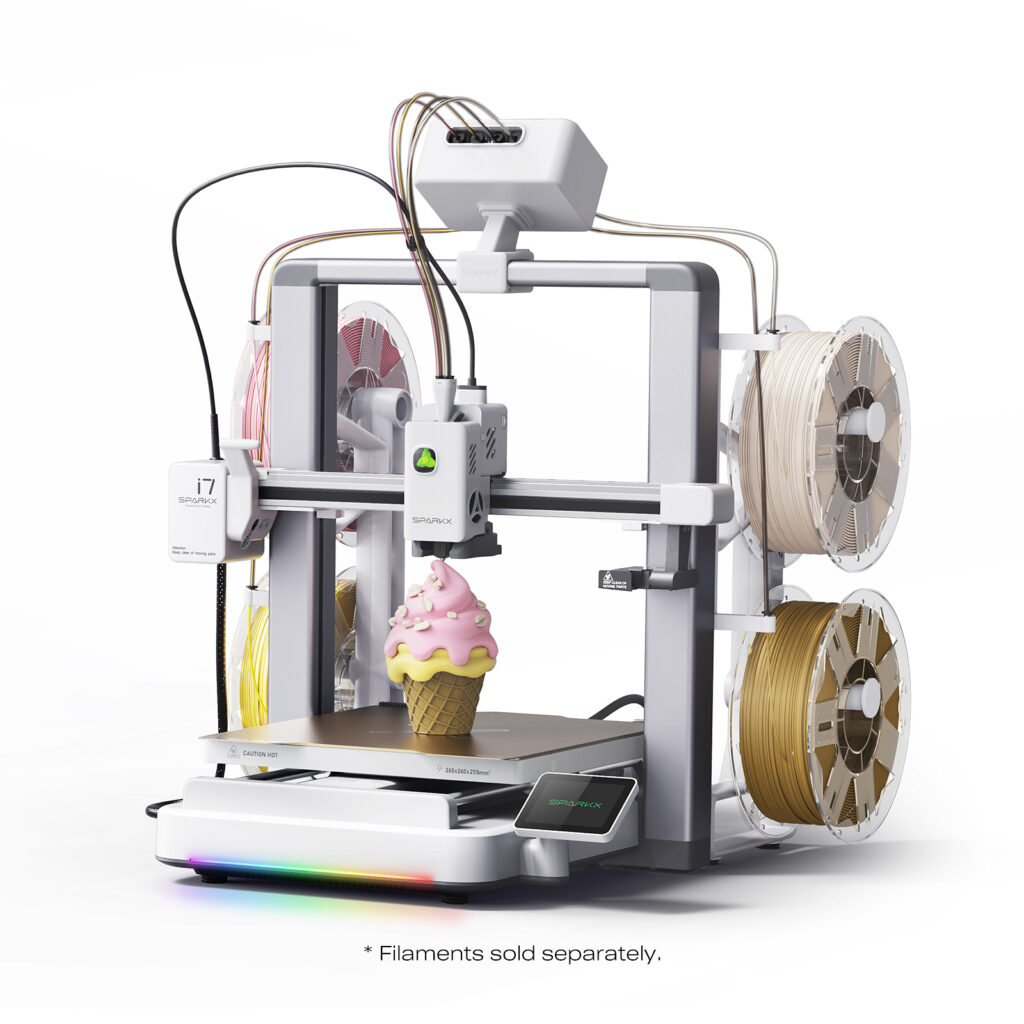
SparkX i8 takes a less mechanically ambitious route. Rather than swapping complete nozzle assemblies, it keeps four filament channels ready inside a four-in-one hotend and uses a short shared melt zone to reduce how far material must move during a color transition. The objective is still faster color changes and less purge waste, but the design is intended to provide a simpler pathway for users who do not need K3’s more sophisticated multi-material capabilities.
That distinction allows Creality to segment its multicolor portfolio. K3 can target advanced creators, print farms and professional applications where time saved on repeated material changes has meaningful economic value. SparkX i8 can concentrate on consumers who mainly want convenient four-color output without the cost or complexity of a multi-nozzle flagship architecture.
Creality has not disclosed final i8 pricing or detailed commercial availability in the IFA release, making it difficult to determine exactly where it will sit relative to the existing SparkX family. That missing price becomes especially important because the company is already attacking the entry level aggressively through i7 Nano.
The strategic benefit comes from having several technical solutions rather than forcing one architecture across every price point. Tool-changing hardware can improve efficiency but adds components, sensors and cost, while a four-channel shared hotend can be cheaper but may retain some purging requirement. If Creality can tune each system for a different buyer, it can compete from first-time multicolor users through much heavier production workloads.
Why does the $299 SparkX i7 Nano matter to Creality’s battle with Bambu Lab and Anycubic?
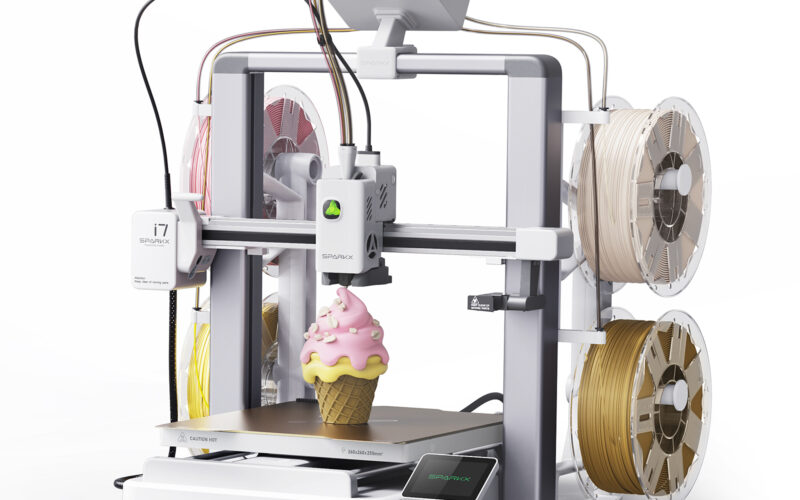
SparkX i7 Nano represents the opposite end of the strategy from K3. Creality launched the printer in the United States on August 15 for $299 including the CFS Nano multicolor system, positioning four-color printing as an entry-level feature rather than a premium upgrade requiring a substantially larger machine.
The i7 Nano provides a 260 x 260 x 255mm build volume, maximum printing speed of up to 500mm/s and a hardened-steel nozzle capable of reaching 300 degrees Celsius. A 720p AI camera monitors failures including spaghetti and air printing, while automatic bed leveling, RFID filament recognition and automatic filament refill are intended to reduce the amount of manual configuration required from first-time users. Creality’s CubeMe feature can also transform a two-dimensional portrait into a multicolor three-dimensional model, tying the printer directly into the company’s wider effort to reduce the modeling skills required before printing can begin.
Its CFS Nano system mounts directly above the printer and automatically switches among as many as four filament colors. Two motors independently manage channel selection and filament feeding, allowing Creality to provide automated multicolor capability without the larger external material system associated with several competing printers.
The $299 price places Creality directly inside one of the industry’s most competitive segments. Bambu Lab’s A1 mini currently starts around $249 in the United States, with four-color capability available through its AMS lite configuration, while Anycubic’s larger enclosed Kobra S1 Combo has recently been offered around the $459 level depending on region and promotion. Price comparisons are imperfect because build volumes, enclosure design, included multicolor hardware and promotional discounts differ, but the competitive direction is unmistakable: automated multicolor printing is moving down the price curve rapidly.
That creates a difficult equation for Creality. Lower prices can increase the installed base and create future demand for filament and accessories, but they can also intensify the gross-margin pressure already visible in the company’s financial statements. The i7 Nano therefore needs to be judged not just by how many units Creality can sell but by whether those customers remain inside the wider ecosystem.
Why does Creality’s RMB59.1 million first-half loss make the IFA ecosystem strategy financially important?
Creality’s first results as a listed company reveal a business growing at the top line while experiencing pressure underneath it. Revenue reached RMB1.626 billion during the six months ended June 30, up 12.9% from approximately RMB1.44 billion a year earlier. Yet the company moved from RMB107.5 million of net profit in the first half of 2025 to a RMB59.1 million loss.
Gross margin declined to 30.8% from 34.4%, a 3.6-percentage-point contraction. Creality attributed the pressure partly to promotional pricing aimed at overseas expansion and clearance of older models as new products entered the portfolio. Cost of sales increased faster than revenue, while higher prices for components including memory, chips and printed circuit board assemblies added pressure.
The expense base was also moving higher. Sales and marketing spending rose 29.3% to RMB304.2 million as Creality invested more in direct online sales, overseas e-commerce, offline stores, advertising and channel promotion. Research and development spending increased 37.6% to RMB143.4 million, equivalent to about 8.8% of revenue, while administrative expenses climbed as the company absorbed listing costs and share-based compensation.
Foreign exchange added another headwind because the renminbi strengthened against currencies in which Creality conducts substantial international business. The company recorded approximately RMB35.4 million of foreign-exchange losses after reporting a gain in the comparable period.
Some of those expenses are transitional or investment-related rather than evidence that every part of the underlying business deteriorated. The more important structural warning comes from segment growth: the category Creality is historically best known for was not the category driving first-half expansion.
Why did consumables grow 48% when Creality’s 3D-printer revenue was almost flat?
Creality generated approximately RMB842.4 million from 3D printers in the first half, only about 0.1% higher year over year. Consumables revenue, by contrast, increased 48.3% to approximately RMB276.6 million. Scanners and laser engravers grew 16.7% to roughly RMB325.9 million, while accessories increased approximately 35.6% to RMB181 million.
Those numbers make the IFA portfolio unusually aligned with the company’s financial needs. M1 and R1 expand Creality into filament production and recycling, Pika strengthens the scanning category in which Creality already holds a leading market position, and new laser systems broaden another adjacent creative-hardware segment. K3 and SparkX can then increase consumption of multiple filament colors and materials after the original printer sale.
Consumables are strategically attractive because they create repeat purchases. A printer may remain in a customer’s home for several years, while filament is consumed every time something is produced. Multicolor printing can accelerate that consumption by encouraging users to maintain several colors simultaneously and, on less efficient systems, by increasing purge waste.
The M1 Filament Maker introduces a different circular-economy angle. Working with Creality’s R1 Shredder, it can turn plastic scrap and failed prints back into material for new filament, while also allowing users to experiment with custom colors and formulations. The system was named an IFA Innovation Award winner, while K3 received Honoree recognition.
There is an apparent commercial tension in selling filament while simultaneously helping consumers recycle it, but the broader ecosystem logic is stronger. Creality can make money from machines, materials, recycling equipment and accessories rather than needing every incremental dollar to come from selling branded spools. Recycling may also make multicolor printing more acceptable to users concerned about the visible plastic waste created by purge-heavy systems.
How do Pika scanning, HALOT resin printers and laser systems turn Creality into more than a printer manufacturer?
Pika illustrates the input side of Creality’s ecosystem. The 260g portable scanner combines seven-line blue laser scanning with near-infrared structured light, supports accuracy of up to 0.03mm and can capture at up to 110 frames per second when connected to a PC. A user can scan a physical part, convert it into an editable digital model and subsequently send the design into a 3D-printing workflow.
That connection matters because modeling remains a significant barrier for consumers. Cheap and reliable printers become less useful if users cannot design objects they want to make. Creality is attacking the problem from both ends through physical scanning and AI tools capable of generating or modifying digital models.
The resin range broadens output options. HALOT-X1 Max offers a 17.1-litre build volume, 16K display, active heating at 40 degrees Celsius, a quad-lead-screw system and a five-litre smart resin supply for users requiring large or continuous resin production. HALOT-X1 Neo targets a more accessible part of the same category.
Creality’s A1C and T1C laser products extend digital creation into engraving, cutting and marking, while Nexbie takes another step by selling digitally manufactured consumer goods such as 3D-printed footwear. That final category is strategically unusual because it moves Creality from selling tools to creators into demonstrating what those tools and manufacturing processes can ultimately produce.
Together, these products explain why the company increasingly describes itself as a consumer 3D creative platform rather than a printer manufacturer. Hardware still supplies most revenue, but Creality is trying to participate in creation, digitization, printing, materials, sharing and eventually commerce around finished objects.
Can Creality Cloud and AI create switching costs that inexpensive hardware cannot?
Creality Cloud may ultimately matter more to retention than another improvement in printer speed. The platform had surpassed 6.2 million registered users and contained approximately 2.7 million 3D models around the time of the company’s May listing, creating a large content library from which users can discover objects without designing everything themselves.
AI is being layered into that workflow to reduce friction further. Creality has deployed tools for generating models from images and prompts, assisting model preparation, monitoring print failures and supporting laser creation. CubeMe in SparkX shows how those capabilities can become consumer-facing features rather than remaining abstract AI branding.
The commercial objective is familiar from other consumer technology categories. Hardware specifications can be copied quickly, and competing Chinese manufacturers can often match one another on motors, sensors, print speeds and build volumes within product cycles. Content libraries, creator communities, saved models, software familiarity and e-commerce relationships can be harder to reproduce.
Creality also launched Nexbie as an overseas commerce platform intended to let creators monetize digital and physical work. If a design moves from Creality Cloud into a Creality printer, uses Creality filament and eventually becomes a product sold through Nexbie, the company participates in more of the economic chain than it would by selling a printer once.
The strategy remains at an early stage financially. Creality does not yet disclose enough standalone software, cloud or marketplace revenue to show that digital services are transforming group economics. The IPO prospectus nevertheless allocated 25% of proceeds to overseas user operations including Creality Cloud and Nexbie, demonstrating that management sees those platforms as a core investment rather than incidental services attached to hardware.
Why is Creality spending another RMB550 million on a Shenzhen additive-manufacturing headquarters?
Creality’s investment cycle is not stopping with the IPO. In August, the company proposed spending up to RMB550 million on a new additive-manufacturing headquarters and innovation center in Shenzhen, subject to successfully acquiring the required land through public tender and obtaining relevant approvals.
The plan comes after raising roughly HK$1.27 billion of net proceeds through the Hong Kong listing. Creality earmarked approximately 30% of IPO funds for research and development, 25% for overseas user operations, 25% for brand and international channel development, 10% for strategic investments or acquisitions and the remaining 10% for working capital.
That capital allocation makes the first-half loss more nuanced. R&D and marketing spending are reducing current profitability, but management is intentionally spending to defend market position as consumer 3D printing shifts toward easier operation, multicolor output, AI assistance and integrated ecosystems. The risk is that competitors are investing at the same time, forcing Creality to spend more simply to avoid losing ground.
Creality ranked second globally in consumer 3D-printer GMV during 2025 with an 11.2% share, according to industry research cited by the company. It ranked first in consumer 3D scanners with 45.3% and fourth in consumer laser engravers with 4.8%. That combination helps explain why management is broadening around printing rather than concentrating every investment on regaining printer share alone.
The global consumer 3D-printing market was estimated at about $6 billion in GMV during 2025 and has been forecast to reach $27.2 billion by 2030. Such forecasts are inherently uncertain, but even a fraction of that expansion would give Creality significant room to grow if it can maintain share while restoring profitability.
What does Creality’s HK$26 share price say about expectations after the first-half loss?
Creality shares closed September 4 at HK$26, up 4% for the session. The stock gained approximately 10.3% over the five trading sessions from August 28 and around 14% compared with its August 3 closing level, indicating that the disappointing first-half profitability has not prevented a recent recovery.
The shares remain well below the HK$34 52-week high recorded since the May listing but substantially above the HK$16.76 low. At HK$26, the stock is approximately 38% above the HK$18.80 IPO price and values the company at roughly HK$12.4 billion.
The September 4 move cannot be attributed to the IFA portfolio announcement because the detailed international release was distributed on Sunday, September 6, when the Hong Kong market was closed. The next regular session will be the first in which investors can react with full knowledge of the K3, SparkX i8 and broader IFA lineup, although any move will also reflect general market conditions.
The valuation debate is increasingly straightforward. Creality can demonstrate revenue growth, a global customer base, leadership in scanners and a rapidly expanding ecosystem, but the company must show that growth ultimately produces sustainable margins. Investors have already seen what happens when aggressive pricing, marketing and R&D expand faster than gross profit.
K3 therefore matters financially even though Creality has not disclosed its price. If nozzle changing reduces waste and time sufficiently to support premium pricing, the product could improve mix rather than simply adding another high-volume low-margin printer. SparkX i7 Nano carries the opposite responsibility: grow the installed base at $299 and create enough future filament, accessories and ecosystem engagement to justify the aggressive entry price.
What will prove that Creality’s IFA 2026 ecosystem is actually improving the business model?
The first proof point will be printer growth. First-half 3D-printer revenue of RMB842.4 million was almost unchanged year over year despite the broader consumer market expanding. K3, SparkX i8, i7 Nano and the wider portfolio need to restart category growth without another round of discounts severe enough to push gross margin lower.
The second is product mix. Consumables already grew 48.3%, demonstrating that Creality can generate recurring revenue after the hardware sale. Continued growth in filament, scanners, laser products and accessories would reduce dependence on the replacement cycle for printers and make the group more resilient when one hardware generation slows.
Gross margin is the third and probably most important measurement. Revenue rose 12.9% in the first half while gross margin fell to 30.8%. A successful second-half launch cycle should eventually allow Creality to grow while stabilizing or improving margin rather than buying market share through promotions.
The fourth proof point is ecosystem activity. Growth in Creality Cloud users, model downloads, AI creation, Nexbie transactions and multi-device ownership would show that customers increasingly interact with Creality between hardware purchases. Without that engagement, the “creative ecosystem” remains primarily a large catalogue.
IFA 2026 makes Creality’s intended answer unusually visible. The $299 SparkX i7 Nano lowers the entry point for multicolor printing, SparkX i8 attempts to make four-color output cleaner and faster, and K3 uses a fundamentally different nozzle-changing architecture to attack waste and multi-material production at the upper end. Around those printers sit recurring materials, recycling, scanning, resin, laser tools, AI software and an emerging commerce platform.
That breadth is exactly what Creality needs after a first half in which its best-known product category barely grew while faster expansion came from the businesses surrounding it. The company has already proved that it can sell millions of printers globally. Its next phase as a HK$12.4 billion listed company depends on proving that every printer can become the entry point to a larger and more profitable creative ecosystem.
What are the key takeaways from Creality’s K3, SparkX i8 and i7 Nano strategy at IFA 2026?
- Creality unveiled the K3 flagship and SparkX i8 at IFA 2026 after launching the four-color SparkX i7 Nano for $299 in August.
- K3’s KliTek architecture swaps nozzles in approximately 4.8 seconds instead of repeatedly retracting and purging filament through one nozzle.
- Creality claims internal tests show K3 can reduce print time by up to 80% and material waste by up to 85%, although results depend on the print.
- SparkX i8 uses a four-channel toolhead and four-in-one hotend intended to reduce transition time and purge waste for four-color printing.
- SparkX i7 Nano provides a 260 x 260 x 255mm build volume, up to 500mm/s printing and four-color capability through CFS Nano at a $299 U.S. price.
- First-half 2026 Creality revenue rose 12.9% to RMB1.63 billion, but the company swung to a RMB59.1 million net loss.
- 3D-printer revenue increased only 0.1%, while consumables grew 48.3%, scanners and laser engravers 16.7% and accessories about 35.6%.
- Gross margin declined from 34.4% to 30.8% as promotions, product transitions, higher component costs and overseas expansion pressured profitability.
- Creality listed in Hong Kong in May at HK$18.80 and closed September 4 at HK$26, valuing the company at approximately HK$12.4 billion.
- The next tests are whether the new printer cycle can restore printer growth, stabilize margins and pull more customers into Creality’s materials, scanning, software and broader creative ecosystem.
Discover more from Business-News-Today.com
Subscribe to get the latest posts sent to your email.