


Penumbra has received FDA clearance for THUNDERBOLT, expanding its computer assisted vacuum thrombectomy technology into acute ischemic stroke treatment. The clearance gives the Alameda-based medical device manufacturer a new neurovascular platform designed to deliver modulated aspiration for clot removal, strengthening its thrombectomy portfolio as Boston Scientific works toward completing its planned acquisition of Penumbra.
Why does THUNDERBOLT matter in the acute ischemic stroke thrombectomy market?
The significance of THUNDERBOLT is that Penumbra is moving computer assisted vacuum thrombectomy more directly into stroke care, where speed and completeness of clot removal can shape neurological outcomes. Acute ischemic stroke caused by large vessel occlusion is a time-sensitive emergency. When blood flow to the brain is blocked, the procedural objective is straightforward but difficult: reopen the vessel as quickly and safely as possible while minimizing clot fragmentation, vessel injury, and procedural delay.
Mechanical thrombectomy has already transformed stroke treatment for eligible patients, but device makers continue to compete on aspiration efficiency, catheter performance, clot engagement, trackability, and procedural workflow. THUNDERBOLT gives Penumbra a new clearance in that contest by applying modulated aspiration through the Penumbra ENGINE platform. The company is positioning the device to detect, fatigue, and ingest clot at the occlusion site, rather than relying only on continuous aspiration or manual technique.
The limitation is that device clearance does not automatically prove superior clinical outcomes across all stroke centers and patient types. Stroke thrombectomy is highly dependent on operator skill, imaging selection, clot composition, anatomy, time to treatment, hospital workflow, and post-procedure care. THUNDERBOLT may improve the technical armamentarium, but adoption will depend on whether neurointerventionalists see consistent procedural benefits beyond existing aspiration and stent retriever approaches.
What is genuinely new and what remains incremental in Penumbra’s clearance?
The genuinely new element is the U.S. clearance of THUNDERBOLT for stroke, bringing Penumbra’s computer assisted vacuum thrombectomy approach into the neurovascular acute ischemic stroke setting. The platform introduces modulated aspiration into the company’s stroke thrombectomy portfolio, with the device pre-packaged alongside selected Penumbra RED catheters. This is commercially meaningful because it connects the new clearance to a catheter family already positioned in neurovascular clot removal.
The incremental element is that aspiration thrombectomy itself is not new. Penumbra has long been associated with aspiration-based thrombectomy, and the broader market already includes multiple device strategies for clot retrieval. THUNDERBOLT’s differentiation rests on computer assistance and modulation of aspiration, not on the creation of an entirely new therapeutic category. That makes the clearance important, but it should be understood as a platform refinement and competitive expansion rather than a first-ever mechanical thrombectomy concept.
This distinction matters because hospitals and physicians will ask whether the incremental technology delivers enough practical benefit. A new aspiration system must justify its place in procedure rooms by improving clot removal consistency, reducing procedural complexity, supporting faster recanalization, or improving confidence in difficult cases. If the device simply adds cost or setup burden without a visible procedural advantage, adoption may be slower. If it improves workflow in real cases, the commercial case becomes much stronger.
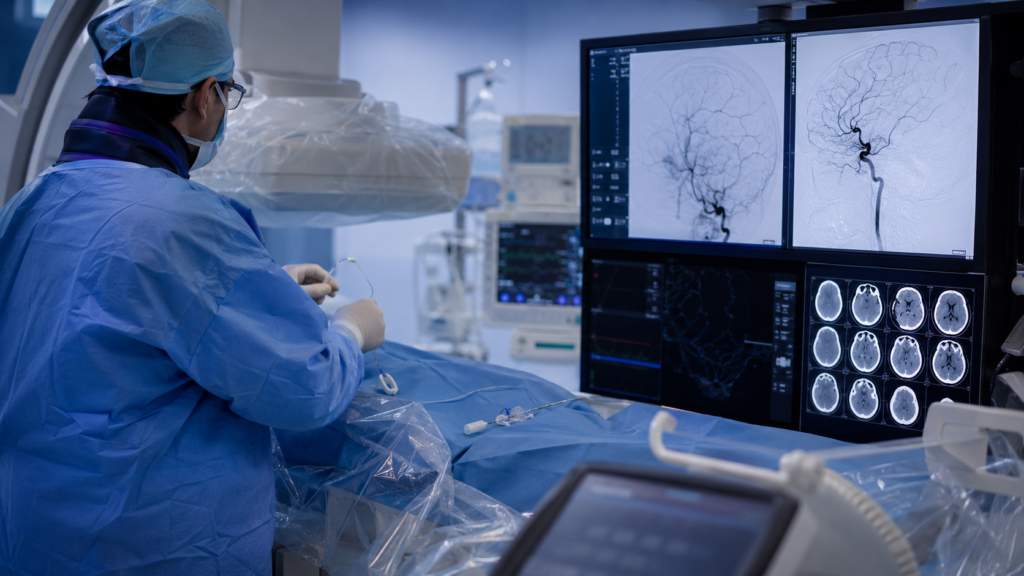
How could modulated aspiration affect stroke procedure workflow?
Modulated aspiration is the key technical feature behind Penumbra’s THUNDERBOLT positioning. In conventional aspiration thrombectomy, negative pressure is used to engage and remove clot through a catheter. THUNDERBOLT adds a computer assisted mechanism designed to vary aspiration forces in a way that may help disrupt, engage, and ingest clot more effectively at the occlusion site. The intended procedural benefit is faster and more complete clot capture with less catheter manipulation.
That could matter in stroke intervention because every minute of delay can influence functional recovery. Neurointerventionalists already operate under intense time pressure, often balancing rapid access, imaging interpretation, device navigation, clot engagement, and rescue strategy selection. A system that reduces repeated passes or supports more complete first-pass removal could be clinically valuable, especially in large vessel occlusion cases where procedural efficiency is critical.
The risk is that workflow gains must be demonstrated in routine practice, not only in early experience or controlled procedural settings. Hospitals will want to know whether THUNDERBOLT is easy to set up, compatible with existing stroke workflow, intuitive for teams, and reliable across clot types. Stroke thrombectomy rooms are not places where teams welcome unnecessary complexity. Computer assistance must feel like simplification, not another layer of equipment management.
Why does this clearance strengthen Penumbra’s broader thrombectomy franchise?
Penumbra’s broader business is built around clot removal across multiple vascular territories, including ischemic stroke, pulmonary embolism, venous thromboembolism, and acute limb ischemia. THUNDERBOLT expands the company’s computer assisted thrombectomy story into stroke, reinforcing the idea that Penumbra is not only selling individual catheters but building a cross-body thrombectomy platform. That broader positioning is strategically valuable because hospitals often prefer technology families that create familiarity across related procedures.
The clearance also strengthens Penumbra’s role in neurovascular intervention, where technology competition remains intense. Stroke care is a high-visibility area for medtech innovation because outcomes are closely tied to rapid diagnosis, patient transfer, imaging triage, and procedural success. A device that can credibly improve clot removal performance has both clinical and commercial significance, especially if it becomes part of a broader institutional stroke protocol.
The limitation is that thrombectomy growth is not determined by devices alone. Procedure volume depends on stroke systems of care, emergency medical services triage, imaging capacity, specialist availability, patient eligibility, and hospital certification. Even a strong device cannot solve gaps in stroke access. Penumbra’s growth opportunity will therefore depend on both product performance and the continued expansion of thrombectomy-capable stroke networks.
How does the Boston Scientific acquisition context change the strategic reading?
The THUNDERBOLT clearance arrives while Boston Scientific is pursuing its acquisition of Penumbra, a transaction valued at about $14.5 billion when announced earlier in 2026. That context matters because Penumbra’s new clearance strengthens the strategic rationale for the deal. Boston Scientific has built scale across cardiovascular and interventional medicine, and Penumbra would give it a deeper entry into mechanical thrombectomy and neurovascular technologies.
From Boston Scientific’s perspective, THUNDERBOLT adds more evidence that Penumbra is not a static asset. It is still advancing differentiated technology in high-growth vascular and neurovascular categories. A new FDA-cleared stroke platform can support the argument that Penumbra brings both existing revenue and future innovation potential. For Penumbra, the clearance can help maintain commercial momentum during the deal period, when companies sometimes face customer uncertainty or internal distraction.
The risk is that the pending acquisition also complicates investor interpretation. Penumbra’s standalone equity story is now tied heavily to deal completion, regulatory approvals, and merger mechanics. Product wins still matter, but the stock may trade more in relation to the acquisition consideration than to near-term product catalysts. That means THUNDERBOLT is strategically important for the combined future portfolio, even if its immediate stock impact is muted.
What does the stock market signal suggest about Penumbra’s current position?
Penumbra shares were trading around $318.32, slightly lower intraday, with a market capitalization of about $12.59 billion. That trading level sits below the previously announced Boston Scientific transaction value of $374 per share in cash or equivalent stock consideration, reflecting the market’s usual discount for pending deal risk, timing, stock component mechanics, and broader market conditions. The modest intraday move suggests investors did not treat the FDA clearance as a standalone rerating event.
For medtech investors, the clearance is still meaningful because it adds product momentum to Penumbra’s thrombectomy portfolio. The company already has a strong identity in clot removal, and THUNDERBOLT extends the computer assisted vacuum thrombectomy narrative into stroke. This can support confidence in Penumbra’s innovation pipeline and may strengthen the long-term strategic fit with Boston Scientific’s vascular ambitions.
The caution is that Penumbra’s valuation is no longer being judged only on operating performance. Investors are watching deal certainty, regulatory timing, integration assumptions, and Boston Scientific’s ability to extract strategic value after closing. THUNDERBOLT improves the product story, but the equity story remains anchored to whether the transaction closes as expected and whether the combined portfolio can convert technology breadth into durable growth.
How could hospitals evaluate THUNDERBOLT against existing stroke thrombectomy tools?
Hospitals are likely to evaluate THUNDERBOLT through a combination of clinical, operational, and economic questions. Clinically, neurointerventionalists will want to see whether the device improves recanalization performance, reduces the number of passes, handles different clot compositions, and integrates well with existing aspiration catheters and rescue strategies. Operationally, stroke teams will ask whether the platform is easy to use under emergency conditions.
Economically, hospitals will assess whether any additional device cost is justified by procedural efficiency, improved outcomes, reduced procedure time, or stronger stroke program performance. In high-volume stroke centers, even small improvements in workflow can matter. In lower-volume centers, adoption may depend more heavily on training support, physician champions, and confidence that the device does not complicate emergency workflow.
The unresolved question is comparative evidence. THUNDERBOLT will enter a market where physicians have existing comfort with aspiration systems, stent retrievers, and combined techniques. To shift practice, Penumbra will need more than a device label. It will need real-world experience, procedural data, peer adoption, and potentially comparative studies that help clinicians understand where modulated aspiration performs best.
What risks remain despite the FDA clearance?
The first risk is procedural variability. Stroke thrombectomy outcomes depend on anatomy, clot composition, collateral circulation, infarct size, time from symptom onset, and team coordination. A device can perform well in one procedural context and offer less benefit in another. This makes it important to understand which patients and occlusion types are best suited for THUNDERBOLT.
The second risk is training and implementation. Computer assisted technology can improve consistency, but only if teams understand how to use it correctly and when to adjust strategy. If the system changes procedural behavior, hospitals will need training protocols and physician experience to avoid misuse or overreliance. The technology must support clinical judgment, not replace it.
The third risk is competitive response. Stroke thrombectomy is a dynamic medtech field, and rivals will continue to advance catheter designs, aspiration systems, stent retrievers, imaging-assisted workflows, and procedural tools. Penumbra has gained a useful first-mover claim in computer assisted vacuum thrombectomy for stroke, but competitors may respond with their own efficiency or automation narratives. The market will not stand still.
Why could this clearance matter for the broader neurovascular device sector?
THUNDERBOLT matters for the broader neurovascular device sector because it reflects a shift from purely mechanical device design toward procedure-assisting systems. Stroke thrombectomy began as a race to develop better clot retrieval tools. It is increasingly becoming a race to make the entire intervention more predictable, faster, and easier to standardize. Computer assistance fits that direction because it may help reduce dependence on manual aspiration control and procedural variability.
This shift is commercially important because stroke systems are trying to treat more eligible patients more quickly. Device makers that can support speed, safety, and consistency may have an advantage as thrombectomy volumes grow. Hospitals are also under pressure to improve stroke metrics, and technologies that support efficient reperfusion could become attractive if supported by evidence.
The caution is that neurovascular innovation must clear a high bar. Stroke outcomes are unforgiving, and physicians will not adopt technology simply because it sounds advanced. The strongest medtech innovations in this space are those that improve performance while preserving or simplifying operator control. THUNDERBOLT’s future will depend on whether neurointerventionalists see it as a practical procedural advantage rather than a technology showcase.
What should clinicians, hospitals, and medtech observers watch next?
Clinicians should watch for early post-clearance experience, including procedural success, first-pass effect, time to reperfusion, complications, need for adjunctive devices, and performance across clot types. The most persuasive data will come from real-world use across diverse stroke centers, not only from experienced early users. If THUNDERBOLT consistently reduces procedural friction, adoption could accelerate.
Hospitals should watch how the device fits into stroke program economics and workflow. Emergency stroke care is already complex, and new technology must integrate smoothly with imaging, transfer protocols, catheterization lab readiness, and neurointerventional staffing. A device that improves procedural efficiency without adding operational burden can become easier to justify.
For the medtech sector, Penumbra’s FDA clearance signals that computer assisted thrombectomy is moving deeper into high-stakes neurovascular care. The clearance strengthens Penumbra’s innovation narrative ahead of the planned Boston Scientific transaction and gives the combined future portfolio a sharper stroke technology story. The opportunity is significant because stroke thrombectomy remains one of medtech’s most consequential growth areas. The test now is whether THUNDERBOLT can prove that modulated aspiration changes not only how clot removal is performed, but how reliably patients can be treated when every minute counts.
Discover more from Business-News-Today.com
Subscribe to get the latest posts sent to your email.