

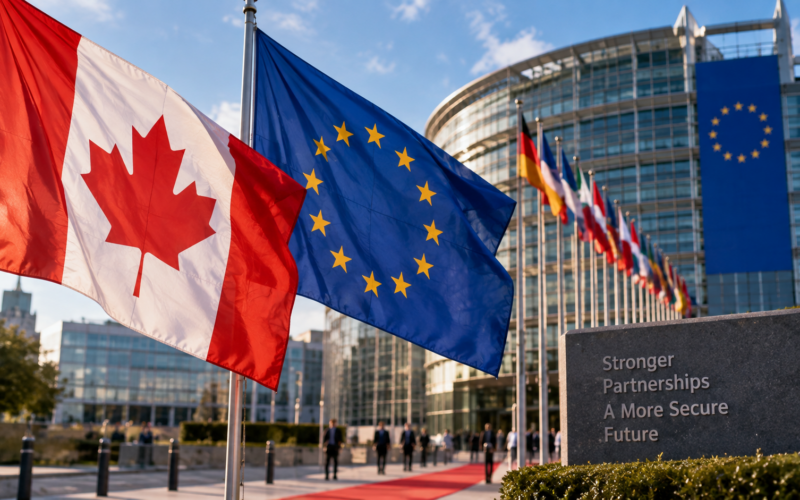
Canadian Prime Minister Mark Carney is exploring whether Canada could secure a new form of “associate membership” with the European Union as deteriorating trade relations with the United States push Ottawa toward deeper economic and strategic integration with Europe. The proposal remains exploratory, and neither the Canadian government nor the European Commission has formally announced negotiations for such a membership category.
The Wall Street Journal reported, and Reuters subsequently confirmed the report’s details, that officials on both sides have discussed the possibility of creating a status that does not currently exist under European Union membership rules. Potential areas of integration include the freer movement of selected goods, services and workers involved in strategic supply chains covering energy, defence, artificial intelligence and critical minerals.
What would Canada becoming an EU ‘associate member’ actually mean?
There is currently no standard European Union category called “associate membership” equivalent to full membership. Canada would therefore not simply be joining an existing tier between a normal trading partner and an EU member state.
Instead, officials appear to be exploring a bespoke institutional arrangement allowing Canada to participate much more deeply in selected parts of the European economic and strategic system. Such a model could theoretically expand market access and mobility without requiring Canada to join the European Union’s political institutions or adopt every element of EU law.
That distinction is crucial. Canada is not a European country seeking ordinary accession, and there has been no suggestion that Ottawa would obtain representation in the European Parliament or become part of the European Commission’s formal political structure.
The significance lies in whether the EU is prepared to create a new external status broad enough to incorporate strategic partners into parts of its internal economic architecture.
Why is Mark Carney looking toward Europe as Canada’s relationship with the United States deteriorates?
The immediate catalyst is Canada’s increasingly difficult economic relationship with Washington. Trade tensions have escalated since Donald Trump returned to the White House, with tariffs affecting tens of billions of dollars of cross-border commerce and undermining assumptions that Canada could always rely on preferential access to the United States market.
That matters because the United States remains overwhelmingly Canada’s largest trading partner. Deep integration of manufacturing, energy, agriculture and automotive supply chains makes abrupt diversification impossible, but the political direction has strengthened Ottawa’s incentive to develop credible alternatives.
Europe is the obvious candidate. The European Union is already Canada’s second-largest trading partner, while both sides cooperate closely on security, Ukraine, critical minerals and clean energy.
EU-Canada goods and services trade reached approximately €130 billion in 2025, up roughly 80% from €72.1 billion in 2016, according to European Commission data. Bilateral trade in goods alone reached €81.5 billion, illustrating that any deeper arrangement would build on an existing commercial base rather than start from scratch.
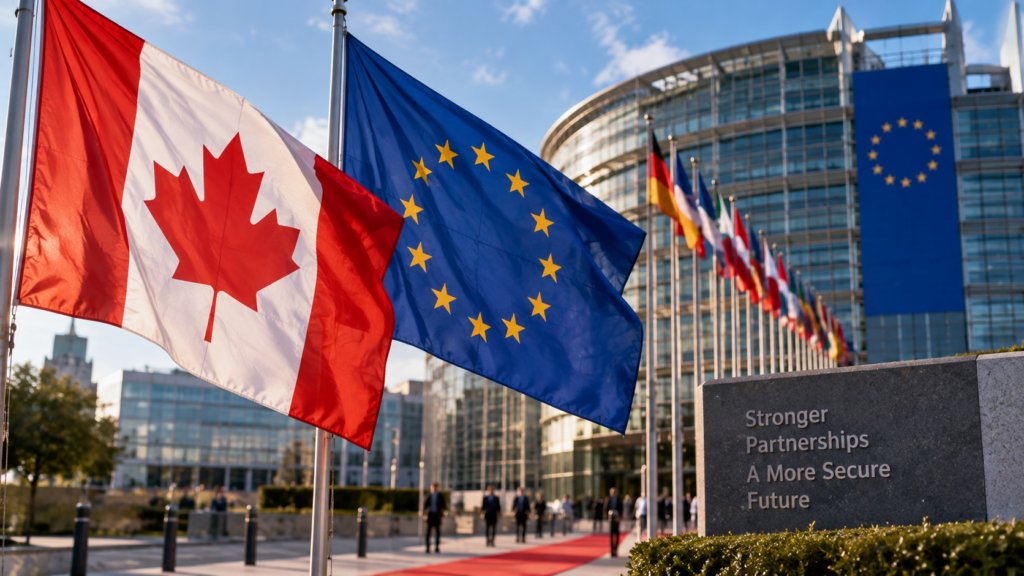
How much integration already exists through the Canada-EU CETA trade agreement?
The Comprehensive Economic and Trade Agreement, better known as CETA, provisionally entered into force in September 2017 and removed or reduced many tariffs while expanding access to procurement, investment and services markets.
Trade has grown substantially since then. EU goods exports to Canada rose from €29.6 billion in 2016 to €48.8 billion in 2025, while bilateral services trade increased from €25.6 billion to approximately €49 billion.
Canada and the European Union also launched negotiations for a Digital Trade Agreement in March 2026, demonstrating that both sides were already trying to deepen the relationship before the latest associate-membership discussion emerged. Canadian and EU officials described stronger trade ties as part of a broader effort to improve economic security and resilience.
Yet CETA itself illustrates how politically difficult deeper integration could become. Nearly a decade after provisional implementation, the agreement has still not been fully ratified by every European Union member state.
Could Canadians eventually live and work in the European Union without visas?
That possibility is reportedly part of the conversation, but it remains far from agreed policy. Carney has discussed mobility issues with European leaders, particularly French President Emmanuel Macron, and officials cited by The Wall Street Journal reportedly raised the possibility of Canadians gaining broader rights to live and work in Europe.
A comprehensive free-movement system resembling that enjoyed by citizens of European Union member states would be politically ambitious. Immigration rules remain sensitive across the continent, and every member state would have interests in how any reciprocal labour arrangement was designed.
A narrower system may be more realistic initially. Workers connected with strategically important industries such as defence, artificial intelligence, critical minerals and energy could receive simplified mobility or visa arrangements without creating unrestricted free movement for the entire Canadian population.
That type of sector-specific integration would fit the broader concept now being discussed: Canada participating more deeply in selected strategic parts of the European economy without becoming a conventional EU member.
Why are energy, AI, defence and critical minerals central to the Canada-EU plan?
Canada possesses several resources and capabilities that Europe increasingly views through a national-security lens. Its critical-mineral deposits can support battery, defence and semiconductor supply chains, while Canadian oil, gas and potential future liquefied natural gas exports offer additional energy diversification.
Europe, meanwhile, brings a market of roughly 450 million consumers alongside advanced manufacturing capacity and substantial defence, aerospace and industrial technology demand.
Artificial intelligence adds another layer. Officials are reportedly discussing underwater cables, data centres, cloud storage and satellite networks, suggesting that the proposal extends into digital infrastructure rather than simply traditional trade.
The potential relationship therefore resembles an economic-security alliance as much as a conventional free-trade agreement. Canada provides geographic scale, energy, minerals and access to North American capabilities, while Europe provides markets, capital, defence demand and an alternative strategic anchor.
Could Canada actually become an EU associate member?
The concept is plausible as a negotiated political framework but nowhere near guaranteed. The European Union has historically guarded the boundaries between membership, European Economic Area participation, accession candidates and ordinary external trade agreements.
Creating an entirely new status for Canada could trigger demands from other close partners seeking comparable treatment. Countries such as the United Kingdom, Japan, Australia or South Korea might reasonably ask why similar arrangements could not be constructed for them.
Domestic politics also matter. European governments would need to determine how much access Canada receives and whether concessions on labour mobility, procurement or strategic industries require national approval.
Carney and Macron are expected to meet later in September, meaning the next useful signal will be whether governments begin describing the concept publicly rather than through reports citing unnamed officials.
For Canada, the strategic logic is nevertheless clear. Ottawa may never be able to replace the United States economically, but the worsening bilateral relationship has made reducing excessive dependence on one market a far more urgent national project.
Discover more from Business-News-Today.com
Subscribe to get the latest posts sent to your email.