


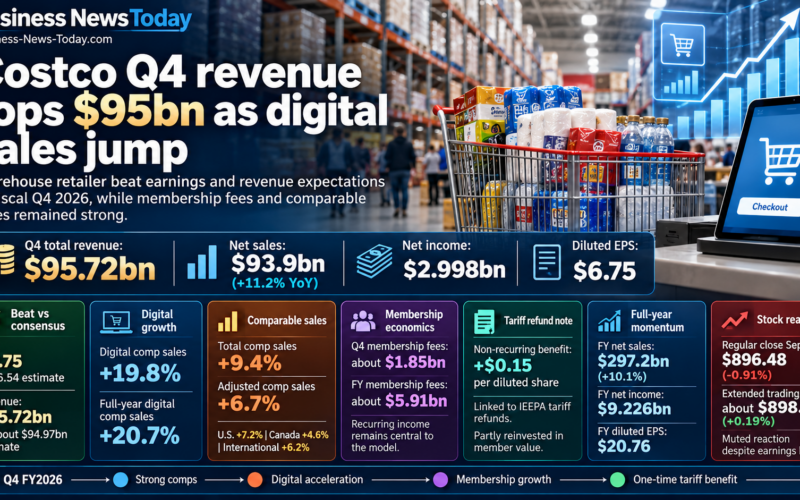
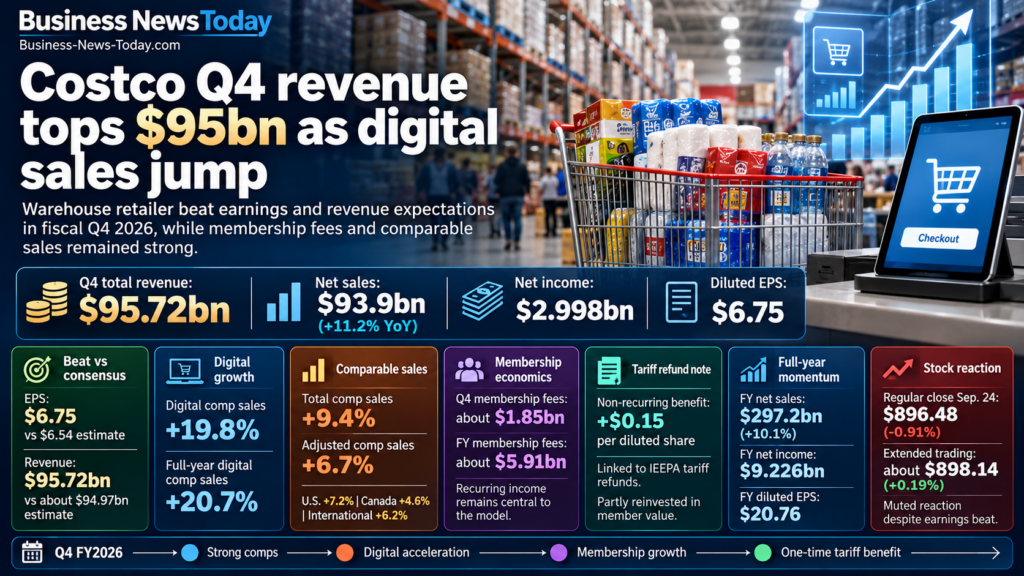
Costco Wholesale Corporation (Nasdaq: COST) has reported fourth-quarter fiscal 2026 total revenue of $95.72bn as its warehouse model continued to generate strong comparable sales and digitally enabled shopping grew almost 20% on an adjusted basis. Net sales for the 16 weeks ended August 30 increased 11.2% to $93.9bn from $84.4bn a year earlier, while full-year net sales rose 10.1% to $297.2bn. Quarterly net income climbed to $2.998bn from $2.610bn, lifting diluted earnings per share to $6.75 from $5.87.
The headline profit figure needs one important qualification. Costco said fourth-quarter earnings benefited by $0.15 per diluted share from non-recurring refunds linked to tariffs imposed under the International Emergency Economic Powers Act, after accounting for the portion reinvested in increased member value. That means the quarter combined underlying operating growth with a one-time tailwind rather than producing the entire year-on-year earnings increase from normal trading alone.
Costco nevertheless surpassed Wall Street expectations on both earnings and revenue. MarketBeat reported a consensus earnings estimate of $6.54 a share and expected revenue of about $94.97bn, compared with Costco’s reported $6.75 and $95.72bn. Even subtracting the $0.15 tariff-related benefit as a simple analytical exercise would leave earnings around $6.60 a share, although Costco did not present that calculation as an official adjusted earnings measure.
What drove Costco’s fourth-quarter sales growth beyond new warehouse openings?
Comparable sales provide the clearest evidence that Costco’s growth was not simply the result of adding locations. Total company comparable sales increased 9.4% in the quarter and 6.7% after excluding changes in gasoline prices and foreign-exchange rates. Adjusted comparable sales increased 7.2% in the United States, 4.6% in Canada and 6.2% across other international markets.
Digitally enabled comparable sales were considerably stronger, rising 19.8% after gasoline and currency adjustments in the fourth quarter and 20.7% for the full fiscal year. That growth matters because Costco was historically built around enormous physical warehouses and deliberately limited assortment rather than the infinite-shelf model associated with ecommerce businesses. The continuing expansion of digital sales suggests Costco is finding ways to add convenience without abandoning the membership economics and treasure-hunt shopping behaviour that differentiate its stores.
The opportunity is not simply to shift existing warehouse transactions online. A stronger digital platform can broaden the range of occasions on which members interact with Costco, improve the economics of bulky or high-value categories that customers may prefer to research online, and increase the value of a membership without requiring every transaction to begin with a warehouse visit. The risk is that fulfilment and last-mile delivery generally carry different cost structures from customers collecting merchandise themselves, so digital growth has to be judged alongside margins rather than viewed as automatically superior revenue.
Why does Costco membership-fee growth remain central to the investment case?
Costco’s model begins with the membership relationship rather than the merchandise transaction. Fourth-quarter membership-fee revenue reached about $1.85bn, compared with $1.724bn a year earlier, while full-year membership fees increased to roughly $5.91bn from $5.32bn. The recurring nature of this income gives Costco an economic advantage that conventional retailers without paid membership programmes do not replicate in the same way.
Membership income also helps explain Costco’s willingness to use scale to reinforce prices and customer value rather than maximise the margin on every individual item. The tariff-refund disclosure is an example: management did not simply allow all the refund economics to flow into profit, because some of the benefit was reinvested in member value. That decision can reduce the immediate earnings contribution while potentially supporting renewal, shopping frequency and the broader perception that the annual membership continues to pay for itself.
For SEO and investor-intent purposes, this distinction is important when asking whether Costco earnings are growing because of price increases, warehouse expansion or stronger customer economics. The fourth-quarter numbers show several engines working simultaneously: comparable sales remained healthy, digital activity grew considerably faster than group sales, membership income increased and net income grew faster than net sales.
How much did tariff refunds really change Costco’s fourth-quarter earnings?
The $0.15 per-share benefit represented only a fraction of Costco’s $6.75 quarterly earnings figure, but it matters because earnings surprises are often evaluated against small differences from consensus estimates. Costco beat the reported $6.54 consensus by $0.21 a share, while the tariff-refund contribution was $0.15. Investors therefore need to separate the quality of the operating result from the accounting benefit when deciding how much of the quarterly upside is repeatable.
The more durable indicators arguably sit elsewhere in the report. Adjusted total comparable sales of 6.7%, digitally enabled growth approaching 20% and double-digit annual net-sales growth point to continued demand across the core business. Full-year net income reached $9.226bn, up from $8.099bn, while full-year diluted earnings per share increased to $20.76 from $18.21.
That combination reduces the importance of treating the tariff refund as either a hidden weakness or an extraordinary profit windfall. It is simply a material non-recurring item that should be stripped out when comparing the quarter with future periods.
Why did Costco stock barely react after an earnings beat?
Costco shares closed the regular September 24 session at $896.48, down 0.91%, before the company released its results after the market closed. MarketBeat recorded the stock at about $898.14 in extended trading, an increase of only 0.19% from the regular close despite the earnings and revenue beats.
That restrained after-hours move can be interpreted as a valuation issue rather than evidence that Costco’s operating performance was weak. Investors already assign Costco a substantial premium for dependable growth, recurring membership economics and defensive consumer characteristics, so strong results may need to exceed already elevated expectations by a wide margin to trigger another sharp re-rating.
For the next quarter, the most useful indicators will be adjusted comparable sales, membership renewal and fee income, digital growth and the relationship between member-value investments and margins. Costco finished fiscal 2026 with considerable momentum. The question for shareholders is no longer whether the warehouse model works; it is how long Costco can sustain high-single-digit underlying sales growth while expanding digitally without compromising the economics that made the model valuable in the first place.
Discover more from Business-News-Today.com
Subscribe to get the latest posts sent to your email.