CoreWeave, Inc. (NASDAQ: CRWV) has emerged as one of the defining infrastructure companies behind the artificial intelligence boom, supplying NVIDIA-powered computing capacity to hyperscalers, frontier AI laboratories, financial institutions and enterprises that cannot secure enough advanced GPU infrastructure through conventional cloud channels. The Livingston, New Jersey-based company generated $5.13 billion in 2025 revenue and another $2.08 billion during the first quarter of 2026, while its revenue backlog reached $99.4 billion at March 31. Yet CoreWeave also reported a $740 million quarterly net loss, held $25.15 billion of principal debt and planned between $31 billion and $35 billion of capital expenditure during 2026.
The contradiction defines the CoreWeave company profile. Demand appears exceptionally strong, with multiyear agreements involving Microsoft Corporation, OpenAI, Meta Platforms, Inc., Jane Street and Anthropic. The company must nevertheless construct and commission data centres, acquire rapidly evolving hardware, manage rising interest expense and maintain sufficient customer utilisation to ensure that its backlog ultimately produces attractive cash returns.
What does CoreWeave do and how does its AI cloud business model operate?
CoreWeave provides cloud infrastructure purpose-built for artificial intelligence training, fine-tuning, inference and application deployment. Customers rent access to clusters of graphics processing units, storage systems, high-speed networking and associated software through committed contracts or on-demand arrangements. CoreWeave manages the underlying infrastructure, allowing customers to consume specialised computing capacity without purchasing and operating entire data-centre systems themselves.
Unlike a conventional software-as-a-service provider, CoreWeave must invest heavily before it can recognise revenue. It secures power, leases or develops data-centre facilities, buys servers and NVIDIA GPUs, installs networking and liquid-cooling infrastructure, and then configures the systems for specific customer workloads. Revenue is recognised as contracted computing services are delivered rather than when a contract is announced or entered into the backlog.
CoreWeave’s customers include AI model developers, hyperscale cloud companies, financial institutions, robotics businesses, biotechnology companies, creative software developers and large enterprises. Some contracts reserve entire clusters for several years, while newer flexible-capacity products allow customers to use shorter reservations or available spot capacity. This mix may help CoreWeave improve utilisation by serving long-term anchor customers alongside more variable workloads.
The company increasingly describes itself as a full-stack AI cloud rather than a GPU-rental business. Its platform includes computing, networking, storage, orchestration, model-development tools, reinforcement-learning capabilities and managed infrastructure services. CoreWeave Mission Control supports cluster management and workload reliability, while the acquisition of Weights & Biases extended the platform into experiment tracking, model training, evaluation and deployment.

How did CoreWeave evolve from cryptocurrency mining into an AI infrastructure company?
CoreWeave was founded in September 2017 by Michael Intrator, Brian Venturo, Brannin McBee and Peter Salanki. The business initially operated as Atlantic Crypto and used graphics processors for cryptocurrency mining. Before 2022, most of its limited revenue came from crypto-mining activities that the company has since discontinued.
The founders recognised that GPUs used for mining could also support rendering, scientific computing, machine learning and artificial intelligence. CoreWeave launched its cloud platform in 2020 and progressively shifted its infrastructure toward high-performance workloads. The acceleration of generative AI after 2022 created a much larger commercial opportunity as developers struggled to access NVIDIA’s most advanced chips.
CoreWeave’s early relationship with NVIDIA Corporation became central to this transition. NVIDIA invested in the company before its public listing, supplied the hardware underlying its platform and used CoreWeave infrastructure for some workloads. CoreWeave, in turn, became an early deployment partner for successive NVIDIA architectures, including Blackwell systems and the Vera Rubin platform expected to enter production during the second half of 2026.
CoreWeave completed its Nasdaq listing in March 2025, pricing 37.5 million Class A shares at $40 each and raising approximately $1.5 billion. The offering was smaller and priced below the company’s earlier ambitions, reflecting investor concern over customer concentration, debt and capital intensity even as AI infrastructure demand remained strong.
Which products and services differentiate the CoreWeave Cloud Platform?
CoreWeave’s primary offering is accelerated computing infrastructure built around NVIDIA GPUs. Customers use this capacity to train foundation models, run large-scale inference, develop autonomous systems, process scientific data and support applications that require large amounts of parallel computing.
The company combines GPUs with high-speed networking, storage and software configured for AI workloads. Infrastructure performance depends not only on the number of chips but also on whether thousands of GPUs can communicate efficiently, receive data without bottlenecks and remain available during prolonged training jobs. CoreWeave’s technical positioning therefore rests on cluster architecture and operational reliability rather than hardware access alone.
CoreWeave Mission Control provides monitoring, telemetry, workload orchestration and infrastructure-management capabilities. AI Object Storage is intended to give customers high-speed access to large training datasets, while Dedicated Inference and flexible capacity plans broaden the platform beyond long-duration model training. CoreWeave ARENA allows customers to evaluate workloads in production-oriented environments before committing them to larger deployments.
The acquisition of Weights & Biases added software used by researchers and developers to track experiments, manage models and monitor AI applications. CoreWeave paid aggregate consideration of approximately $1 billion for the business, although media reports before closing had placed the prospective transaction value higher. The acquisition’s financial contribution remained immaterial to CoreWeave’s consolidated results during 2025, indicating that its immediate value was strategic rather than revenue-transformational.
CoreWeave also acquired OpenPipe, Marimo and Monolith AI. OpenPipe brought reinforcement-learning technology for improving AI agents, Marimo added an open-source Python notebook environment, and Monolith extended the platform toward industrial engineering and physical-product development. Together, these transactions indicate that CoreWeave wants to capture more of the AI development workflow rather than remain solely an infrastructure supplier.
How large is CoreWeave’s data-centre and power infrastructure footprint?
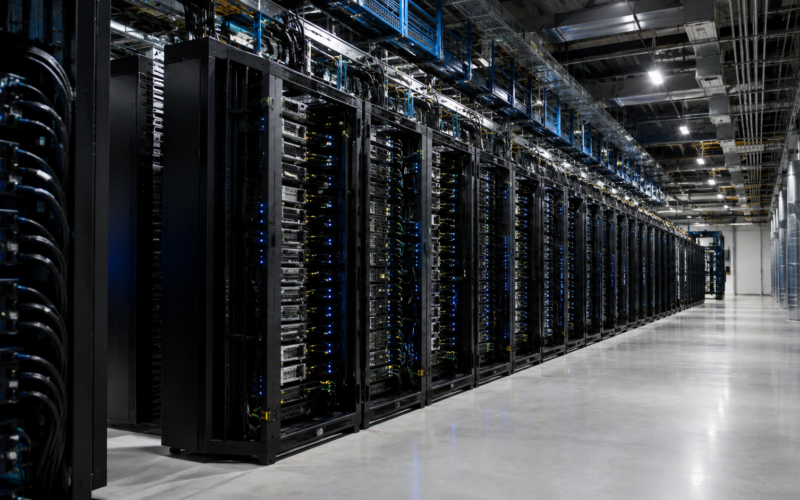
CoreWeave’s physical footprint has expanded at extraordinary speed. The company operated 10 data centres supported by approximately 70 megawatts of active power at the end of 2023. That increased to 32 data centres and more than 360 megawatts at the end of 2024, followed by 43 data centres and more than 850 megawatts of active power at December 31, 2025. Contracted power capacity reached approximately 3.1 gigawatts at the end of that year.
By March 31, 2026, CoreWeave had surpassed one gigawatt of active power and expanded contracted power beyond 3.5 gigawatts. The company also outlined an expanded relationship with NVIDIA intended to support more than five gigawatts of AI factories by 2030, while management said its overall active-power footprint could exceed eight gigawatts by that date. These are development objectives rather than currently operating capacity.
CoreWeave primarily uses third-party data-centre providers, although it is beginning to participate more directly in development through projects such as its Kenilworth, New Jersey joint venture. Leasing infrastructure can accelerate expansion and reduce the need to own every building, but it creates dependence on developers, utilities and construction partners.
That dependency has already produced operational pressure. CoreWeave disclosed delays involving certain facilities expected from a third-party data-centre provider during 2025. The company also warned that AI facilities often require extensive retrofits, specialised cooling, high-speed interconnections and unusually large power supplies, making late delivery or inadequate performance financially significant.
How did CoreWeave perform financially during 2025?
CoreWeave generated $5.13 billion in revenue during 2025, an increase of approximately 168% from $1.92 billion in 2024. Revenue had been only $229 million in 2023, demonstrating how quickly the business scaled once generative AI demand and new computing capacity converged.
The company reported an operating loss of $46 million in 2025, compared with operating income of $324 million in 2024. Net loss widened to $1.17 billion from $863 million as interest expense and infrastructure-related costs increased. Net interest expense reached $1.23 billion during 2025, more than three times the $361 million recorded a year earlier.
CoreWeave’s non-GAAP results presented a more favourable operating picture. Adjusted EBITDA increased to $3.09 billion from $1.22 billion, representing an adjusted EBITDA margin of 60%. Adjusted operating income reached $666 million, but adjusted net loss remained $606 million after financing and other expenses.
The difference between adjusted EBITDA and net income is particularly important for evaluating the CoreWeave business model. Adjusted EBITDA excludes depreciation, interest, taxes, stock-based compensation and selected other costs. For a company financing tens of billions of dollars of short-lived computing equipment, depreciation and interest are not peripheral issues. They are fundamental costs of producing the service.
Microsoft Corporation accounted for approximately 67% of CoreWeave’s 2025 revenue. That concentration helped the company scale rapidly but also means historical performance depended heavily on one customer. Meta, OpenAI and other newer agreements are expected to diversify future revenue, although the largest contracts may still leave the company dependent on a small group of technology and AI businesses.
What do CoreWeave’s first-quarter 2026 results reveal about its momentum?
CoreWeave generated $2.08 billion in first-quarter 2026 revenue, an increase of 112% from $982 million in the comparable period. Approximately 38% of the increase came from expansion among existing customers, while the remaining increase came from new customers. The expansion of CoreWeave’s data-centre footprint allowed it to fulfil more of the demand represented by its contract book.
The cost of revenue increased 173% to $716 million and rose to 34% of revenue from 27%. Technology and infrastructure expense increased 127% to $1.27 billion. Total operating expenses reached $2.22 billion, producing a $144 million operating loss compared with a $27 million loss a year earlier.
Net loss widened to $740 million from $315 million. The principal pressure below the operating line was interest expense, which doubled to $536 million. Depreciation and amortisation reached $1.15 billion as CoreWeave placed more GPUs and data-centre infrastructure into service.
Adjusted EBITDA increased to $1.16 billion from $606 million, but its margin declined to 56% from 62%. Adjusted operating income fell to $21 million from $163 million, and adjusted net loss widened to $589 million. The results showed that computing demand remained strong while component, infrastructure and financing costs were absorbing much of the economic benefit.
CoreWeave’s backlog increased from $66.8 billion at the end of 2025 to $99.4 billion at March 31, 2026. Backlog includes remaining performance obligations and additional amounts the company estimates will be recognised under committed customer contracts, subject to service delivery and capacity availability. It therefore provides demand visibility but is not equivalent to guaranteed near-term revenue.
Why are Microsoft, OpenAI, Meta, NVIDIA and Jane Street central to CoreWeave’s outlook?
Microsoft was CoreWeave’s dominant historical customer, using the company to supplement internal Azure capacity as demand for artificial intelligence computing exceeded available infrastructure. Microsoft’s role gave CoreWeave scale and credibility, but the resulting concentration became one of the main concerns surrounding its IPO and valuation.
OpenAI signed an initial agreement with CoreWeave worth up to $11.9 billion through 2030. Subsequent expansions increased the total potential contract value to approximately $22.4 billion. OpenAI also received $350 million of CoreWeave shares at the $40 IPO price, aligning the customer with the infrastructure provider’s public-market performance.
Meta initially committed up to approximately $14.2 billion through 2031 and expanded the relationship in April 2026 through an additional agreement worth approximately $21 billion through December 2032. The new capacity is expected to include early deployments of NVIDIA’s Vera Rubin platform, taking Meta’s disclosed commitments with CoreWeave to roughly $35.2 billion.
Jane Street committed approximately $6 billion to use CoreWeave’s cloud platform across several facilities and invested $1 billion in CoreWeave Class A shares at $109 each. The agreement adds a sophisticated financial-services customer whose computing requirements extend beyond frontier-model development.
Anthropic entered a multiyear agreement to use CoreWeave infrastructure for the development and deployment of its Claude models, although the parties did not disclose a contract value. CoreWeave said the agreement meant its platform was serving nine of the ten leading AI model developers, illustrating its increasing importance across competing AI ecosystems.
NVIDIA is simultaneously CoreWeave’s primary technology supplier, investor, strategic partner and customer. NVIDIA invested another $2 billion in January 2026 at $87.20 per share. A subsequent ownership disclosure showed NVIDIA beneficially owned approximately 47.2 million CoreWeave Class A shares, representing 10.66% of that class as of January 23, 2026.
This relationship is a significant competitive advantage but also a concentration risk. CoreWeave receives early access to advanced NVIDIA systems and acts as a showcase for their performance. At the same time, NVIDIA benefits when CoreWeave raises capital and purchases more GPUs, creating a commercially interdependent structure.
Can CoreWeave’s balance sheet support its planned infrastructure expansion?
CoreWeave reported $2.24 billion of cash and cash equivalents at March 31, 2026, down from $3.13 billion at the end of 2025. Including available borrowing commitments, it reported total liquidity of approximately $11.09 billion. Property and equipment had reached $36.42 billion, while total assets stood at $55.57 billion.
Principal debt reached $25.15 billion, including approximately $7.55 billion classified as current. Contractual principal payments included $6.07 billion during the remainder of 2026 and $5.65 billion in 2027, although CoreWeave can refinance, repay or restructure facilities as its customer contracts and assets mature.
First-quarter operating cash flow was $2.98 billion, but the company spent $7.70 billion on property and equipment. Financing activities generated $3.91 billion, mainly through debt and equity issuance. The figures show that customer cash receipts support the business, but external capital remains essential because infrastructure investment substantially exceeds internally generated cash.
CoreWeave closed an $8.5 billion non-recourse delayed-draw facility backed by contracted infrastructure, with floating-rate pricing of the Secured Overnight Financing Rate plus 2.25% and an initial fixed-rate tranche of approximately 5.9%. It later closed another $3.1 billion GPU-backed facility and announced a $3.5 billion senior-notes offering in June. These transactions demonstrate access to deep capital markets while simultaneously increasing the scale of future debt servicing.
Management raised the lower end of expected 2026 capital expenditure to $31 billion from $30 billion while maintaining a $35 billion upper limit. It also targeted between $18 billion and $19 billion of annualised run-rate revenue by the end of 2026. Both objectives depend on data-centre delivery, hardware availability and customer acceptance.
How does CoreWeave compare with hyperscalers and other AI neocloud providers?
CoreWeave competes with Amazon Web Services, Microsoft Azure, Google Cloud Platform and Oracle Cloud Infrastructure. These hyperscalers possess broader product portfolios, global distribution, established enterprise relationships and much larger balance sheets. Several are also CoreWeave customers, creating a relationship in which the same companies may buy capacity from CoreWeave while competing against it for end users.
Specialist competitors include Nebius Group N.V., IREN Limited, Lambda and other GPU-focused cloud operators. These businesses seek to compete through faster access to advanced chips, specialised engineering support, transparent infrastructure and purpose-built clusters rather than the vast but more generalised services available from hyperscalers.
CoreWeave’s advantage is execution at scale. It has deployed successive NVIDIA architectures rapidly, built a large backlog and developed a financing structure that connects customer contracts with GPU-backed debt. Its software acquisitions may also help it move beyond commoditised infrastructure pricing.
Its disadvantage is financial fragility relative to the largest competitors. Amazon.com, Inc., Microsoft Corporation, Alphabet Inc. and Oracle Corporation can fund infrastructure through diversified cash-generating businesses. CoreWeave relies far more heavily on debt, external financing and a limited group of AI customers.
How has the CoreWeave share price performed in 2026?
CoreWeave shares closed at $71.88 on July 24, 2026, giving the company a market capitalisation of approximately $37.88 billion. The stock fell 11.37% during that session amid renewed investor concern over AI infrastructure expenditure, debt and the valuation of neocloud providers.
The July 24 closing price was almost unchanged from the adjusted December 31, 2025 close of $71.61, leaving the shares up approximately 0.4% for 2026. However, they were nearly 29% below the June 24 close of $100.88 and approximately 53% below the 52-week high of $153.20. The shares remained about 80% above the $40 IPO price.
Based on the latest market capitalisation and approximately $6.23 billion of trailing revenue, CoreWeave traded at roughly six times trailing sales. A conventional price-to-earnings ratio is not meaningful because the company remains loss-making. The sales multiple also understates the financial burden borne by shareholders because it does not reflect the company’s substantial debt and lease obligations.
Analyst opinion remained divided. Several firms maintained positive long-term views based on backlog and AI demand, while others reduced ratings or highlighted capital costs, interest expense and customer concentration. Published targets varied widely, showing that small changes in expected utilisation, margins or financing costs can produce dramatically different equity valuations.
What does CoreWeave’s ownership and governance structure reveal?
Michael Intrator is CoreWeave’s co-founder, chief executive officer, president and chairperson. Brian Venturo serves as chief strategy officer, Brannin McBee as chief development officer and Nitin Agrawal as chief financial officer. The combination of chief executive and board-chair roles places considerable strategic authority with Intrator.
CoreWeave has a dual-class share structure. Class A shares carry one vote each, while Class B shares carry ten votes each. As of April 15, 2026, Intrator controlled approximately 38.7% of total voting power through directly and indirectly held shares and exercisable securities. Executive officers and directors collectively controlled approximately 72.3% of voting power.
The structure allows the founders to pursue a capital-intensive strategy without being easily displaced by public shareholders. It also limits the influence of minority investors over board composition, executive compensation and major strategic decisions.
Magnetar-managed funds held approximately 17.1% of Class A shares and NVIDIA held approximately 10.7% based on the ownership information used in CoreWeave’s 2026 proxy statement. These investors provide financial and strategic support, although both relationships also involve related commercial or financing transactions that warrant continued shareholder attention.
What are the biggest risks facing CoreWeave through 2027?
Customer concentration remains one of the most important risks. Microsoft generated approximately two-thirds of 2025 revenue, while future growth increasingly depends on OpenAI, Meta, Jane Street and other large contracts. Diversification is improving, but a delay, renegotiation or reduction involving one anchor customer could materially affect infrastructure utilisation.
Debt and refinancing risk are equally significant. CoreWeave’s first-quarter net interest expense of $536 million exceeded its operating loss several times over. The company must continuously balance debt maturities, equipment-financing costs and new construction requirements against customer receipts and access to capital markets.
Infrastructure-delivery risk could delay the conversion of backlog into revenue. CoreWeave depends on utilities, developers, equipment suppliers and data-centre operators. Power shortages, construction delays, permitting problems, liquid-cooling requirements and network bottlenecks can postpone customer acceptance even when demand remains strong.
Hardware obsolescence creates another challenge. NVIDIA’s architecture cycle is moving rapidly from Hopper to Blackwell and then Vera Rubin. CoreWeave must recover the cost of existing GPUs before newer systems weaken their pricing or utilisation.
Competition may intensify as hyperscalers add internal capacity, neoclouds raise more capital and large customers consider building or reselling infrastructure themselves. CoreWeave’s backlog provides protection, but long-term pricing will depend on whether specialised cloud platforms continue offering performance or flexibility that customers cannot obtain elsewhere.
Governance and insider-selling concerns may also affect investor sentiment. Founder control reduces the ability of public shareholders to influence strategy, while executive share sales can attract scrutiny when the company is simultaneously raising capital and carrying substantial debt.
What is the growth outlook for CoreWeave through 2027?
CoreWeave has already demonstrated that it can attract some of the largest and most technically demanding AI customers in the world. Its $99.4 billion backlog, one-gigawatt active-power footprint and strategic relationship with NVIDIA establish the company as far more than a speculative data-centre developer.
The next phase will be measured by execution rather than contract announcements. Investors should track recognised revenue, connected power, adjusted operating income, depreciation, interest expense, capital expenditure and net debt. Backlog growth matters, but its economic value ultimately depends on the margins and financing costs attached to each deployment.
The movement from training toward inference could expand the addressable market because production AI applications require continuous computing rather than periodic model-building cycles. CoreWeave’s investments in dedicated inference, reinforcement learning, model monitoring and developer software are intended to capture this broader opportunity.
The company’s greatest strength is that demand is not currently hypothetical. Microsoft, OpenAI, Meta, Anthropic, NVIDIA and Jane Street have provided commercial validation at a scale few independent providers can match. Its greatest weakness is that building the infrastructure needed to serve that demand requires extraordinary amounts of capital before the returns are fully visible.
Markets are therefore likely to assess CoreWeave through a relatively unforgiving framework. Rapid revenue growth alone will not be sufficient if debt and interest expense continue expanding at a similar pace. If CoreWeave converts its backlog into commissioned capacity, improves adjusted operating margins and reduces its cost of capital, it could become a durable independent layer of the global AI economy. If construction delays, hardware costs or customer concentration prevent that conversion, its capital structure could turn exceptional demand into disappointing shareholder returns.
Discover more from Business-News-Today.com
Subscribe to get the latest posts sent to your email.