



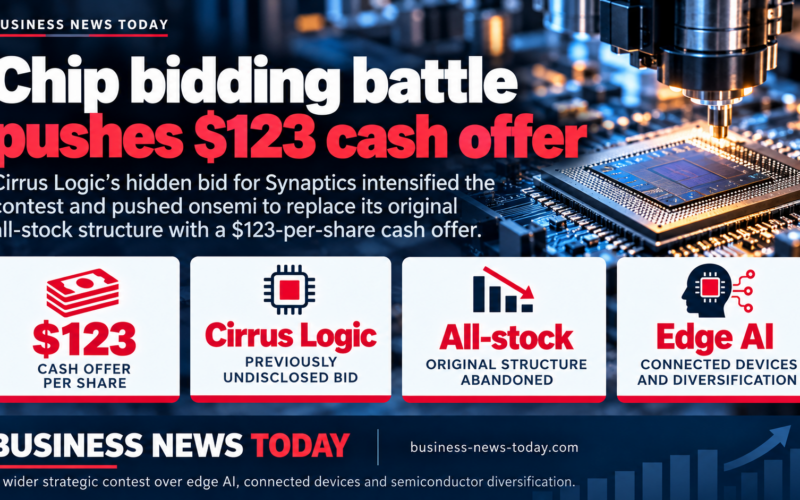
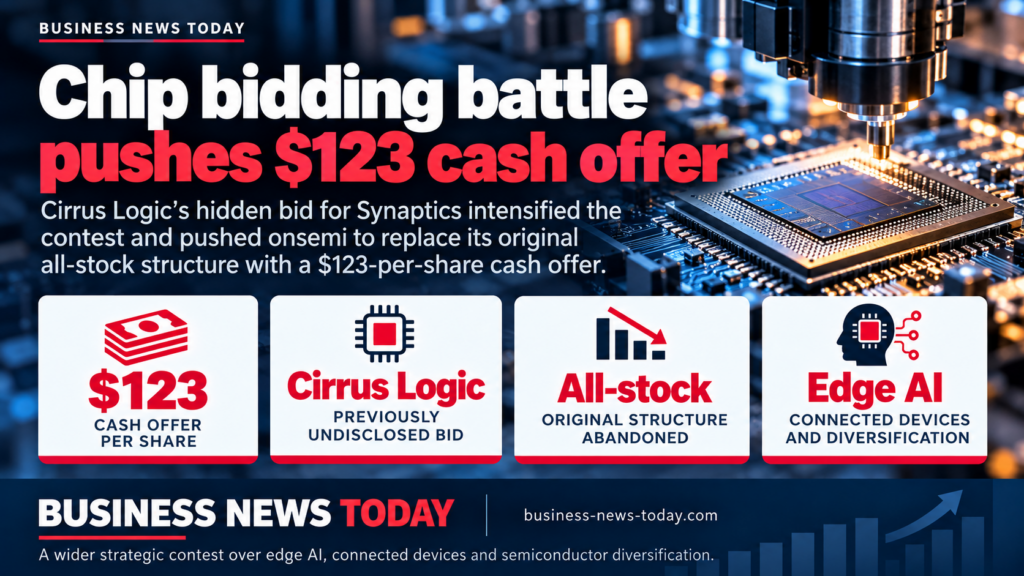
Cirrus Logic, Inc. (NASDAQ: CRUS) made an unsolicited attempt to acquire Synaptics Incorporated (NASDAQ: SYNA), according to Bloomberg reporters Liana Baker and Yiqin Shen, emerging as the bidder identified only as “Party A” in Synaptics’ regulatory filings. Synaptics’ October 8 proxy filing shows that the competing proposal eventually reached an implied value of about $131.36 per Synaptics share on September 29, higher than ON Semiconductor Corporation’s (NASDAQ: ON) eventual $123-per-share offer, but with approximately 52% of the rival consideration tied to Party A stock. Synaptics nevertheless chose onsemi after weighing cash certainty, financing, shareholder-vote requirements and regulatory progress, leading onsemi to replace its original 1.35-share exchange agreement with an all-cash acquisition valued at approximately $5.7 billion. The episode is more than a bidding-war footnote because Cirrus Logic’s involvement reveals how strategically valuable Synaptics’ edge artificial intelligence, connectivity and sensing portfolio has become to semiconductor companies trying to diversify beyond mature core markets.
How did Cirrus Logic’s rival Synaptics proposal force onsemi to rewrite its original acquisition?
The competitive process had been developing for months before Cirrus Logic’s identity became public. Synaptics’ preliminary proxy shows that Party A had already approached the company earlier in 2026, eventually proposing $102.50 per Synaptics share on April 1, with 45% of the consideration in cash and 55% in Party A stock. Synaptics continued discussions but ultimately announced an agreement with onsemi on June 25 under which each Synaptics share would be exchanged for 1.35 onsemi shares, a transaction initially described as having an enterprise value of roughly $7 billion.
The situation changed again on September 2 when Party A submitted another unsolicited cash-and-stock proposal worth an implied $118.15 per Synaptics share based on Party A’s September 1 closing price. Negotiations continued through September, and by September 20 the Synaptics board had concluded that the revised proposal constituted a “Superior Proposal” under the existing onsemi merger agreement. That determination activated a contractual period during which onsemi could respond with improved terms rather than immediately losing the transaction.
On September 24, onsemi responded by offering $120 per share entirely in cash. Party A then improved its proposal again on September 27 to $62.50 in cash plus shares, producing an implied total value of $130.85 per Synaptics share based on Party A’s September 25 market price. Onsemi raised its offer once more on September 29 to $123 per share in cash, supported by a $2.45 billion senior secured term-loan commitment from Morgan Stanley Senior Funding.
At that point the headline value favoured Party A. Synaptics’ advisers calculated the rival proposal at approximately $131.36 per share on September 29, around 6.8% above onsemi’s $123 cash offer. Synaptics still concluded that the rival bid no longer qualified as superior because its stock component created valuation uncertainty and the alternative transaction would require a Party A shareholder vote, while the onsemi deal had already secured early termination of its US Hart-Scott-Rodino antitrust waiting period.
Why was Synaptics willing to accept $123 in cash instead of a higher implied rival offer?
The decision illustrates why the highest headline number does not always win a public-company auction. Approximately 52% of Party A’s final proposal consisted of shares, meaning Synaptics shareholders would remain exposed to changes in the bidder’s stock price between signing and closing. Onsemi’s $123 offer, by contrast, fixes the consideration in cash and removes semiconductor-sector volatility from the amount Synaptics shareholders would ultimately receive.
That certainty became particularly important because the original onsemi transaction had already demonstrated how quickly stock-based acquisition value can move. The June agreement valued Synaptics at about $7 billion when announced, but Synaptics’ proxy states that the implied value of the original stock consideration had fallen to about $102.53 per share by September 29 as semiconductor valuations declined. The Philadelphia Semiconductor Index fell roughly 9% between June 25 and September 29, while Synaptics’ broad-market and edge-semiconductor peer group excluding onsemi declined around 22%.
Synaptics itself had closed at $125.62 before the original merger announcement and at $100.79 on September 29. Against that backdrop, the new $123 cash consideration represented an approximately 22% premium to the September 29 closing price and roughly 20% more than the value of the original onsemi stock consideration at that point. The revised deal therefore exchanged some theoretical upside from the competing proposal for substantially greater price certainty.
Onsemi also had greater closing momentum. US antitrust clearance under the Hart-Scott-Rodino process had already advanced, whereas a transaction with Party A would have required a new review. Synaptics’ board additionally considered financing arrangements, closing conditions and the need for Party A shareholder approval, creating execution variables that could matter even though the competing proposal carried the larger notional price.
Why would Cirrus Logic want Synaptics badly enough to challenge an agreed semiconductor merger?
The most compelling strategic explanation is diversification. Cirrus Logic generated approximately 91% of fiscal 2026 net sales from Apple Inc. through contract manufacturers, up from 89% in fiscal 2025 and 87% in fiscal 2024. That concentration has allowed Cirrus Logic to build a highly profitable position in audio and high-performance mixed-signal components, but it also means the company remains unusually dependent on the product decisions and shipment cycles of one customer.
Synaptics would dramatically broaden that exposure. The company sells edge artificial intelligence processors, wireless-connectivity chips, touch and display controllers, biometric technology, audio products and other sensing solutions across Internet of Things, industrial, automotive, personal-computer and consumer applications. Fiscal 2026 Core Internet of Things revenue grew 43% and represented 33% of total sales, while overall fiscal-year revenue increased 11% to approximately $1.2 billion.
For Cirrus Logic, acquiring Synaptics could therefore accelerate a diversification strategy that would otherwise take years of internal development. Cirrus Logic reported fiscal 2026 revenue of approximately $2.0 billion, with management already emphasising expansion beyond smartphone audio into high-performance mixed-signal products, personal computers and additional markets. Adding Synaptics would have created a company with substantially broader exposure to wireless connectivity, edge processing and embedded artificial intelligence.
The scale, however, would have made the transaction highly consequential. Cirrus Logic ended October 9 with a market capitalisation of approximately $5.36 billion, while Synaptics was valued at roughly $4.7 billion. This was therefore not a conventional bolt-on acquisition by a much larger buyer but a proposed combination involving companies of broadly comparable equity-market size.
Could Cirrus Logic have financed a Synaptics acquisition without stretching its balance sheet?
Cirrus Logic entered the process from a strong financial position, but the size of Synaptics would still have required significant transaction engineering. At June 27, Cirrus Logic held approximately $810.7 million in cash, $80.6 million of current marketable securities and $276.1 million of long-term marketable securities, giving it roughly $1.17 billion across those categories. The company’s balance sheet therefore provided considerable flexibility, but substantially less than the cash component implied by its final Synaptics proposal.
The cash-and-stock structure was consequently logical. It allowed Cirrus Logic to offer Synaptics shareholders substantial immediate value without attempting to finance the entire acquisition from cash or debt. Synaptics’ filing also shows that the parties conducted reverse due diligence on Party A’s financing plans and discussed closing certainty, while Party A ultimately increased the cash component of its proposal during negotiations.
Cirrus Logic’s underlying operating profile was strong enough to make a large transaction plausible. First-quarter fiscal 2027 revenue reached a record $460 million, while fiscal 2026 revenue was approximately $2.0 billion and GAAP operating profit reached $460.4 million. The company generated $598.6 million of operating cash flow during the twelve months ended June 27, although first-quarter operating cash flow itself was $64.1 million.
Even so, the acquisition would have changed Cirrus Logic’s risk profile materially. The transaction would have reduced the relative importance of Apple, which is strategically attractive, but would also have introduced integration risk, a substantially larger operating footprint and potential dilution for existing shareholders receiving Synaptics through a share component. Synaptics’ board specifically considered uncertainty surrounding Party A’s future stock value when comparing the proposals.
Why does onsemi still want Synaptics after semiconductor valuations fell sharply?
Onsemi’s rationale is different from Cirrus Logic’s customer-diversification argument. The company wants to combine its existing strength in power semiconductors and sensing with Synaptics’ connected compute, wireless and interface technologies, creating a broader platform for what onsemi describes as physical artificial intelligence. When the original transaction was announced, onsemi estimated that Synaptics could expand its addressable market by approximately $30 billion to $243 billion by 2030.
The revised financial structure may actually be more attractive to onsemi shareholders than the original deal despite the bidding competition. Onsemi now expects the acquisition to be immediately accretive to non-GAAP earnings per share, compared with the original expectation of accretion within 18 months. Management also says it expects incremental synergies beyond the initial $200 million estimate through revenue opportunities and manufacturing insourcing.
The unusual feature is that the headline transaction value fell from approximately $7 billion under the June announcement to roughly $5.7 billion under the revised agreement. That does not mean Synaptics accepted a worse deal. The original $7 billion figure reflected the market value of onsemi shares when the stock agreement was announced, while the subsequent decline in onsemi’s share price reduced the value of the fixed 1.35-share exchange ratio. Converting the transaction to $123 cash effectively increased what Synaptics shareholders would receive relative to the late-September value of the original deal even while reducing the transaction value compared with June’s headline figure.
Financing will increase onsemi’s leverage, although the company expects net leverage to remain below two times. At July 3, onsemi had approximately $3.51 billion of cash and cash equivalents and $350 million in short-term investments, compared with $3.66 billion of long-term debt. It generated $425.4 million of free cash flow in the second quarter, and Morgan Stanley has committed up to $2.45 billion of senior secured term financing for the Synaptics transaction.
What does the market pricing of Synaptics, Cirrus Logic and onsemi imply after the bidding battle?
Synaptics closed October 9 at $119.82, leaving the stock approximately 2.7% below onsemi’s $123 cash offer. A modest merger spread is normal when completion still requires shareholder approval and additional regulatory clearances, while also reflecting the time value of waiting until the transaction closes. The relatively narrow gap suggests the market is assigning meaningful probability to completion, although it does not eliminate execution risk.
Cirrus Logic closed at $106.87 on October 9, down 5.59% for the session and only slightly above its 52-week low of $106.26. That regular-session decline occurred before Bloomberg’s report identifying Cirrus Logic as the rival bidder was published after the US market close, so it should not be presented as a reaction to the disclosure. Cirrus Logic subsequently traded around $108 in after-hours activity, although a single extended-hours move provides limited evidence of how shareholders ultimately view the previously undisclosed acquisition attempt.
Onsemi closed at $77.53 on October 9 after falling 2.37%, extending a three-session decline. The stock remains far below its 52-week high of $134.92, which helps explain why the original stock-based Synaptics agreement lost substantial value before being rewritten. As with Cirrus Logic, the latest daily move reflects broader semiconductor and company-specific factors and should not be attributed solely to the acquisition.
The transaction itself remains the more informative valuation event. Onsemi has effectively converted a volatile stock consideration into a fixed cash obligation while preserving ownership of the combined company entirely for existing onsemi shareholders. Synaptics shareholders surrender participation in post-merger upside in exchange for $123 cash, while Cirrus Logic remains outside the deal unless it chooses to return with another proposal.
Could Cirrus Logic return with another Synaptics bid before the onsemi transaction closes?
The regulatory filing leaves that possibility open without suggesting that another proposal is imminent. Bloomberg reported that it was unclear whether Cirrus Logic remained interested, and neither Cirrus Logic nor onsemi provided Bloomberg with substantive comment on the identification of Party A. The current binding agreement remains the $123-per-share onsemi transaction.
Importantly, Synaptics’ board expressly considered the fact that Party A could make another bid even after Synaptics signed the revised agreement with onsemi. That means the September bidding process did not permanently remove the possibility of additional competition, although any renewed offer would have to overcome the value certainty, regulatory progress and contractual protections attached to the existing merger.
A new Cirrus Logic proposal would also face a higher strategic hurdle than its previous bid. Synaptics shareholders are now being offered fixed cash rather than volatile onsemi shares, while US antitrust review has already advanced. Cirrus Logic would therefore need either meaningfully higher value, stronger certainty of closing, a greater cash component or some combination of those features to create a compelling reason for Synaptics’ board to reopen the process.
The more durable conclusion is that Cirrus Logic’s intervention has already created substantial value even without winning Synaptics. Its bid forced onsemi to improve the consideration from a stock package worth about $102.53 per share by late September to $123 in cash, fundamentally changing the economics for Synaptics shareholders. It also revealed the strategic urgency surrounding edge artificial intelligence and connected semiconductor portfolios, where larger product breadth is becoming an increasingly important route to growth.
Key takeaways from the Cirrus Logic, Synaptics and onsemi bidding contest
- Bloomberg identified Cirrus Logic as the previously unnamed Party A that made an unsolicited proposal for Synaptics.
- Synaptics’ October 8 proxy confirms that Party A submitted repeated cash-and-stock proposals during 2026.
- Party A’s final disclosed proposal carried an implied value of about $131.36 per Synaptics share on September 29.
- Onsemi ultimately increased its offer to $123 per share entirely in cash.
- Synaptics chose onsemi despite the rival proposal’s higher implied value because of value certainty, financing and closing considerations.
- Onsemi’s original June transaction used a fixed exchange ratio of 1.35 onsemi shares for each Synaptics share.
- The original stock consideration had fallen to an implied value of about $102.53 per share by September 29.
- Cirrus Logic’s strategic rationale appears particularly strong because Apple represented approximately 91% of its fiscal 2026 revenue.
- Synaptics would have added fast-growing Core Internet of Things, connectivity, sensing and edge artificial intelligence businesses to Cirrus Logic.
- The onsemi transaction still requires Synaptics shareholder approval and remaining regulatory clearances, leaving completion as the next measurable milestone.
Discover more from Business-News-Today.com
Subscribe to get the latest posts sent to your email.


