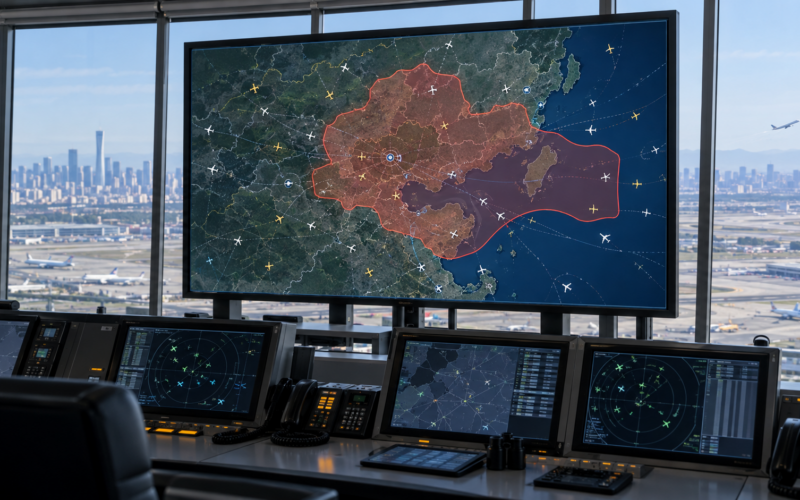
China’s sweeping new airspace security zone around Beijing takes effect on September 20, creating one of the largest permanent restricted-airspace areas surrounding a national capital. The roughly 280,000-square-kilometre Special Restricted Area stretches across Beijing, Tianjin, most of Hebei and portions of Inner Mongolia, Shanxi, Shandong, Liaoning and the Bohai Sea, covering an area comparable in size to Italy. Reuters calculated that roughly 100 million people and dozens of airports and smaller airfields fall inside the zone.
The restriction follows a rare June 26 breach of Beijing’s tightly controlled airspace, when a light sport aircraft deviated from its approved route and struck the 108-storey CITIC Tower in Beijing’s central business district. Chinese authorities said the pilot was killed and 13 other people were injured, while subsequent official reporting said the 66-year-old pilot had repeatedly written about ending his life. The incident exposed an unusual vulnerability in airspace around China’s political centre and prompted a much wider security response than a temporary local flight restriction.
How large is China’s new Beijing Special Restricted Area?
The restricted zone is centred on Beijing and extends roughly 600 kilometres across at its widest span. Unlike the relatively small exclusion areas normally associated with government buildings or temporary major events, this arrangement covers several provinces and municipalities, as well as a section of the Bohai Sea. From ground level upward, unauthorised flight operations are prohibited throughout the designated airspace.
Commercial airline services are exempt, as are approved business flights and authorised military, customs, police, firefighting and rescue operations. Those exceptions mean the measure does not close Beijing’s major commercial airports or prevent scheduled passenger traffic, but it dramatically narrows the space available for private, recreational and general aviation.
The scale makes the policy notable beyond China. Large national capitals frequently maintain protected airspace around sensitive government locations, but establishing a permanent restricted zone across more than a quarter-million square kilometres represents a substantially broader security perimeter.
What requirements apply to aircraft still allowed inside the Beijing zone?
Aircraft permitted to operate inside the zone must follow pre-approved flight plans closely and obtain authorisation before making deviations. Pilots are required to maintain continuous two-way radio contact with air traffic control and aircraft must carry surveillance and identification equipment capable of allowing controllers to track them electronically.
Pilots must also report their security status before entering the controlled area. Together, these provisions effectively create a continuous identification and monitoring regime for aircraft operating across the wider Beijing region.
China already maintains some of the world’s most tightly controlled civilian airspace because the military retains substantial authority over national airspace management. The new rules nevertheless represent an additional layer of control specifically designed around protection of the capital and sensitive infrastructure.
Why did the CITIC Tower crash trigger such a large security response?
The June incident demonstrated that an aircraft operating from a general-aviation facility outside central Beijing could deviate from its authorised area and reach one of the capital’s most prominent structures. CITIC Tower, widely known as China Zun, stands in Beijing’s central business district and is the city’s tallest building.
Authorities said the aircraft lost contact with the suburban general-aviation airport from which it had departed before striking the skyscraper. The fact that the pilot was able to penetrate heavily monitored airspace before the crash raised obvious questions about detection, interception and coordination between civilian and security authorities.
China subsequently announced additional restrictions on drones as well. Reuters reported that Beijing intends to prohibit drone possession, operation and storage throughout the city from November 15, extending the security response from conventional light aircraft into the rapidly expanding unmanned-aircraft market.
Will ordinary airline passengers notice the new Beijing no-fly zone?
Scheduled commercial flights should continue because airlines operating approved routes are explicitly exempt. Beijing Capital International Airport and Beijing Daxing International Airport therefore remain accessible to normal passenger services, although airlines will need to comply with the heightened monitoring regime.
The more immediate consequences fall on general aviation, sightseeing operators, private pilots, recreational flying and other activities that previously operated under more limited approvals. Operators whose routes cross the new restricted area will face significantly tighter planning and authorisation requirements.
The broader policy could also influence China’s still-developing general-aviation sector. Beijing has promoted aviation-related industries and low-altitude commercial applications, but national-security requirements around the capital are now clearly taking precedence over liberalisation.
Could Beijing’s decision influence drone and low-altitude aviation rules elsewhere in China?
China is simultaneously promoting what it describes as a low-altitude economy involving drones, air taxis, logistics aircraft and other emerging aviation technologies. That creates an inherent policy tension between commercial expansion and security control, particularly near major cities and strategic facilities.
The Beijing zone demonstrates how authorities may resolve that tension around sensitive locations. Instead of permitting broad low-altitude access and responding individually to threats, the capital region is moving toward a presumption that unauthorised flight is prohibited unless it falls within an approved category.
Other major Chinese cities may not necessarily replicate a zone of comparable scale, but the policy establishes a significant precedent for using permanent geographic restrictions alongside electronic identification and continuous tracking.
What are the key takeaways from China’s giant Beijing airspace restriction?
The restriction taking effect September 20 is far larger than a conventional city-centre no-fly zone. It covers more than 280,000 square kilometres across Beijing and surrounding areas, while preserving scheduled commercial and explicitly authorised government and business aviation.
The June CITIC Tower crash was the immediate catalyst, but the resulting rules go well beyond preventing a repeat of one incident. They establish a substantially expanded security perimeter in which aircraft identity, route adherence and continuous communications become prerequisites for permitted flight.
What should aviation operators watch after the September 20 rollout?
Implementation will show how aggressively Chinese authorities enforce the boundaries against general aviation and whether additional technical requirements emerge for aircraft operating inside the region. Drone rules scheduled for November will provide the next major test of Beijing’s effort to control increasingly crowded low-altitude airspace.
The wider significance lies in the model China has chosen. As civilian drones, electric air taxis and autonomous aircraft make low-altitude aviation easier and cheaper, governments worldwide will face the same basic question of how much accessible urban airspace can coexist with national-security requirements.
Discover more from Business-News-Today.com
Subscribe to get the latest posts sent to your email.