



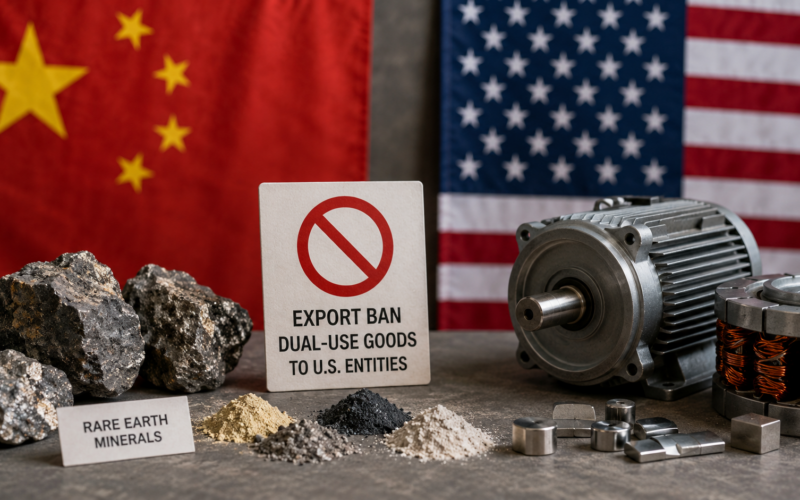
China has imposed an immediate ban on exports of Chinese dual-use goods to 10 United States entities it says are connected to the American military, including rare-earth companies MP Materials Corporation and USA Rare Earth Inc. The June 22, 2026, action also covers Aveox Inc., a manufacturer of high-performance electric motors used in mission-critical applications, alongside seven other organisations identified by Beijing.
The Chinese Ministry of Commerce said companies and individuals anywhere in the world are prohibited from transferring or supplying China-origin dual-use items to the targeted entities. The decision converts earlier licensing requirements into a full prohibition, potentially affecting direct shipments, intermediaries and international suppliers using Chinese components or materials.
China separately excluded 46 United States companies from its procurement market, preventing relevant Chinese buyers from purchasing products manufactured by those businesses. United States-funded enterprises operating inside China are exempt from that procurement restriction, indicating that Beijing has designed the measure to punish named companies without imposing a blanket prohibition on all American commercial activity.
The action is retaliation for the United States placing Alibaba Group Holding Limited, Baidu Inc., BYD Company Limited, NIO Inc. and other major Chinese companies on a Pentagon list of businesses Washington believes assist China’s military. The escalation moves the bilateral conflict deeper into rare earths, permanent magnets, defence manufacturing and the industrial supply chains both governments consider essential to national security.
What exactly has China prohibited under the June 22 export-control measures?
The Ministry of Commerce added 10 United States entities to China’s export-control list for dual-use items. Dual-use products are goods, software, technology or materials that can support ordinary commercial operations but also have potential military, aerospace, intelligence or security applications.
Chinese exporters must immediately stop supplying controlled dual-use products to the listed companies. The measure also prohibits organisations and individuals outside China from transferring China-origin controlled items to the targeted entities, expanding the practical reach of the decision beyond direct trade between China and the United States.
This distinction is important because the affected companies may not buy every component or material directly from a Chinese supplier. They may use international distributors, equipment manufacturers or processing partners whose products contain controlled Chinese technology or inputs.
The previous rules generally required exporters to obtain licences before completing sensitive transactions. Moving from licensing to a full ban removes the possibility that a supplier could secure approval by providing end-user documents or demonstrating an apparently civilian purpose.
Companies throughout the supply chain will now need to verify whether their products contain controlled Chinese-origin content before supplying the named entities. The compliance burden could extend to equipment, specialised metals, magnets, electronic components, production machinery and technical services, depending on the detailed classifications applied by Chinese authorities.

Why were MP Materials and USA Rare Earth particularly important targets for Beijing?
MP Materials Corporation, listed on the New York Stock Exchange under the ticker MP, operates the Mountain Pass mine and processing complex in California. It describes itself as the only fully integrated United States rare-earth producer, with operations extending from mining and separation to metal and permanent-magnet manufacturing.
Mountain Pass is the only active rare-earth mine of significant scale in the United States. MP Materials has also developed magnet-production capabilities in Texas as Washington attempts to rebuild a domestic industry that can supply defence systems, electric vehicles, robotics, electronics and industrial equipment.
The United States government has provided substantial strategic support to MP Materials. The company’s expansion is central to Washington’s objective of producing rare-earth magnets without relying on Chinese mining, processing or manufacturing capacity.
USA Rare Earth Inc., listed on Nasdaq under the ticker USAR, is constructing a mine-to-magnet platform involving resources, separation, metal and alloy production, and permanent-magnet manufacturing. Its projects include the Round Top deposit in Texas and magnet-production capacity in Stillwater, Oklahoma.
USA Rare Earth announced proposed access to approximately $1.6 billion in United States government funding in January 2026, including potential grants and a secured loan. Targeting the company therefore sends a message beyond one commercial transaction because it challenges a government-backed attempt to create an alternative to China’s rare-earth dominance.
Beijing has not accused MP Materials or USA Rare Earth of violating Chinese law through a specific transaction. It has placed them on the list because it considers them connected to the United States military and national-security system.
Could China’s ban slow the United States mine-to-magnet strategy despite domestic mines?
Mining rare-earth ore is only the first stage in a complex industrial chain. Producers must separate individual elements, convert them into metals and alloys, manufacture magnetic material, and produce finished magnets that meet demanding technical specifications.
China has developed dominant positions across several of these stages. Its leverage extends beyond raw mineral output to chemical separation, specialised equipment, technical expertise, magnet manufacturing and the supply of supporting components.
MP Materials and USA Rare Earth are specifically attempting to close these gaps by developing integrated operations outside China. Their business models are intended to reduce Chinese dependence rather than continue relying indefinitely on Chinese inputs.
That strategy does not guarantee complete insulation from the new restrictions. Equipment suppliers and subcontractors may still use Chinese-origin electronics, tools, chemicals, metals or controlled technology, even when the final product is manufactured in the United States or Europe.
The immediate commercial impact cannot be determined until the companies and their suppliers complete detailed exposure reviews. Neither MP Materials, USA Rare Earth nor Aveox had issued a substantive public response when the Chinese decision was first announced.
The action may also create delays rather than permanent shortages. Companies can redesign supply chains, seek alternative components or increase inventories, but qualification and testing can take months when products must meet aerospace or military standards.
Why are rare-earth magnets critical to United States defence and advanced technology?
Rare-earth elements are used to manufacture powerful permanent magnets capable of maintaining performance under demanding conditions. These magnets are essential to electric motors, generators, guidance systems, sensors, actuators and precision-control equipment.
Defence applications can include fighter aircraft, missiles, drones, satellites, radar systems, submarines, naval vessels and air-defence platforms. Samarium-cobalt magnets are particularly valuable in high-temperature aerospace and military environments, while neodymium-iron-boron magnets are widely used in compact, high-performance motors.
Commercial demand is similarly broad. Electric vehicles, wind turbines, industrial robots, hard drives, medical-imaging equipment, consumer electronics and data-centre cooling systems all depend on specialised magnetic materials.
The United States Department of Defense faces restrictions from January 2027 on procuring certain rare-earth magnets sourced from China, Russia, Iran or North Korea. Domestic producers are therefore under pressure to establish reliable output before the sourcing restrictions take full effect.
China’s measure targets companies attempting to satisfy that requirement. The action may not stop United States production, but it could increase development costs and expose parts of the supply chain that remain indirectly dependent on Chinese products.
This is why rare-earth controls have become a powerful geopolitical instrument. A country can possess significant mineral deposits but remain vulnerable when it lacks the processing, alloying and manufacturing capabilities required to turn those deposits into usable components.
How does Beijing’s action respond to the Pentagon’s expanded Chinese military-company list?
The United States Department of Defense expanded its Section 1260H list in June by adding prominent Chinese companies including Alibaba, Baidu, BYD and NIO. Washington says listed companies contribute directly or indirectly to China’s military-industrial system.
The designation does not automatically prohibit every American company or consumer from conducting business with a listed Chinese company. Its immediate effect includes restrictions on United States defence procurement and heightened reputational, regulatory and investment scrutiny.
The targeted Chinese companies reject Washington’s allegations. Several have said they operate as civilian commercial businesses and have no improper connection with the People’s Liberation Army.
China described the Pentagon’s action as a malicious use of national-security policy to suppress Chinese companies. Its June 22 response applies a similar principle in reverse by declaring selected United States companies too closely connected to military activity to receive Chinese controlled goods.
The two governments are effectively building parallel corporate blacklists. Each side argues that its own restrictions protect national security while describing the other government’s measures as discriminatory, politically motivated and economically coercive.
This reciprocal approach increases uncertainty for multinational companies. A supplier may comply with United States restrictions and face retaliation in China, while compliance with Chinese requirements may create legal or political problems in the United States.
What does China’s separate procurement ban against 46 American companies mean?
China’s Finance Ministry introduced a second measure covering 46 United States companies. Relevant Chinese buyers are prohibited from purchasing products manufactured by the named businesses through the affected procurement system.
The procurement ban differs from the dual-use export prohibition. The export action restricts what the 10 targeted companies can receive from China, while the procurement measure restricts their ability to sell specified products into the Chinese market.
Companies exposed to Chinese government, public-sector or state-linked procurement could lose access to contracts or tenders. The practical financial impact will vary because some affected businesses may have significant Chinese revenue, while others may primarily serve United States defence customers and conduct limited commercial activity in China.
The exemption for United States-funded enterprises operating within China is notable. It suggests Beijing wants to preserve selected domestic investment and employment while directing retaliation towards named corporate entities.
China may also be attempting to prevent an uncontrolled withdrawal by foreign investors. A broader prohibition affecting every American-funded company could damage Chinese supply chains, employment and business confidence at a time when Beijing is seeking to support domestic economic growth.
The combination of export restrictions and procurement exclusions gives China pressure at both ends of commercial activity. It can restrict access to strategic inputs while simultaneously reducing market access for targeted foreign suppliers.
Does the escalation undermine the trade understanding between Donald Trump and Xi Jinping?
Donald Trump and Chinese President Xi Jinping reached a temporary trade understanding in 2025 that was expected to reduce restrictions affecting critical-mineral supplies. However, United States businesses have continued reporting licensing delays and difficulty obtaining strategically important materials from China.
The United States-China Business Council said in June that several critical minerals remained nearly unobtainable. Among affected companies surveyed by the organisation, 29 percent were actively shifting towards non-Chinese suppliers and another 47 percent were searching for alternatives.
The new corporate bans show that the earlier understanding did not remove critical minerals from the strategic competition. China has retained the ability to target individual businesses, sectors or countries when it believes its security or diplomatic interests are threatened.
Washington is also continuing to expand restrictions involving Chinese companies, artificial intelligence, semiconductors, biotechnology, robotics and electric vehicles. The trade relationship is therefore operating under a fragile truce rather than a durable settlement.
Donald Trump and Xi Jinping may still seek to prevent the dispute from escalating into broad tariffs or a complete commercial rupture. However, both governments increasingly treat technology and industrial supply chains as security assets rather than ordinary areas of trade.
The risk is a cycle in which each new blacklist produces a retaliatory list. This can gradually separate supply chains even when the two leaders continue describing the wider economic relationship as stable.
How are the Group of Seven countries responding to China’s critical-mineral leverage?
Group of Seven leaders recently agreed to strengthen coordination on critical minerals, stockpiling and alternative supply chains. Their stated objective is to reduce dependence on any single external supplier for rare earths and permanent magnets to below 60 percent by 2030, with an eventual target of 50 percent.
China criticised the initiative as an attempt to form exclusive economic groupings and undermine international trade. Beijing maintains that its controls are consistent with international practice and are intended to fulfil national-security and non-proliferation obligations.
Western governments argue that dependence on one dominant supplier creates an unacceptable vulnerability. Earlier Chinese restrictions disrupted automotive, defence and electronics supply chains and demonstrated that comparatively small volumes of specialised material can affect large industrial sectors.
Diversification will require new mines, processing plants, magnet factories, recycling systems and long-term purchasing agreements. These projects are expensive, technically complex and often face environmental or permitting challenges.
Australia, Canada, the United States and several European countries possess rare-earth resources, while Japan has invested heavily in alternative processing and magnet supply. Building a complete non-Chinese system will nevertheless take years rather than months.
China’s June 22 decision may accelerate these investments. It also demonstrates that diversification efforts themselves can become targets when Beijing believes they are connected to military containment.
What should companies and governments watch after China’s latest retaliation?
The first issue will be the publication and interpretation of the complete lists of 10 export-control targets and 46 procurement targets. Companies must determine whether subsidiaries, affiliates, intermediaries or joint ventures are included.
The second will involve enforcement. Chinese authorities may investigate attempted transshipment, revoke exporter privileges or penalise suppliers that continue serving prohibited entities through third countries.
The third will be the response from MP Materials, USA Rare Earth and Aveox. Their statements may clarify whether they currently use Chinese-origin equipment, technology, materials or components affected by the ban.
The fourth will be Washington’s reaction. The Trump administration could add more Chinese companies to federal restriction lists, impose additional export controls or accelerate financial support for domestic critical-mineral projects.
The fifth will be allied coordination. Japan, Australia, Canada and European governments may increase stockpiling and joint investment if they conclude that company-specific Chinese restrictions will become a recurring feature of geopolitical disputes.
The longer-term question is whether both governments can establish limits around economic retaliation. Without such limits, rare earths, semiconductors, artificial intelligence, electric vehicles and defence manufacturing could become part of a steadily expanding system of reciprocal exclusion.
What are the key takeaways from China’s action against United States companies?
- China imposed a full ban on China-origin dual-use exports to 10 United States entities on June 22, 2026, replacing the previous system under which exporters could seek licences for sensitive transactions.
- MP Materials Corporation, USA Rare Earth Inc. and Aveox Inc. were among the named targets, placing direct pressure on companies involved in rare-earth production, permanent magnets and mission-critical electric-motor technology.
- China prohibited organisations and individuals in any country from transferring controlled Chinese-origin items to the listed entities, potentially affecting international intermediaries and suppliers rather than only direct Chinese exporters.
- A separate Finance Ministry action excluded 46 United States companies from the affected Chinese procurement market, although United States-funded enterprises operating within China were exempted from that restriction.
- Beijing said the measures retaliate against Washington’s decision to place Alibaba Group Holding, Baidu, BYD, NIO and other Chinese companies on a Pentagon list of businesses allegedly supporting China’s military.
- MP Materials operates the only active rare-earth mine of significant scale in the United States, while USA Rare Earth is developing an integrated mine-to-magnet system backed by proposed federal funding.
- The immediate business impact remains uncertain because the affected companies are designed to reduce reliance on China, but equipment, subcontractors and indirect supply chains may still contain controlled Chinese materials or technology.
- The escalation demonstrates that critical minerals are becoming a central instrument of United States-China competition, increasing pressure on Western governments to accelerate mining, processing, recycling and permanent-magnet production outside China.
Discover more from Business-News-Today.com
Subscribe to get the latest posts sent to your email.