

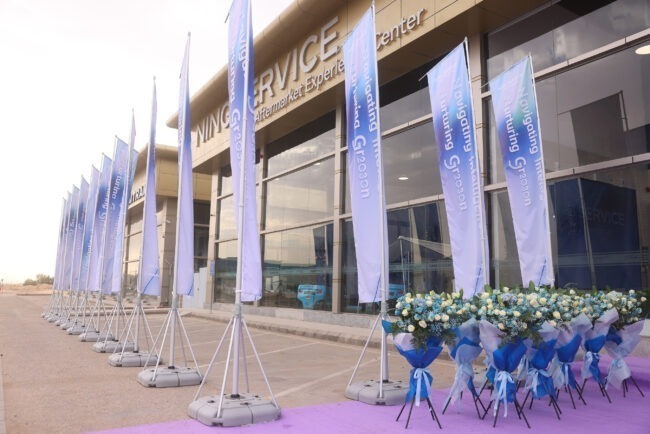
Contemporary Amperex Technology Co., Limited (CATL) has opened its first NING SERVICE Experience Center in the Middle East, located in Riyadh, Saudi Arabia. The facility, at over 7,000 square meters, is currently the largest new energy aftermarket operation outside China and is positioned as both a full-lifecycle service center and regional industrial ecosystem hub. The launch is directly aligned with Saudi Arabia’s Vision 2030 electrification goals and broader regional decarbonization efforts.
This is not just a physical footprint. CATL is signaling a long-term play to embed its services, training systems, and logistics infrastructure within a region historically dominated by fossil fuel value chains. The question is whether this move marks a turning point in the region’s readiness to scale new energy services or whether infrastructure bottlenecks and execution risks still outweigh the momentum.
How does CATL’s Riyadh aftermarket center fit into the Middle East’s electrification roadmap?
Saudi Arabia’s ambitious target to convert 30 percent of all vehicles in Riyadh to electric by 2030 is not just a headline—it is part of a systemic overhaul under Vision 2030. But while policy incentives, national programs like the Saudi Green Initiative, and high-level decarbonization targets are gaining traction, the supporting physical and service infrastructure remains shallow. Charging networks are limited, grid stress is rising, and climate-adapted service facilities are rare.
CATL’s new Riyadh center tackles precisely these pain points. Beyond servicing electric vehicles, it also covers energy storage systems, commercial fleets, and equipment categories like electric forklifts, which are being promoted under sustainability policies. The center houses diagnostic, maintenance, and refurbishment zones; training areas; aftermarket logistics support; and customer experience sections. This blend of functional zones signals a readiness to support not just CATL battery owners but regional integrators and logistics operators transitioning to electrified assets.
From an operational standpoint, the ability to perform battery-level diagnostics, repairs, and lifecycle assessments locally could reduce dependency on China-based workflows and significantly cut downtime for fleet operators. In a region that faces harsh operating conditions such as intense heat, dust, and grid volatility, CATL’s service localization could enhance real-world asset performance and accelerate adoption rates for battery-electric and hybrid systems.
Is this an aftermarket play, or a supply chain anchor for CATL’s deeper Middle East ambitions?
The aftermarket positioning is only part of the strategic calculus. CATL is effectively laying the groundwork for regional supply chain stickiness. By embedding its NING SERVICE framework, which includes training, warehousing, and recycling, CATL is building a foundation that could later support assembly, local integration, or even module-level manufacturing, depending on partner interest and future policy shifts.
CATL executives made clear that the Riyadh center is intended as a regional ecosystem hub, not a standalone facility. It links to CATL’s global service footprint spanning 76 countries and supports more than 6 million EVs to date. With 1,200+ professional service locations and 73 global parts warehouses, CATL is leveraging a formidable global backbone to ensure parts availability and standardized workflows, which are often cited as constraints in emerging markets.
Crucially, the company is also advancing local partnerships. Early-stage engagements with infrastructure firms, energy developers, and fuel station operators indicate that CATL is not simply reacting to demand but actively shaping it. For example, discussions with gas station networks to deploy solar-plus-storage systems and with fleet electrification partners highlight how CATL is leaning into energy infrastructure as well as mobility.
What are the competitive and industrial implications for local players and global OEMs?
The most immediate effect of CATL’s Riyadh center may be on the expectations it sets across the regional new energy value chain. While most EV and battery original equipment manufacturers have focused on front-end distribution and pilot projects, CATL is putting capital behind backend reliability through after-sales support, diagnostics, and asset lifecycle assurance.
For local players, including Saudi-based fleet operators, energy developers, and oil companies exploring diversification, this creates a new benchmark. The availability of high-quality, locally delivered battery services could accelerate procurement timelines and reduce perceived operational risks, particularly for commercial buyers. The move also increases pressure on global battery suppliers that lack a physical support footprint in the region.
On the EV OEM side, this raises the bar for companies like Tesla, Lucid, and BYD in terms of aftermarket readiness. Many EV OEMs entering the Middle East have focused on showroom presence and retail brand building, while service networks often lag. CATL’s model integrates service as a business asset, not a cost center, and that positioning could become a key differentiator in government tenders, fleet conversions, and utility-scale storage contracts.
Can talent development and localization efforts offset geopolitical and execution risks?
CATL’s localization strategy is central to both its ESG narrative and its operational viability in the Middle East. The company operates 10 global NING SERVICE training centers and has already certified over 9,700 after-sales professionals. The Riyadh center adds to this footprint and is intended to catalyze local workforce development, with vocational training and partnerships to develop battery maintenance and service skills.
This is especially relevant in the Gulf context, where labor nationalization policies like Saudi Arabia’s “Nitaqat” program prioritize domestic employment. CATL’s emphasis on local capability building aligns with national labor goals and could smooth regulatory engagement. However, it will need to demonstrate consistency, especially as battery technologies and service protocols evolve rapidly.
On the geopolitical front, operating in a region subject to energy volatility, regulatory flux, and diplomatic uncertainty carries clear risks. Yet CATL’s move can also be read as a hedge, offering a way to gain operational footholds outside the core China, Europe, and United States trade corridors. By embedding itself into Saudi Arabia’s transition story early, CATL could shape future market standards and secure influence that extends beyond simple product sales.
What does this signal for Saudi Arabia’s energy transition credibility and ecosystem maturity?
The presence of a globally dominant battery player like CATL with end-to-end service infrastructure signals growing credibility for Saudi Arabia’s energy transition roadmap. It validates the seriousness of local electrification efforts and signals to investors and OEMs that technical reliability is catching up with ambition.
It also complements moves by other global players, including Lucid Group’s manufacturing presence, ABB’s industrial electrification push, and Huawei’s solar-plus-storage projects, all of which aim to operationalize clean energy transitions in the Kingdom.
Still, the biggest unanswered question is whether the Riyadh center will function as a regional accelerator or remain an isolated showcase. CATL’s commitment to ecosystem partnerships, service scale-up, and localization will determine whether this is the beginning of a regional aftermarket transformation or simply a strategic outpost with limited multiplier effect.
Key takeaways: What does CATL’s Riyadh facility mean for the Middle East’s clean energy shift?
- Contemporary Amperex Technology Co., Limited has opened the largest new energy aftermarket facility outside China in Riyadh, Saudi Arabia, under its NING SERVICE brand.
- The center provides full-lifecycle services across EVs, energy storage, and electrified equipment, targeting both service reliability and downstream asset value.
- CATL is integrating technical diagnostics, repair, refurbishment, logistics, and workforce training into a single facility, signaling a systemic ecosystem play.
- Local partnerships with energy providers, fuel station operators, and infrastructure firms hint at broader ambitions beyond aftermarket support.
- The move raises competitive pressure on EV OEMs and battery suppliers with limited local support presence in the Middle East.
- Workforce development and localization strategies align with national employment policies, but execution consistency remains critical.
- CATL’s investment reinforces Saudi Arabia’s clean energy transition credibility while hedging geopolitical supply chain concentration.
- The facility could serve as a launchpad for scaled deployment of solar-plus-storage and electrified logistics across the Gulf region.
Discover more from Business-News-Today.com
Subscribe to get the latest posts sent to your email.