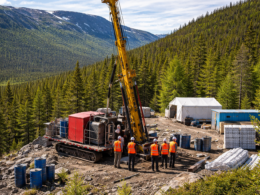



Cassius Mining Limited (ASX: CMD) has secured firm commitments for 101.25 million new ordinary shares at A$0.02 each, raising A$2.025 million before costs from professional and sophisticated investors. The placement price represents a 16.67% discount to Cassius Mining’s A$0.024 closing price on August 7 and a 24.81% discount to its 15-day volume-weighted average price of A$0.0266. The company intends to use the proceeds across the Soalara Limestone Project, its Ghana arbitration and general working capital, creating a financing bridge across two very different potential sources of future value. The central question is therefore not simply whether Cassius has raised enough cash, but whether the additional capital can move Soalara materially closer to development while legal expenditure begins to moderate following the arbitration hearing.
The placement also arrives against a demanding financial backdrop. Cassius finished June 2026 with A$2.659 million in cash after recording A$2.956 million of net operating cash outflow during the quarter, resulting in an estimated 0.90 quarters of available funding under its Appendix 5B calculation. That expenditure was unusually influenced by legal and other costs associated with the Ghana arbitration, according to Cassius, meaning the June-quarter burn rate should not automatically be treated as a steady-state forecast. Even so, the latest placement materially strengthens near-term liquidity at a point when funding flexibility had become a measurable issue rather than an abstract future consideration.
The market has not treated that strengthened liquidity as an unqualified positive. Cassius Mining shares were trading at A$0.021 on August 12, down 12.5% from the previous A$0.024 close, with the stock down 22.22% over five days and 27.59% over one month. The shares were sitting only marginally above their A$0.020 52-week low and approximately 59% below the A$0.051 52-week high, although trading volume remained relatively light at the time of the market check. The post-announcement price has effectively compressed most of the placement discount, with A$0.020 now only about 4.8% below the A$0.021 traded price.
How much financial runway does the A$2.025 million Cassius Mining placement actually provide?
The most revealing comparison is between the size of the raise and Cassius Mining’s recent cash consumption. The A$2.025 million gross placement is equivalent to about 76% of the A$2.659 million cash balance reported on June 30 and approximately 68.5% of the A$2.956 million operating cash outflow recorded during the June quarter. Those ratios show that the financing is meaningful for a company of Cassius Mining’s size, but it is not large enough to remove capital requirements from the investment case.
A simple sensitivity illustrates the point. Adding the gross A$2.025 million placement proceeds to the June 30 cash balance produces A$4.684 million before allowing for subsequent cash movements, placement costs or expenditure since quarter-end. If the unusually high June-quarter operating outflow of A$2.956 million were repeated, that theoretical pool would represent roughly 1.58 quarters of funding. That is not a forecast of Cassius Mining’s actual runway, because the company specifically identified Ghana arbitration expenditure as a contributor to the June-quarter overhead burden and the cash position has changed since June 30, but it demonstrates why cost normalisation matters almost as much as the headline amount raised.
The financing should therefore be viewed as a bridge rather than a balance-sheet transformation. Cassius already raised A$5 million through secured convertible notes during the June quarter, with A$4.95 million of convertible-note facilities remaining drawn at June 30. The latest equity placement adds cash without increasing that debt-like funding exposure, but shareholders now need to assess the additional ordinary-share dilution alongside the existing convertible securities and options already embedded in the capital structure.
This is where the next several months become important. If legal expenditure declines after the post-hearing phase of the Ghana proceedings, a greater proportion of available capital could theoretically be redirected towards Soalara planning, partner engagement and development studies. Conversely, if arbitration expenditure remains elevated while Soalara requires increasingly detailed engineering, environmental, infrastructure and commercial work, another financing requirement could emerge before either workstream produces a decisive value-creating event.
How much dilution could Cassius Mining shareholders face from the placement and attaching options?
Cassius Mining is issuing 101.25 million placement shares, with another two million ordinary shares to be issued to advisers connected with the capital raising. Against approximately 752.99 million shares outstanding before the placement, that would lift the ordinary share count to roughly 856.24 million, assuming no other changes before allotment. On that basis, the placement and adviser shares represent approximately a 13.7% increase in the ordinary share count and reduce the proportional ownership of pre-placement shareholders by around 12.1%.
That is only the first layer of the capital structure. Subject to shareholder approval at an upcoming general meeting, placement investors will also receive one free attaching listed CMDO option for every placement share, creating another 101.25 million potential options with an A$0.03 exercise price and June 8, 2029 expiry. If every new placement option were eventually exercised, Cassius could receive about A$3.04 million in additional cash, but another 101.25 million ordinary shares would also be created.
The distinction between potential and immediate dilution is important. The options do not become ordinary shares simply because they are issued, and their A$0.03 exercise price currently sits around 43% above the A$0.021 market price. Their future funding value therefore depends partly on Cassius creating sufficient operating, project or legal catalysts to support a substantially higher share price before expiry.
The new securities also join an already option-rich structure. Cassius issued approximately 93.39 million loyalty options during June with the same A$0.03 exercise price and June 2029 expiry, while noteholders also received option entitlements under the earlier convertible-note funding arrangement. That provides the company with potential future sources of exercise proceeds if the share price strengthens, but it also means investors should analyse Cassius on a fully diluted basis rather than relying exclusively on the current ordinary share count.
Can the Soalara Limestone Project turn Cassius Mining’s new capital into a commercial development pathway?
For the placement to do more than extend financial flexibility, investors will eventually need to see measurable commercial progress at Soalara. Cassius has concentrated its project portfolio around the Madagascar limestone asset after relinquishing two Chenene lithium exploration licences in Tanzania during the June quarter, making Soalara increasingly central to the company’s operating strategy.
The project contains a reported JORC 2012 Mineral Resource Estimate of 340 million to 440 million tonnes at approximately 97% limestone purity, including higher-purity material depending on the selected cut-off and mining approach. The deposit sits near Soalara township and approximately 28 kilometres from Toliara port, with Cassius evaluating mine configuration, processing, infrastructure, power, water and logistics requirements. The company was also continuing discussions with existing and prospective joint-venture partners during the June quarter.
Those partner discussions may prove more strategically important than incremental technical work alone. Cassius is a small-cap company attempting to advance a potentially large industrial-minerals resource, and development economics could eventually require capital far beyond what can be efficiently supplied through repeated small equity placements. A credible joint-venture arrangement, offtake-backed structure or other third-party development model could reduce the amount of project capital Cassius itself needs to provide.
The project’s commercial proposition will ultimately depend on more than resource scale. Cassius has highlighted Madagascar’s domestic cement market as an initial demand opportunity while retaining the possibility of international sales, but transport economics, product specification, mine throughput, infrastructure investment, environmental approvals and customer commitments will determine whether the resource can translate into an attractive operating business. The next important step is therefore not simply another resource statement. Investors need evidence that project planning is converging towards an executable commercial configuration.
Why does the Ghana arbitration remain important to Cassius Mining’s funding strategy?
The Ghana arbitration occupies an unusual position in the Cassius Mining investment case because it is both a potential source of future value and a current consumer of cash. Cassius commenced international arbitration through its wholly owned Ghanaian subsidiary in February 2023, and the in-person hearing was held at the Peace Palace in The Hague from June 15 to June 19, 2026.
The proceedings remain unresolved. Post-hearing briefs are due on August 14, with reply briefs scheduled for September 18, after which the tribunal may request oral closing submissions before retiring to consider its decision. Neither the existence of the arbitration nor completion of the hearing establishes that Cassius will obtain an award, and any potential value should therefore remain separate from the company’s current balance-sheet assessment.
From a capital-allocation perspective, however, the approaching end of the active hearing and briefing phase matters. Cassius reported A$2.202 million of administration and corporate costs during the June quarter, with the company explaining that corporate overheads included legal and other expenditure connected with the Ghana proceedings. If those costs decline materially once submissions are completed, the placement could support a longer effective runway than a simple extrapolation of the June quarter suggests.
That creates an important test for subsequent quarterly cash-flow reports. A clear reduction in corporate and arbitration-related expenditure, combined with continued Soalara advancement, would indicate that the company is beginning to convert financing into a more development-focused spending profile. Persistently high cash consumption without a corresponding project milestone would instead increase the likelihood that further capital raising remains part of the medium-term funding equation.
What does Cassius Mining’s falling share price say about sentiment after the capital raise?
The market reaction suggests that investors are weighing improved liquidity against the price and structure of that liquidity. At A$0.021, Cassius Mining was down 12.5% during the August 12 session and was trading close to the placement price after returning from the capital-raising halt. Five-day and one-month performance were negative, while the stock remained near the bottom of its A$0.020 to A$0.051 52-week trading range.
It would be premature to infer a definitive investor verdict from that move because the reported trading volume remained well below Cassius Mining’s longer-term daily average. Small-cap resources stocks can move sharply when liquidity is thin, and a single session provides limited information about durable institutional or retail positioning. What can be said is that the market has repriced the equity much closer to the A$0.020 placement price, substantially reducing the discount available to participants compared with the pre-halt close.
Using the approximately 752.99 million reported shares outstanding and the A$0.021 traded price gives an indicative pre-placement equity value of about A$15.8 million. Against that figure, the A$2.025 million raise is equivalent to roughly 12.8% of the company’s current undiluted equity value, highlighting how significant the financing is relative to Cassius Mining’s present scale. The same calculation also explains why dilution matters: a relatively modest absolute capital raise represents a meaningful percentage of the company’s market value.
What are the key takeaways from Cassius Mining’s A$2.025 million capital raising?
- Cassius Mining has secured A$2.025 million through 101.25 million new shares priced at A$0.02 each.
- The placement price represented a 16.67% discount to the August 7 closing price and a 24.81% discount to the 15-day VWAP.
- Cassius plans to deploy the proceeds across the Soalara Limestone Project, Ghana arbitration proceedings and general working capital.
- The company reported A$2.659 million in cash at June 30 after A$2.956 million of June-quarter operating cash outflow.
- Cassius reported only 0.90 quarters of funding at the June-quarter spending rate, although arbitration costs contributed to elevated expenditure.
- The placement and two million adviser shares could expand the existing ordinary share count by approximately 13.7%.
- Placement investors may receive 101.25 million attaching options at A$0.03, subject to shareholder approval.
- The Soalara project contains a reported 340 million to 440 million tonne JORC resource at approximately 97% limestone purity and remains the company’s principal development focus.
- Ghana arbitration post-hearing briefs are due on August 14, followed by reply briefs on September 18.
- Cassius Mining shares were trading at A$0.021 on August 12, down 12.5% for the session and close to the placement price.
What will determine whether the Cassius Mining capital raise creates lasting shareholder value?
Cassius Mining has solved an immediate financing problem, but the A$2.025 million placement does not remove financing from the company’s strategic equation. It provides additional liquidity at an important point in the Ghana arbitration process and allows Cassius to continue advancing Soalara, while the equity structure avoids adding another layer of borrowings to the balance sheet. The trade-off is a larger share base, additional potential option dilution and a market price that has already moved substantially closer to the placement level.
The strongest evidence of progress would now be a combination of lower corporate cash burn, a clearly defined commercial development pathway for Soalara and tangible progress with prospective project partners. Any material reduction in arbitration expenditure could make the new capital work harder, while a credible joint-venture or commercial arrangement at Soalara could reduce Cassius Mining’s dependence on recurring equity issuance.
The weaker scenario would be one in which cash expenditure remains elevated while neither workstream reaches a measurable milestone. Cassius does not need every strategic uncertainty resolved immediately, but the next quarterly cash-flow statement should reveal whether the financing has changed the company’s trajectory or merely reset the funding clock. For shareholders, that cash conversion test is now more important than the headline size of the placement itself.
Discover more from Business-News-Today.com
Subscribe to get the latest posts sent to your email.