


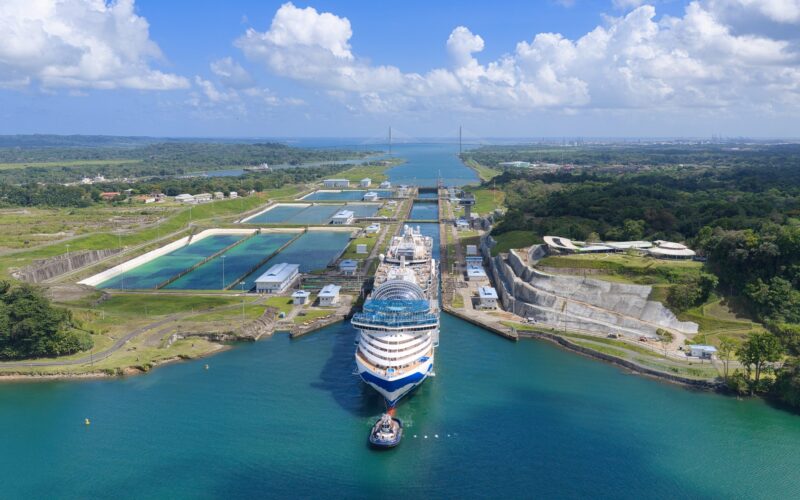
Carnival Corporation & plc (NYSE: CCL; NYSE: CUK) has used Princess Cruises’ newest ship, Star Princess, to complete its first Panama Canal transit, turning what might look like a travel-marketing moment into a useful signal about fleet deployment, itinerary economics, and brand positioning. The crossing comes during Star Princess’ inaugural season and reinforces Princess Cruises’ long-running association with canal voyages. For Carnival Corporation, the move matters because premium destination positioning remains one of the cleaner ways to defend pricing without relying only on discount-led volume. Carnival shares were trading around $28.80 on April 20, 2026, below the stock’s 52-week high of $34.03 but above its March 20 close of $24.12, suggesting investors are still giving the company credit for recovery execution even as cruise names remain sensitive to fuel, macro, and discretionary-spending risk.
Why does Star Princess’ first Panama Canal transit matter beyond a routine cruise itinerary milestone?
On the surface, a first canal crossing is a neat ceremonial event. In practice, it is a strategic branding tool. The Panama Canal remains one of the few cruise itineraries that blends bucket-list appeal, itinerary scarcity, and a high level of built-in guest engagement. That combination matters because it helps cruise operators justify premium pricing through experience design rather than just cabin inventory management. When a new ship makes that passage early in its life, the operator is effectively telling the market that the vessel is not merely a floating hotel, but a destination asset being inserted into one of cruising’s most defensible route categories.
For Princess Cruises, this is especially on-brand. The company has deep historical equity in canal itineraries, with official Princess material stating that Princess Italia first passed through the canal in 1967 and that the line pioneered regularly scheduled Panama Canal cruising in that era. That heritage gives Princess Cruises something many travel brands struggle to build, namely, a believable claim to category leadership that is not entirely invented by a marketing department over coffee and adjectives. In a sector where multiple operators sell similar sun-and-sea narratives, heritage-linked itineraries still carry differentiation power.
The transit also gives Princess Cruises a content engine. Canal crossings are naturally rich in onboard programming, destination storytelling, visual spectacle, and social media shareability. Those are not soft extras. They directly support onboard spend, guest satisfaction, and brand recall, all of which influence repeat booking behavior in a business where customer acquisition costs matter more than cruise brochures would like to admit.

How does deploying Star Princess in canal-linked cruising support Princess Cruises’ premium growth strategy?
Star Princess is a large, 177,800-ton Sphere Class vessel carrying about 4,300 guests, and Princess Cruises launched it in October 2025 as the sister ship to Sun Princess. That scale matters because it shows Princess Cruises is willing to pair one of its newest, highest-profile hardware assets with a route that historically attracts destination-focused travelers rather than purely resort-at-sea demand. This is not just about filling berths. It is about showing that newbuild investment can be monetized through itinerary prestige as well as onboard amenities.
There is also a portfolio logic here. Carnival Corporation owns a wide range of cruise brands, each with different customer profiles and deployment priorities. Princess Cruises sits in a more premium-leaning lane than the group’s mass-market brands, so using Star Princess in a headline canal moment reinforces that identity. It tells travel advisors, repeat guests, and prospective premium cruisers that Princess Cruises is not surrendering iconic destination leadership while the broader industry pours capital into ever-bigger Caribbean and Mediterranean volume plays.
The company’s disclosed 2026-2027 Panama Canal season also supports that reading. Princess Cruises has said the season will feature six ships, 31 departures, nine itineraries, 13 transits through the historic locks, and 26 transits through the new locks. That breadth suggests the brand is not treating the canal as a niche side show. It is maintaining a scaled product architecture around the destination, which improves itinerary choice, departure flexibility, and distribution appeal across multiple North American embarkation points.
What does this Star Princess canal milestone suggest about Carnival Corporation’s broader commercial discipline in 2026?
Carnival Corporation’s latest reported results showed record first-quarter 2026 operating performance, including net income of $258 million, adjusted net income of $275 million, record adjusted EBITDA of about $1.3 billion, and record bookings, according to the company’s March 27 release. Those numbers matter because they suggest Carnival is still in the phase where careful deployment and revenue quality remain central to the equity story. A milestone like this canal transit fits that discipline. It is brand-building, yes, but it is also capacity placement aimed at sustaining pricing power and deposit momentum.
The market context is helpful here. Carnival shares at roughly $28.80 remain below the 52-week high of $34.03, which indicates investors have not fully erased concerns around fuel costs, consumer resilience, and the broader volatility that travel names face. At the same time, the stock is up materially from the roughly $24.12 close on March 20, 2026, reflecting better sentiment than many deeply cyclical names have enjoyed this year. Inference matters: investors appear willing to reward execution, but they still want proof that demand strength can hold without margin erosion. Premium itinerary messaging helps support that proof point indirectly.
This is where canal cruising becomes more than postcard material. A differentiated voyage can support stronger yields, shore excursion spend, and onboard monetization while also improving the brand halo around a new ship. In other words, the canal is scenery for guests, but yield management with better photography for operators.
What risks and execution questions still matter even if the Star Princess transit is strategically useful?
The first risk is that symbolic milestones do not automatically translate into sustained economics. A successful first transit generates attention, but the real test is whether Princess Cruises can convert that visibility into strong booking curves across the broader canal season. Cruise companies have become better at storytelling, but stories do not pay bunker fuel bills unless they hold pricing.
The second risk is ship-size economics versus itinerary complexity. Large vessels bring operating leverage, but they also require careful itinerary design, port coordination, and guest-flow planning. Canal voyages are operationally distinctive, and travelers book them with high expectations for enrichment, viewing access, and smooth execution. That raises the importance of onboard programming quality and destination delivery. If the experience feels generic, the premium narrative weakens.
The third issue is competitive positioning. Princess Cruises can credibly claim deep canal heritage, but the broader cruise market remains crowded with brands chasing premium guests through newer ships, upgraded suites, and more curated destination experiences. The canal helps Princess Cruises stand out, but not indefinitely on nostalgia alone. The company still needs to show that Star Princess and the wider Panama portfolio deliver a more compelling blend of hardware, service, and itinerary design than competing premium and upper-premium alternatives.
How could Star Princess’ Panama Canal debut shape Princess Cruises’ next phase of destination-led growth?
The strongest takeaway is that Princess Cruises appears to be leaning into destination authority rather than treating new ships purely as onboard entertainment platforms. That matters because the cruise business is entering a phase where hardware alone is less differentiating than it used to be. New restaurants, new atriums, and new cabin categories still help, but iconic routes with strong heritage can do more to protect pricing and reinforce brand identity over time.
It also suggests Carnival Corporation sees continued strategic value in distributing fleet investment across experience tiers and destination categories instead of concentrating the growth narrative in one region. That is a healthier sign than it may seem. A portfolio that can still make money from iconic transit routes, not just short warm-weather turnarounds, is usually one with broader demand resilience. It also gives travel advisors more reasons to sell the brand beyond price promotion.
For Princess Cruises, the canal milestone is therefore not just a commemorative event. It is a statement that Star Princess is being inserted into one of the brand’s most historically resonant and commercially defensible itinerary categories. If Princess Cruises executes well across the 2026-2027 season, this crossing will look less like a one-day headline and more like the opening scene of a broader premium deployment strategy.
What are the key takeaways on what Star Princess’ Panama Canal transit means for Princess Cruises, Carnival Corporation, and the cruise industry?
- Star Princess’ first canal crossing is strategically useful because it supports premium destination-led pricing, not just publicity.
- Princess Cruises is reinforcing a category where it has credible historic leadership dating back to 1967.
- Deploying a flagship new ship on a canal route suggests confidence in itinerary-based demand quality.
- The move helps Princess Cruises differentiate from rivals that rely more heavily on generic large-ship resort positioning.
- Carnival Corporation can use canal-linked premium experiences to support yield discipline while maintaining brand segmentation across its portfolio.
- The disclosed scale of the 2026-2027 canal season shows Princess Cruises still views the destination as commercially important, not symbolic.
- Investors are likely to see this as a small but constructive signal inside a larger recovery story centered on bookings, pricing, and margin control.
- The market still needs proof that demand strength can offset fuel and macro risk, so narrative wins must be backed by operating performance.
- Canal voyages offer unusually strong content, enrichment, and guest-engagement potential, which can support onboard spending and repeat intent.
- If Star Princess performs well in this role, Princess Cruises strengthens its case that destination authority remains a durable edge in premium cruising.
Discover more from Business-News-Today.com
Subscribe to get the latest posts sent to your email.