


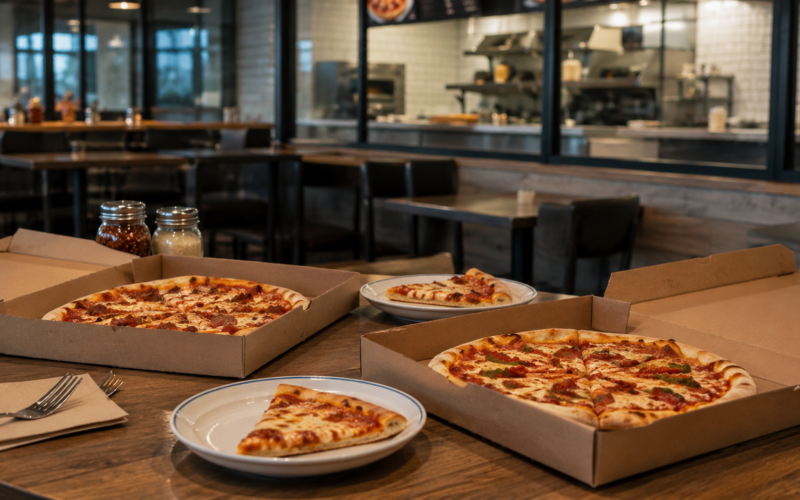
Yum Brands Inc. (NYSE: YUM) is in exclusive talks to sell its Pizza Hut chain to private equity firm LongRange Capital as the restaurant group looks to simplify its portfolio around stronger-performing brands. Reuters reported, citing a source familiar with the matter, that the two sides are advancing discussions and that a potential transaction could be agreed in the coming weeks, although no final deal is guaranteed. The talks follow Yum Brands Inc.’s earlier strategic review of Pizza Hut after years of weaker sales momentum, especially in the United States. Yum Brands Inc. shares last traded at $147.95, giving the company a market capitalization of about $40.78 billion, with investors watching whether a Pizza Hut sale could improve growth quality and capital allocation across Taco Bell, KFC and the remaining Yum Brands Inc. platform.
Why would Yum Brands sell Pizza Hut after building one of the world’s biggest fast-food portfolios?
Yum Brands Inc.’s possible Pizza Hut sale is best understood as a portfolio discipline story rather than a simple brand retreat. The company has spent decades building a global quick-service restaurant portfolio around KFC, Taco Bell and Pizza Hut, with each brand occupying a different consumer occasion. KFC gives Yum Brands Inc. global chicken scale, Taco Bell gives it one of the strongest United States fast-food growth stories, and Pizza Hut gives it a legacy pizza brand with enormous global recognition. The problem is that recognition and momentum are not the same thing.
Pizza Hut has been the weaker part of the Yum Brands Inc. portfolio for years. Reuters reported that Pizza Hut accounted for 12% of Yum Brands Inc.’s revenue in 2025 but had posted declining United States same-store sales for ten consecutive quarters. That underperformance has made Pizza Hut a drag on Yum Brands Inc.’s broader story, especially when Taco Bell has continued to generate stronger demand and KFC remains a major international engine. For investors, a sale would be less about abandoning pizza and more about removing a slower-growth brand from a company that wants to trade on higher-quality growth.
The strategic review announced in 2025 already signalled that Yum Brands Inc. was prepared to consider more radical options. In a highly competitive fast-food market, legacy brands need capital, franchisee alignment, technology investment, marketing reinvention and menu relevance. If Pizza Hut needs a deeper operational turnaround than Yum Brands Inc. wants to fund internally, private equity ownership could provide a more focused reset.
The catch is that Pizza Hut is still a globally recognised name. Selling it would be a major decision, not a tidy housekeeping exercise. Yum Brands Inc. would need to preserve franchise relationships, protect brand value and ensure that any buyer has the capital and operational patience needed to revive performance. Pizza may be simple to order, but fixing a global pizza chain is not exactly extra cheese.
Why would LongRange Capital want Pizza Hut in this consumer environment?
LongRange Capital’s reported interest suggests that private equity still sees value in underperforming restaurant brands with global scale, even when near-term consumer conditions are difficult. Pizza Hut has weaknesses, but it also has assets that are difficult to build from scratch: global brand awareness, thousands of restaurants, franchise infrastructure, delivery relevance, supplier relationships and a long operating history in the pizza category. For a buyer with a turnaround playbook, those assets can be attractive if the entry price is right.
The restaurant industry is facing pressure from inflation, cautious consumers, higher labour costs and shifting demand patterns. Reuters noted that fast-food operators are dealing with weak demand, rising inflation and changing consumer preferences, including the potential impact of GLP-1 weight-loss drugs on eating habits. That may sound like a tough backdrop for buying a pizza chain, but private equity often looks for assets that public companies are tired of defending. LongRange Capital may believe Pizza Hut can perform better with dedicated ownership and a more targeted capital plan.
Private equity buyers can take a different approach from public-company parents. They can close weaker stores, renegotiate franchise arrangements, invest in digital ordering, refresh menus, reset pricing, sell or refranchise markets, and restructure operations away from quarterly investor expectations. If Pizza Hut is struggling because it is trapped inside a broader portfolio with competing capital priorities, dedicated ownership could help.
However, the turnaround would not be easy. Pizza Hut competes against Domino’s Pizza Inc., Papa John’s International Inc., Little Caesars, local pizza restaurants, delivery platforms, frozen pizza, and a vast casual-dining and takeaway universe. The brand’s challenge is not merely ownership. It is relevance, speed, value, product consistency and franchisee economics. LongRange Capital would be buying a famous brand, but also a famous to-do list.
How does a Pizza Hut sale fit Yum Brands’ Taco Bell and KFC growth priorities?
A Pizza Hut sale could make Yum Brands Inc. a cleaner growth story by increasing the relative weight of Taco Bell and KFC. Taco Bell has been one of the strongest performers in the United States fast-food market, with value-led menus, digital engagement, younger consumer relevance and a product format that lends itself to innovation. KFC remains a major international growth platform, with broad brand recognition and strong exposure to emerging markets and global chicken demand.
If Pizza Hut exits the group, Yum Brands Inc. would become more concentrated, but potentially more focused. Investors often reward companies that simplify around their best-performing assets, especially when the divested business has been suppressing consolidated growth. The question is whether Yum Brands Inc. can achieve a valuation benefit from removing Pizza Hut that outweighs the loss of revenue and diversification.
The transaction could also free management attention. Restaurant turnarounds consume time, operational bandwidth and franchisee diplomacy. If Pizza Hut’s underperformance has required increasing internal focus, a sale could allow Yum Brands Inc. to allocate more leadership attention to Taco Bell expansion, KFC market development, digital ordering systems, loyalty programmes, delivery partnerships and franchisee support.
Capital allocation is another factor. Depending on deal structure and proceeds, Yum Brands Inc. could use a sale to reduce debt, repurchase shares, reinvest in technology, support franchisee development or fund international growth. Investors will want clarity on proceeds because the strategic logic of selling Pizza Hut becomes stronger if Yum Brands Inc. can redeploy capital into higher-return opportunities.
What does Yum Brands stock reaction say about investor sentiment?
Yum Brands Inc. stock last traded at $147.95 after touching an intraday high of $153.00, with market capitalization near $40.78 billion. The stock was broadly flat by the latest trade, but Reuters and market reports noted that Yum Brands Inc. shares rose after the Pizza Hut sale talks became public, indicating that investors initially viewed the potential divestiture positively. That reaction makes sense because the market has long seen Pizza Hut as the weaker brand inside the Yum Brands Inc. portfolio.
The stock’s current valuation, with a price-to-earnings ratio near 23.9, suggests that investors still assign Yum Brands Inc. a premium consumer-franchise profile. The key issue is whether a Pizza Hut sale would make that profile cleaner. A company with two stronger engines may be easier to value than a company with three brands where one repeatedly drags on the consolidated story.
Investor sentiment is likely to depend on three variables: sale price, deal structure and retained exposure. If Yum Brands Inc. sells Pizza Hut outright at a strong valuation, the stock could benefit from portfolio simplification. If the company retains some exposure or accepts a complex structure with contingent payments, investors may take a more cautious view. If the sale price is lower than expected, the market could question whether Pizza Hut’s problems are deeper than previously assumed.
The market will also watch whether a sale affects Yum Brands Inc.’s global franchising economics. Pizza Hut may be underperforming in the United States, but it still has international presence and brand value. A clean sale could simplify the story, but Yum Brands Inc. must ensure that the transaction does not create operational disruption or damage franchise relationships in key markets.
Why does Pizza Hut’s underperformance reflect wider fast-food industry pressure?
Pizza Hut’s struggles sit inside a wider fast-food reset. Consumers are more value-sensitive after years of inflation, and quick-service chains are facing pressure to prove that they still offer affordability. Delivery economics have also changed the competitive landscape. Pizza once had a clear delivery advantage, but almost every restaurant category now competes in the delivery channel through apps, aggregators and in-house ordering systems.
That shift has weakened one of Pizza Hut’s historical advantages. When pizza delivery was one of the few convenient food-at-home options, the category had structural strength. Today, consumers can order burgers, chicken, burritos, sushi, salads, groceries or convenience items with similar ease. Pizza brands therefore need sharper value, faster service, stronger digital platforms and clearer product differentiation.
Pizza Hut has also faced intense category competition. Domino’s Pizza Inc. has been especially strong in technology, delivery execution and value messaging. Papa John’s International Inc. has explored its own strategic options. Little Caesars continues to compete aggressively on price. Local pizza operators remain highly relevant in many markets. For Pizza Hut, being famous is not enough when competitors are faster, cheaper or more locally loved.
GLP-1 drugs add another longer-term uncertainty. Reuters noted that changing consumer eating habits linked to weight-loss drugs are becoming part of the fast-food industry discussion. It is too early to say how much these medicines will reshape restaurant demand, but brands associated with indulgent, high-calorie occasions may face more pressure to adapt menus and messaging over time.
What would private equity ownership need to change at Pizza Hut?
Private equity ownership would need to start with franchisee economics. Pizza Hut’s success depends heavily on franchise operators, store-level profitability, delivery efficiency and capital investment willingness. If franchisees are struggling with traffic, labour costs, ingredient inflation or weak unit economics, a new owner must address those fundamentals before expecting brand transformation.
The second priority would be digital ordering and delivery execution. Pizza Hut still has delivery relevance, but the category is now technology-led. Consumers expect fast ordering, accurate timing, loyalty rewards, clear pricing and smooth app experiences. A buyer would need to invest in digital infrastructure without overwhelming franchisees with costs.
The third priority would be brand positioning. Pizza Hut must decide whether it wants to compete primarily on value, nostalgia, family dining, delivery convenience, product innovation or a premiumised pizza experience. Trying to be everything to everyone can make the brand feel blurry. Turnarounds often require narrowing the message before broadening the growth.
The fourth priority would be market structure. Some regions may need refranchising, store closures, remodels, new formats or master franchise agreements. A private equity buyer may be more willing than Yum Brands Inc. to make painful decisions quickly. That could improve long-term economics, but it could also create short-term disruption. The oven may need cleaning before anything rises.
What are the biggest risks if Yum Brands sells Pizza Hut?
The first risk is deal failure. Reuters reported that the discussions are exclusive and advancing, but there is no guarantee that a transaction will be reached. If talks collapse, Yum Brands Inc. would still need to explain how it plans to fix Pizza Hut after signalling that a sale was possible. That could increase investor pressure on management.
The second risk is valuation disappointment. If the market expects a strong sale price and the final valuation is modest, Yum Brands Inc. shareholders may question how much value Pizza Hut actually retains. A low sale price could validate concerns about underperformance rather than create excitement about portfolio simplification.
The third risk is execution complexity. Pizza Hut is a global franchise business, not a single corporate division that can be unplugged overnight. Separating systems, franchise agreements, supply chains, intellectual property, international arrangements and corporate services could be complicated. The cleaner the separation, the easier the market will find it to reward the deal.
The fourth risk is strategic concentration. Selling Pizza Hut would make Yum Brands Inc. more dependent on Taco Bell and KFC. That may improve growth quality, but it also reduces brand diversification. If Taco Bell slows or KFC faces international disruption, Yum Brands Inc. would have fewer internal offsets.
What happens next for Yum Brands, LongRange Capital and the Pizza Hut brand?
The next stage is whether exclusivity turns into a definitive agreement. If Yum Brands Inc. and LongRange Capital reach a deal, investors will focus immediately on valuation, sale perimeter, retained liabilities, franchisee consent, international arrangements and use of proceeds. The more detailed the announcement, the easier it will be to judge whether the transaction improves Yum Brands Inc.’s long-term profile.
If the deal happens, Pizza Hut would enter a new strategic phase under ownership that could prioritize operational reset over portfolio balance. That may involve difficult decisions around stores, franchisee performance, technology and brand identity. For employees and franchisees, ownership change could bring uncertainty, but also the possibility of sharper focus.
For Yum Brands Inc., a sale would mark one of the most significant portfolio decisions in its recent history. The company could emerge more focused on Taco Bell and KFC, with a clearer growth narrative and potentially stronger investor sentiment. But management would also need to prove that the sale was not simply a way to avoid a hard turnaround. Shareholders will judge the move by what Yum Brands Inc. does next with the proceeds and strategic bandwidth.
For the wider restaurant industry, the story confirms that private equity remains interested in consumer brands with operational problems but strong recognition. Pizza Hut may be struggling, but it is not obscure. Sometimes the most attractive turnaround targets are not broken brands. They are famous brands that have forgotten how to win.
Key takeaways on what a Pizza Hut sale would mean for Yum Brands and fast-food investors
- Yum Brands Inc. is in exclusive talks to sell Pizza Hut to LongRange Capital, with discussions reportedly advancing but not guaranteed.
- Pizza Hut has been the weakest major brand inside Yum Brands Inc., with declining United States same-store sales for ten consecutive quarters.
- A sale would allow Yum Brands Inc. to focus more clearly on Taco Bell and KFC, which have stronger growth narratives.
- LongRange Capital may see Pizza Hut as a turnaround opportunity built around global brand recognition, franchise infrastructure and delivery relevance.
- The transaction could improve Yum Brands Inc.’s portfolio clarity if sale proceeds are redeployed into debt reduction, buybacks, technology or higher-growth brand development.
- The main risks are valuation disappointment, deal collapse, franchisee disruption and reduced diversification after Pizza Hut exits the portfolio.
- Pizza Hut’s challenges reflect broader fast-food pressures, including inflation, value sensitivity, delivery competition and changing consumer eating habits.
- Private equity ownership could bring sharper operational focus, but the brand still needs stronger execution against Domino’s Pizza Inc., Papa John’s International Inc. and local competitors.
- Yum Brands Inc. stock reaction suggests investors are open to portfolio simplification but still need deal terms before fully reassessing the company.
- The broader industry signal is that underperforming restaurant brands with strong recognition remain attractive private equity targets.
Discover more from Business-News-Today.com
Subscribe to get the latest posts sent to your email.
