Woodside Energy Group Ltd (ASX: WDS, NYSE: WDS) reported a second-quarter 2025 revenue of $3.28 billion, reflecting a 1% decline from the previous quarter despite higher production volumes. The Australian energy producer delivered 50.1 million barrels of oil equivalent (MMboe), a 2% sequential increase and 13% higher year-on-year, driven by exceptional output from the Sangomar oil project and steady performance across its Australian LNG portfolio. However, average realised prices fell to $59 per barrel of oil equivalent, down from $65 in Q1, pressured by softer Brent, WTI, JKM, and TTF benchmarks.
Institutional investors view the quarter as a strong operational performance but remain cautious about margin compression. Analysts highlighted that Woodside’s lower unit production cost guidance—revised to $8.0–$8.5 per boe from $8.5–$9.2—offset part of the price weakness, positioning the group for robust cash generation in the second half of 2025.
What do Woodside’s Q2 2025 production gains and cost guidance reveal about its operational resilience amid volatile LNG prices?
The quarter underscored Woodside’s operational resilience across its diversified portfolio. Sangomar marked its first production anniversary in June with an exceptional 101 thousand barrels per day at 99.6% reliability, contributing $510 million to quarterly revenue. Liquids output surged 46% year-on-year to 230 thousand barrels per day, while total sales rose 8% sequentially to 54.4 MMboe. LNG reliability remained high across its Australian assets, with North West Shelf operations achieving 97.4% uptime and Pluto LNG maintaining 94.9%.
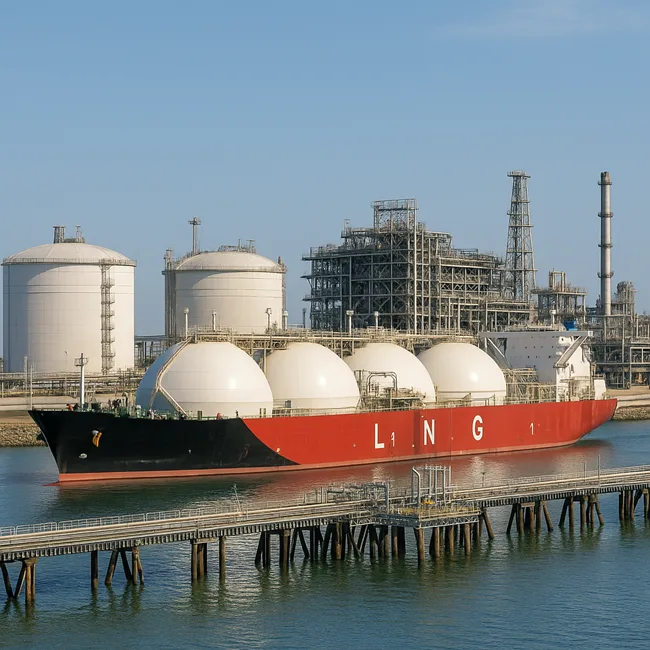
Woodside updated its full-year production guidance to 188–195 MMboe, slightly narrowed from the prior 186–196 MMboe, reflecting consistent project execution and the completed Greater Angostura divestment. Investors interpret the revised unit cost range as evidence of disciplined operations, achieved through production optimisation and lower maintenance costs across Australian LNG hubs. However, weaker realised prices on both oil and LNG remain a concern, as global gas benchmarks softened due to milder weather in Asia and increased supply competition.
How does the Louisiana LNG final investment decision and Stonepeak sell-down reshape Woodside’s global LNG strategy for the next decade?
The final investment decision (FID) on the Louisiana LNG Project in April 2025 positions Woodside as a trans-Pacific LNG player, complementing its established Australian portfolio. Train 1 of the 16.5 million tonnes per annum (Mtpa) project reached 22% completion by the end of June, with marine civil works progressing under Bechtel’s supervision. Woodside completed a 40% sell-down of Louisiana LNG Infrastructure LLC to Stonepeak for approximately $1.9 billion, with the private equity partner covering 75% of capital expenditure in 2025 and 2026. This significantly de-risks the balance sheet while preserving future cash flows.
Institutional sentiment has been positive toward the sell-down, with investors viewing the transaction as a strategic move to balance risk and retain upside exposure. Long-term offtake agreements signed with Uniper, bp, and PETRONAS reinforce the project’s commercial viability. Analysts believe the Aramco collaboration agreement, which includes potential equity participation and lower-carbon ammonia cooperation, could further enhance Louisiana LNG’s strategic footprint. First LNG cargo is targeted for 2029, aligning with rising U.S. export capacity demand.
Can Sangomar, Scarborough, and Trion projects sustain Woodside’s production growth despite upcoming plateau declines and decommissioning challenges?
Beyond Louisiana, Woodside’s growth profile rests on three key projects: Sangomar, Scarborough, and Trion. While Sangomar delivered plateau performance in Q2, production is expected to taper from Q3 2025, prompting ongoing assessments for future development phases. The Scarborough Energy Project reached 86% completion, with first LNG cargo expected in the second half of 2026. Recent milestones include connecting the floating production unit hull and topsides and completing the third development well, which met reservoir expectations.
The Trion deepwater oil project offshore Mexico, now 35% complete, continues to advance with equipment procurement and subsea fabrication ahead of first oil in 2028. Analysts suggest that Scarborough and Trion will be crucial in offsetting the decline from mature Australian fields and Sangomar’s plateau exit.
However, decommissioning challenges remain a drag on sentiment. The company reported increased expenses of $400–$500 million pre-tax in H1 2025 related to legacy sites, including Stybarrow and Minerva. Although Woodside is applying engineering learnings to reduce future costs, some investors remain wary of the scale of future abandonment liabilities.
What are institutional investors signaling about Woodside’s financial health after the $3.5 billion bond issuance and $8.4 billion liquidity position?
Financial discipline remained a central theme in Q2. Woodside raised $3.5 billion through multi-tranche U.S. senior unsecured bonds, which were heavily oversubscribed, signaling strong credit market confidence. The group ended the quarter with approximately $8.4 billion in liquidity, bolstered by proceeds from the Louisiana sell-down and the $259 million Angostura asset divestment.
Institutional investors view the robust liquidity position as supportive of both capital-intensive growth projects and shareholder returns. However, analysts also noted that capital expenditure fell sharply to $752 million from $1.8 billion in Q1, primarily due to the Stonepeak contribution offsetting Louisiana LNG spending. Excluding Louisiana, capex was stable at $868 million, focused on Scarborough, Trion, and Bass Strait gas projects.
The hedging program also provided partial revenue stability, with 58% of 2025 oil production hedged at $78.7 per barrel and nearly all Corpus Christi LNG volumes hedged through Henry Hub and TTF swaps.
Will Woodside’s updated full-year guidance and hedging strategy offset margin pressures from weaker oil and LNG realised prices?
Woodside’s revised full-year guidance signals confidence in sustaining production growth despite commodity price pressures. The average realised price for Q2 dropped 9% sequentially, yet strong operational performance and cost control enabled updated full-year production cost guidance. Hedging gains of approximately $42 million for the half-year, including $58 million from oil positions, are expected to partially cushion the impact of weaker markets.
Analysts believe the second half of 2025 will hinge on the pace of Sangomar’s decline, progress at Scarborough, and potential additional sell-downs at Louisiana LNG. Institutional investors are watching for the August 19 half-year earnings release, where updated dividend guidance and cash flow details may influence market sentiment. If Woodside maintains its cost discipline and delivers key project milestones, some analysts expect the stock to trade at a premium relative to other Asia-Pacific LNG peers.
Discover more from Business-News-Today.com
Subscribe to get the latest posts sent to your email.