



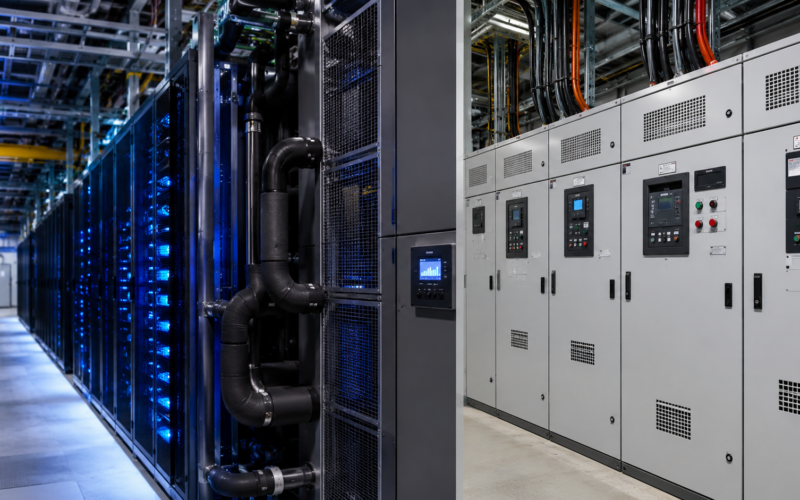
Trane Technologies plc (NYSE:TT) and Eaton Corporation plc (NYSE:ETN) have announced a strategic collaboration to publish what both companies describe as an industry-first joint reference design for artificial intelligence data centres, integrating Trane’s thermal management architecture with Eaton’s medium-voltage power distribution and aligning the combined stack with the NVIDIA DSX AI Factory Reference Design. The two companies said the pre-coordinated system can lift energy efficiency by up to 15%, cut installation costs by up to 30% and reduce copper use by up to 80% compared with conventional low-voltage architectures.
The announcement lands against a widely cited McKinsey scenario in which global data centre capacity may almost triple by 2030, with AI workloads driving about 70% of that growth. For both suppliers, the collaboration formalises a strategic direction they have already been pursuing separately through acquisitions in liquid cooling and high-density thermal management, while simultaneously answering competitive pressure from Vertiv Holdings and other rivals that market power and cooling under a single vendor umbrella. The central question for investors is whether a jointly branded, NVIDIA-aligned reference design converts into faster order intake at both companies or functions largely as a marketing framework in an already crowded AI infrastructure narrative.
Why does the Trane Technologies and Eaton reference design matter for AI data centre deployment cycles?
The strategic significance sits in the deployment timeline rather than the raw efficiency percentages. Hyperscale operators and colocation providers building for generative and reasoning AI workloads have consistently identified electrical and thermal design coordination as a critical bottleneck, because power distribution, chilled water, coolant distribution units, busways, switchgear and rack-level cooling have historically been specified by separate engineering teams from separate vendor catalogues. That siloed process forces integration risk onto the customer, extends design cycles and generates rework when a power topology change downstream forces a cooling redesign upstream.
By publishing a pre-coordinated reference design, Trane Technologies and Eaton are attempting to compress that iteration loop. The companies said the joint approach enables power distribution and cooling systems to exchange leading indicators and respond dynamically, moving from static single-line diagrams to an integrated architecture that can be repeated across sites. That claim, if it holds up in customer deployments, would meaningfully reduce the time from land acquisition to commissioning for a gigawatt-class AI campus. In an environment where NVIDIA Corporation’s product cadence is accelerating and where thermal design point requirements shift with each generation of GB200, GB300 and Rubin-class systems, deployment speed increasingly outweighs marginal capex differences.

How does medium-voltage architecture change the economics of high-density AI campuses?
The reference design is explicitly medium-voltage rather than low-voltage, which is where the 80% copper reduction and 30% installation cost improvement figures originate. Traditional data centre distribution has run at 400 to 480 volts, requiring very large conductor cross-sections to move the megawatt-scale currents demanded by dense AI racks. Moving to medium-voltage distribution, generally in the several-kilovolt range, reduces current for the same power delivered, which shrinks copper requirements, cable trays, breaker sizes and the physical footprint of the electrical rooms.
For customers, the economic case involves a trade-off. Medium-voltage equipment carries higher unit cost and demands specialised installation and safety practices, but total installed cost falls once copper, labour, real estate consumed by electrical rooms and thermal losses in low-voltage cabling are added together. For Eaton, this is a portfolio pivot the company has been signalling for several quarters, most visibly through capacity expansion in switchgear manufacturing. For Trane Technologies, the coordination point is thermal management that can scale to the higher power densities that medium-voltage distribution unlocks, particularly through liquid cooling technology strengthened by its LiquidStack acquisition completed earlier in 2026. Eaton has moved along a parallel path with its Boyd Thermal acquisition, which added liquid cooling capabilities directly relevant to high-density AI racks.
What do the Trane Continuum Rubin DSX and Eaton Beam Rubin DSX platforms actually integrate?
The reference design is embedded in two branded platforms, Trane Continuum Rubin DSX and Eaton Beam Rubin DSX, both aligned to NVIDIA’s DSX platforms and the NVIDIA Omniverse DSX Blueprint for AI data centres. The naming convention signals coordination with NVIDIA’s Rubin-generation architecture, and the Omniverse Blueprint is designed as a digital-twin planning framework that lets operators simulate an entire AI factory before ground is broken.
That matters for the collaboration’s commercial framing because the Omniverse DSX Blueprint gives NVIDIA a downstream lever over infrastructure specification. Operators using the blueprint receive pre-validated combinations of compute, power and cooling, which functionally standardises component selection across projects and reduces the risk that one vendor’s design incompatibility stalls a deployment. For Trane Technologies and Eaton, appearing inside that blueprint as a coordinated pair positions them ahead of rivals that are validated only against parts of the stack. The design is also structured to evolve as emerging liquid cooling technologies and direct-current architectures become mainstream, a hedge that acknowledges the current uncertainty about whether hyperscalers will settle on high-voltage direct current or continue with alternating current distribution over the next infrastructure cycle.
How does the collaboration fit against Vertiv Holdings and other single-vendor AI infrastructure competitors?
The competitive backdrop is where the strategic logic becomes clearest. Vertiv Holdings has spent the last two years positioning itself as a single-vendor answer to AI infrastructure, selling power distribution, uninterruptible power supplies, thermal management and rack-level cooling under one commercial relationship. Vertiv exited a recent quarter with a backlog of roughly 15 billion United States dollars on order growth exceeding 250%, a scale that reflects the customer preference for consolidated procurement. Schneider Electric has pursued a similar integrated model through its partnerships with NVIDIA.
Trane Technologies and Eaton are the two largest specialists in their respective domains but neither offers the other’s full stack. The joint reference design is the commercial response, allowing them to present customers with a coordinated proposition without either company diluting its focus through acquisitions outside its core competency. The unresolved competitive question is whether hyperscalers accept a two-vendor coordinated design as functionally equivalent to a single-vendor stack, or whether procurement teams continue to reward vendors that can carry integration risk themselves. The answer will likely differ by customer type, with the largest hyperscalers more comfortable orchestrating multiple vendors while enterprise and mid-tier colocation operators may still favour a single point of accountability.
What does the joint reference design mean for Trane Technologies shareholders after its record Q2 2026 backlog?
Trane Technologies enters the collaboration from a position of unusual strength. The company reported second-quarter 2026 adjusted earnings per share of 4.31 United States dollars, up 11 percent year on year, on net revenue of 6.35 billion United States dollars, and it raised full-year 2026 adjusted earnings per share guidance to a range of 15.20 to 15.30 United States dollars. Enterprise bookings rose 37 percent organically in the quarter and the company disclosed a record backlog of roughly 12.1 billion United States dollars, with data centre demand cited by management as a primary driver alongside broader commercial heating, ventilation and air conditioning strength.
Against that backdrop, the incremental question is not whether data centre exposure adds to growth, since that is already visible in bookings, but whether the joint reference design accelerates the conversion of pipeline into signed contracts. If the coordination with Eaton allows customers to shortlist Trane earlier in the design phase for AI-specific projects, the effect over multiple years could be a structurally higher win rate on the highest-power-density opportunities. The counter-risk is that the reference design formalises Trane’s positioning without materially changing the tender dynamics, in which case the announcement is primarily a defensive move to prevent share loss to Vertiv Holdings and other integrated competitors. Neither outcome is fully visible from a single announcement, and investors will need several quarters of bookings commentary to assess the pull-through.
What does the collaboration add to Eaton’s already-record electrical backlog and NVIDIA partnership?
Eaton faces a parallel version of the same question. The company reported first-quarter 2026 sales of 7.5 billion United States dollars, up 17 percent year on year, with segment margins of 22.7 percent above its own guidance range, and management has highlighted electrical orders growing more than 40 percent organically in recent quarters. Eaton also has an independent partnership with NVIDIA focused on high-voltage direct current infrastructure and has been expanding switchgear capacity to serve the data centre order book, which by earlier reporting had reached a record of approximately 19.6 billion United States dollars.
The Trane collaboration therefore adds a coordinated cooling counterpart to Eaton’s existing power positioning rather than opening a new addressable market. The commercial value depends on whether joint proposals with Trane displace competing configurations at the specification stage, particularly where hyperscalers are choosing between medium-voltage and legacy low-voltage topologies. Given the current premium valuation reflected in Eaton’s share price and the level of insider selling reported earlier in 2026, marginal share gains matter, because the investment case increasingly requires evidence that the AI data centre order book is durable rather than a one-cycle bulge. A visible increase in coordinated wins with Trane over the next several quarters would strengthen that narrative.
Which execution risks could delay the promised efficiency, installation cost and copper savings?
The efficiency, installation cost and copper reduction figures are quoted as up-to numbers rather than typical outcomes, which is a standard convention in vendor reference designs but requires interpretation. Achieving the full 15 percent efficiency gain depends on the customer’s existing baseline, the workload profile of the deployed AI hardware and the operating point at which the facility runs, which varies materially between training and inference workloads. The 80 percent copper reduction is a physics-driven outcome of moving to medium voltage but only applies to the segments of the electrical distribution that are converted, meaning site-level totals will fall well short of that headline number for facilities that retain low-voltage distribution beyond the main switchgear.
Beyond the technical caveats, execution risk sits in customer adoption speed. Medium-voltage distribution changes the operating and safety envelope inside a data centre and requires updated commissioning practices, training and in some jurisdictions revised electrical inspection procedures. Adoption is likely to be led by hyperscalers with the in-house engineering depth to absorb those changes, with enterprise and mid-tier colocation operators moving more slowly. The reference design also faces the possibility that the direct-current architectures both companies acknowledge as an emerging option displace medium-voltage alternating current before it becomes standard, in which case some of the current coordination work would need to be revised.
What are the next measurable proof points investors should track after the reference design launch?
For both companies, the near-term proof points are unlikely to appear as line items in a single quarter. Investors should watch for named customer deployments citing the joint reference design, particularly in disclosures from hyperscalers and large colocation operators. The next Trane Technologies and Eaton earnings updates will provide the first opportunity for management to characterise pipeline activity linked to the collaboration, and analysts are likely to press on whether the joint design is producing coordinated wins or whether procurement decisions continue to be made component by component.
Broader industry signals also matter. Adoption of the NVIDIA Omniverse DSX Blueprint by additional infrastructure operators would validate the framework Trane and Eaton have aligned with, while any move by Vertiv Holdings, Schneider Electric or Carrier Global to announce competing coordinated propositions would confirm that the two-vendor coordinated model has become a recognised competitive template. The regulatory environment for data centre construction, particularly around water use, grid interconnection queues and permitting, remains a wildcard that could either amplify or blunt the impact of design efficiency improvements on the actual pace of AI infrastructure buildout.
Key takeaways from the Trane Technologies and Eaton AI data centre collaboration
- Trane Technologies plc (NYSE:TT) and Eaton Corporation plc (NYSE:ETN) have announced a joint reference design for AI data centres, aligned with the NVIDIA DSX AI Factory Reference Design and the NVIDIA Omniverse DSX Blueprint.
- The companies claim the pre-coordinated system can improve energy efficiency by up to 15%, cut installation costs by up to 30% and reduce copper use by up to 80% versus conventional low-voltage designs.
- The design is embedded in the Trane Continuum Rubin DSX and Eaton Beam Rubin DSX platforms, integrating medium-voltage power distribution with high-density thermal management.
- The strategic value lies in compressing AI data centre deployment cycles by eliminating the traditional siloed handoff between electrical and thermal engineering.
- The collaboration is a competitive response to Vertiv Holdings and Schneider Electric, which have positioned themselves as single-vendor answers for integrated AI infrastructure.
- Trane Technologies enters the collaboration with a record backlog of roughly 12.1 billion United States dollars and raised 2026 earnings guidance, with data centre demand already contributing to bookings growth.
- Eaton enters with electrical orders growing more than 40 percent organically and a separate NVIDIA partnership on high-voltage direct current infrastructure.
- Execution risk centres on customer adoption of medium-voltage architecture, which requires updated commissioning practices and may favour hyperscaler-led rather than enterprise-led uptake.
- The next measurable proof points are named customer deployments and management commentary in upcoming quarterly results confirming coordinated wins linked to the reference design.
- The unresolved strategic question is whether a two-vendor coordinated design converts into procurement share equivalent to a single-vendor stack, or whether the reference design remains primarily a defensive positioning against integrated competitors.
Discover more from Business-News-Today.com
Subscribe to get the latest posts sent to your email.