


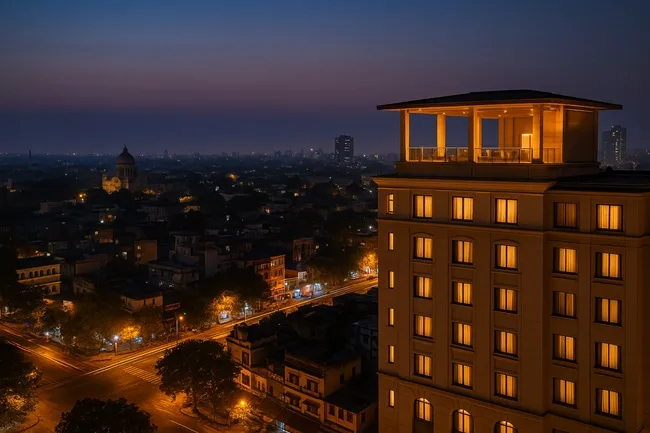
When Hyatt Hotels Corporation announced the signing of The Landmark Kanpur as India’s second JdV by Hyatt property, the move immediately stood out. The 170-key hotel, owned by Som Datt Landmark Hotels and Recreations Private Limited, is set to open in early 2026 following a comprehensive restoration that aligns with JdV’s design ethos and “joy of life” philosophy. Featuring a rooftop lawn on the twenty-first floor, a spa, multiple dining venues, and extensive event facilities, the property will anchor Hyatt’s push into India’s under-served tier-II hospitality markets.
The signing is part of a broader acceleration. Hyatt has outlined plans to open six new Indian hotels in 2025, including projects in Ghaziabad, Kochi, Bhopal, Jaipur, Vithalapur, and Kasauli, and aims to double its national portfolio to around 100 hotels within five years. The strategy mirrors a wider industry trend: global chains are chasing growth beyond Delhi, Mumbai, and Bengaluru toward regional centers with rising affluence, improved infrastructure, and expanding domestic travel.
Why does Hyatt’s Landmark Kanpur move matter for India’s hospitality map, and what demand signals are pulling luxury and lifestyle brands into tier-II cities?
The shift toward tier-II markets is not speculative—it reflects structural changes in India’s consumer and economic base. More than 80 percent of new hotel signings in 2025 have occurred in tier-II and tier-III cities, a sharp jump from pre-pandemic levels. These markets now contribute meaningfully to room revenue growth as household incomes rise and regional air connectivity deepens.
Highways, new airports, and rapid-transit projects are shrinking travel times across North and West India, while states like Uttar Pradesh, Gujarat, and Madhya Pradesh actively promote business-tourism corridors. This infrastructure dividend, combined with cheaper land and faster project execution cycles, makes smaller cities commercially attractive for branded hotels.
The demand side is equally strong. Domestic travelers, especially younger professionals, are trading utilitarian stays for experience-driven trips that combine leisure, dining, and local culture. Boutique and lifestyle hotels, once confined to metros, are finding resonance with guests seeking curated interiors, craft-led cuisine, and wellness experiences closer to home. Analysts note that this “everywhere luxury” phenomenon is driving global operators to deploy asset-light models that partner with local developers rather than build from scratch.
How does The Landmark Kanpur fit into Hyatt’s global pipeline strategy, and what does the brand’s portfolio shift tell investors about where growth is coming from?
Hyatt closed 2024 with a record development pipeline of about 138,000 rooms worldwide and a near-50 percent year-on-year surge in its lifestyle segment. The company reorganized its portfolio into five pillars—Luxury, Lifestyle, Inclusive, Classics, and Essentials—to sharpen investor visibility into margins and growth drivers. For shareholders, the message is clear: fee-rich, experience-centric brands like JdV are becoming Hyatt’s principal engines of expansion.
India is integral to that equation. The country remains one of Hyatt’s fastest-growing Asia-Pacific markets, supported by favorable demographics, rising consumer spending, and a widening domestic travel base. Management has reiterated double-digit revenue growth expectations from India and confirmed that most incremental properties over the next five years will come from non-metro markets.
The Landmark Kanpur therefore operates as both proof of concept and pipeline template—an adaptive reuse of a legacy five-star property repositioned as a global lifestyle hotel at lower capital intensity. Its scale allows premium positioning without oversupply risk, an appealing model for owners in similar cities.
Which city clusters could follow Kanpur, and what selection criteria are global brands applying as they move beyond the metros into tier-II India?
The list of likely successors is growing quickly. Regional clusters such as Ahmedabad–Gandhinagar, Lucknow, Indore, Nashik, Coimbatore, and Kochi have emerged as hotbeds for mid-to-luxury hotel signings. In Gujarat alone, more than 1,200 premium keys are under development across new projects, including those around GIFT City. These locations combine corporate anchors, industrial corridors, event tourism, and religious or cultural attractions—factors that provide both weekday business and weekend leisure traffic.
Global peers are following similar logic. Hilton and Marriott are executing multi-year expansion plans aimed squarely at smaller Indian cities, seeking to capture unmet branded-room demand among rising middle-income travelers. Their acceleration confirms that tier-II markets can sustain international standards when the product mix balances global design language with local cultural cues.
For operators, site selection now depends less on population size and more on connectivity, stable year-round demand, and F&B revenue potential. Hotels capable of integrating wedding and MICE (meetings, incentives, conferences, exhibitions) facilities enjoy stronger economics in these cities than pure business-travel properties.
What are the principal risks to making a lifestyle hotel work in a non-metro market, and how might owners and operators protect yields once the novelty fades?
Despite optimism, the tier-II experiment comes with execution challenges. Demand patterns can be volatile, with pronounced seasonality tied to events and festivals. Operators must therefore cultivate local patronage through destination dining, spa memberships, and social programming to stabilize occupancy between peaks.
Talent availability is another hurdle. Many regional markets lack hospitality-school pipelines capable of supplying trained staff. Brands like Hyatt and Marriott are responding by establishing in-house academies and rotational programs that groom local recruits to global service standards.
Supply-chain constraints also persist. Sourcing imported fittings, specialty foods, and advanced building systems outside metro hubs increases logistics costs. Developers mitigate this by expanding domestic vendor networks and using hybrid local-international design approaches.
A subtler risk lies in regulatory and tax exposure. In 2025, India’s Supreme Court ruled that Hyatt’s India operations fall under permanent-establishment norms, implying greater tax accountability for foreign hotel operators. This precedent could influence how future management contracts allocate profits and define operational control. Multinationals are already reassessing contract structures to remain compliant without eroding brand quality or profitability.
How does Kanpur specifically advance JdV by Hyatt’s brand promise, and what micro-economics of the asset matter most for performance?
The Landmark Kanpur’s repositioning embodies JdV’s essence—locally rooted, creatively designed, and community-connected. Its 170 keys, balanced scale, and diversified amenities position it as a city social hub as much as a hotel. The 7,200 square-foot rooftop lawn and multiple restaurants target the city’s wedding and events market, a segment known to generate some of the highest F&B margins in India’s hospitality business.
Because the project involves adaptive reuse rather than a ground-up build, its capital intensity is lower and break-even timelines shorter. Hyatt’s emphasis on a “thoughtful restoration” indicates design investment in cultural storytelling, art, and materiality—touchpoints that encourage repeat visits and social-media amplification. Analysts view such soft-value differentiation as key to sustaining premium average daily rates once initial novelty fades.
The broader consumer backdrop supports this positioning. Recent studies highlight that tier-II India is undergoing a restaurant and leisure boom driven by Gen Z and millennial spending power. For Hyatt, this means The Landmark Kanpur’s F&B and events revenue could become its main yield driver, reinforcing why lifestyle branding is economically viable beyond metros.
Where is investor sentiment on Hyatt and India’s hospitality trade today, and what should observers watch in the next 12–24 months?
Investor appetite for hospitality assets in India is at its strongest level in nearly a decade. JLL India projects cumulative hotel investments approaching one billion dollars by 2028, while quarterly signings remain above historical averages. Global capital is favoring operators with diversified geographic exposure and asset-light models that limit balance-sheet risk.
For Hyatt’s shareholders, India represents one of the few large emerging markets with sustained room-supply shortages and expanding discretionary travel. The company’s global pipeline growth, coupled with India’s structural demand, positions it well for earnings compounding through management-fee income.
Analysts tracking Hyatt’s stock—trading recently in the mid-$140 range—are watching India’s contribution to revenue, fee growth, and occupancy ramp-up at upcoming openings. A successful execution in Kanpur would validate Hyatt’s thesis that lifestyle hotels can achieve metro-level performance in smaller cities, setting up replication across dozens of locations.
What makes Hyatt’s Landmark Kanpur launch a turning point in India’s transformation toward experience-driven hospitality, and how should success be measured beyond room counts?
The deeper story behind Hyatt’s Kanpur bet is cultural, not just commercial. It represents the emergence of a new hospitality geography where industrial cities recast themselves as lifestyle destinations. In Kanpur, long known for its manufacturing base, the arrival of an international lifestyle brand signals confidence in the city’s evolving identity—one defined increasingly by leisure, design, and community spaces.
For India’s hospitality industry, the lesson is clear. Growth is no longer confined to the metros; it is diffusing across the map in sync with rising urban aspirations. Success will not be measured solely by key counts but by brand resonance, cross-venue spending, social engagement, and repeat patronage.
With over 42,000 rooms signed across India in 2024 and new investments accelerating, the momentum behind this shift is tangible. If Hyatt’s Landmark Kanpur delivers on its promise, it could become the blueprint for how lifestyle hospitality—and by extension, global investment—reshapes the next decade of Indian travel.
Discover more from Business-News-Today.com
Subscribe to get the latest posts sent to your email.