




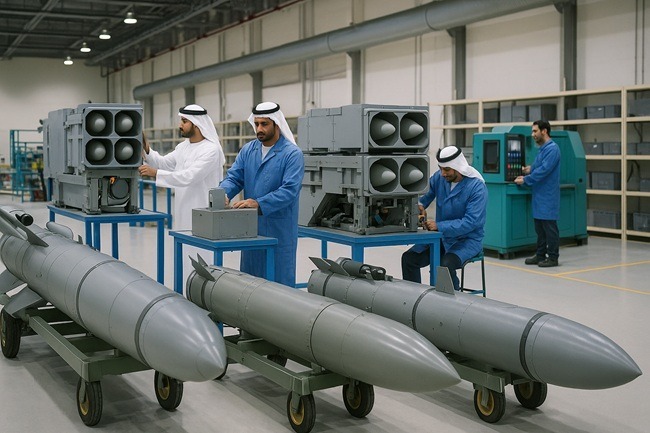
The United Arab Emirates (UAE) is no longer content being one of the world’s most active defence importers. It now has its sights set on becoming a sovereign defence manufacturing power, capable of designing, producing, and exporting advanced weapons systems at scale. Through state-backed players like EDGE Group and key partners including Leonardo S.p.A. and HALCON, the UAE is executing a high-speed pivot from buyer to builder. Recent joint venture developments, industrial ramp-ups, and strategic manufacturing investments signal the country’s intent to establish itself as the Gulf’s dominant defence production hub.
At the centre of this transition is the proposed 2026 joint venture between EDGE Group and Italian defence conglomerate Leonardo S.p.A. Announced at the Dubai Airshow 2025, the partnership is structured with EDGE holding 51 percent and Leonardo the remaining 49 percent. The goal is to co-develop and manufacture advanced defence systems inside the UAE, not only for domestic use but also for export into international markets. Alongside this initiative, HALCON, a core missile and smart weapons entity under EDGE Group, is expanding its domestic production base with new facilities, supply-chain localisation, and precision engineering capabilities. The UAE’s evolving industrial defence strategy aims to shift the global defence supply chain southward—both in geography and influence.
Why the UAE is accelerating its shift toward sovereign defence production
As global supply chains fragment and major defence exporters tighten their control over sensitive technologies, the UAE’s strategy reflects a broader trend among rising geopolitical players: reduce dependency on imports and increase industrial sovereignty. For the UAE, building an indigenous defence industry offers both strategic control and economic upside. By producing weapons systems locally, the UAE can avoid export bottlenecks, maintain operational readiness, and capture more value within its domestic economy.
EDGE Group, formed in 2019 through the merger of over 25 entities, has become the tip of the spear in this transformation. Today, it encompasses more than 35 companies across five defence clusters: platforms and systems, missiles and weapons, electronic warfare and cyber technologies, mission support, and trading and services. Over 80 percent of EDGE’s product portfolio is now manufactured within the UAE, according to official disclosures, backed by a domestic supplier base that includes more than 170 manufacturing and integration facilities.
HALCON, one of EDGE Group’s most mature subsidiaries, plays a pivotal role in building out the UAE’s missile and guided weapons capability. From smart munitions and loitering drones to turbojet engines and sub-assemblies, HALCON’s vertical integration strategy has enabled it to produce increasingly complex systems within UAE borders. This internal capability is foundational to the country’s export ambitions and its plan to serve markets beyond the Gulf.
How the EDGE–Leonardo joint venture reflects a new export-forward defence model
The upcoming joint venture between EDGE Group and Leonardo S.p.A. is not a transactional alliance—it represents a new kind of defence industrial strategy that merges sovereign ambitions with global systems integration expertise. Leonardo brings decades of experience in aerospace platforms, sensor systems, and secure communications, while EDGE contributes facilities, regional knowledge, and capital.
The scope of the joint venture includes the design, development, testing, industrialisation, production, and export of systems across air, land, sea, and electro-optical domains. The agreement also covers through-life support and the creation of a highly skilled workforce inside the UAE. This structure allows for technology transfer, domestic IP localisation, and long-term capability building. The systems co-developed through the joint venture will be manufactured in the UAE and marketed both domestically and to select international buyers, providing EDGE with an export pipeline powered by Leonardo’s battle-tested components and system designs.
The structure is also consistent with the UAE’s broader industrial policy frameworks, such as “Make it in the Emirates” and “Operation 300bn.” These initiatives aim to boost national manufacturing GDP, attract global partnerships, and localise strategic industries, including defence. By embedding Leonardo’s technology stack within a UAE-controlled operating structure, the joint venture enables greater autonomy over production and export while leveraging European R&D standards.
How HALCON is building the foundation of localised weapons system production
While EDGE is pursuing high-profile international partnerships, HALCON is quietly building the industrial backbone of the UAE’s defence ambitions. The company specialises in smart weapons, precision-guided munitions, loitering aerial systems, seekers, actuation units, and propulsion modules. In 2025, HALCON announced a major new investment in local supply-chain infrastructure through a partnership with Emirates Cable Corporation Interconnect to establish a next-generation cable harness production facility in Abu Dhabi.
Cable harnesses are a core element of any guided weapon, enabling precise electronic control of propulsion, navigation, and data transmission. By localising this capability, HALCON reduces reliance on foreign suppliers and accelerates its time to deployment. The new facility also aligns with EDGE’s strategy of vertical integration and workforce upskilling. HALCON has invested heavily in Industry 4.0 automation, additive manufacturing, and embedded software development, allowing its systems to evolve in tandem with global battlefield requirements.
Through HALCON, the UAE now boasts the ability to design, build, and integrate end-to-end missile systems at scale. This includes modular air defence systems, anti-tank missiles, loitering drones, and air-to-surface strike packages. HALCON’s catalogue is not only being adopted by the UAE Armed Forces but is also being positioned for exports across Africa, Southeast Asia, and Latin America—markets where mid-tier, politically flexible systems are in high demand.
What makes the UAE structurally suited to become a defence production powerhouse?
Several factors make the UAE uniquely suited to become a hub for global defence manufacturing. First, its political leadership is stable, centralised, and pro-innovation, allowing long-term planning and rapid industrial scaling. Second, it benefits from deep capital reserves and access to global investment channels that can accelerate industrial infrastructure development. Third, its geography, which is at the crossroads of Europe, Asia, and Africa, gives it unique access to fast-growing defence markets often underserved by Western defence giants.
EDGE Group’s conglomerate structure also allows it to span multiple technology stacks across platforms, sensors, guidance systems, and support logistics. It can pursue concurrent development of land vehicles, naval platforms, radar systems, and munitions—all under one industrial umbrella. This kind of integration is rare even among Western primes.
Moreover, the UAE’s openness to industrial collaboration allows it to bypass innovation bottlenecks by partnering with firms like Leonardo S.p.A., Embraer, and Hanwha, while gradually building its own domestic R&D capability. Its growing base of skilled Emirati engineers, supported by AI-based training systems and dual-education programs with global institutions, provides a strong human capital pipeline to support sovereign innovation.
What challenges could slow the UAE’s emergence as a defence export hub?
Despite rapid progress, there are real constraints. High-end defence technology—particularly in seeker heads, radar arrays, semiconductor-based guidance modules, and classified encryption—is still subject to Western export control regimes. Even with joint ventures, certain source codes or system components may remain locked behind regulatory barriers.
There is also the issue of international trust. While the UAE has expanded its global diplomatic influence, some buyer nations may remain cautious about the long-term viability of UAE-based weapons systems, especially those still reliant on hybrid foreign parts. Moreover, to move beyond regional markets, the UAE will need to prove it can support global after-sales, maintenance, and upgrade ecosystems.
Building a successful defence export model requires more than factories. It requires trusted supply chains, robust IP protections, independent R&D capacity, and the ability to service customers across continents and decades. The UAE has made rapid strides, but these capabilities are still maturing.
What comes next for the UAE’s defence industrial roadmap?
In 2026, the formal launch of the EDGE–Leonardo joint venture will be a critical litmus test. Successful transfer of manufacturing lines, hiring of skilled personnel, and first-phase product rollout will determine whether the UAE can build and export under a co-development model with a G7 defence giant. In parallel, HALCON’s increased production capacity is expected to push out next-generation systems aimed at export into non-Western markets.
Observers are also watching for potential orders from Africa and Central Asia, regions where the UAE has cultivated economic and diplomatic relationships. EDGE is expected to showcase new integrated systems at IDEX 2026, including interoperable air defence and drone swarms. If export contracts materialise, it will further reinforce the UAE’s shift from arms importer to weapons innovator.
Ultimately, the UAE is building not just a manufacturing hub, but a new strategic node in the global defence ecosystem. In a world of increasingly multipolar conflict and procurement, that node may soon play a far larger role than the industry has yet realised.
Discover more from Business-News-Today.com
Subscribe to get the latest posts sent to your email.

