




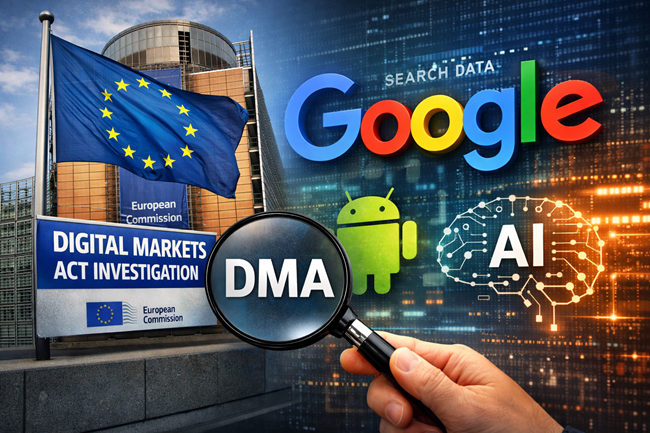
The European Commission has launched formal specification proceedings against Google LLC to clarify and enforce two key obligations under the Digital Markets Act (DMA): one covering interoperability of Android-controlled AI features, and another on equitable access to Google Search data. These dual-track proceedings mark a critical inflection point for EU digital competition enforcement, targeting structural power asymmetries in both mobile ecosystems and foundational AI training resources.
What changed and why now: Inside the EU’s proceedings on Android AI and Google Search data access
The first action addresses Google’s obligations under Article 6(7) of the Digital Markets Act to enable third-party developers free and effective interoperability with hardware and software features on Android devices—particularly those used by Google’s own AI products like Gemini. By clarifying what constitutes “equally effective” access to device functionalities such as voice activation, sensor arrays, or on-device inferencing, the Commission is attempting to prevent ecosystem foreclosure by Google’s vertically integrated AI stack.
Simultaneously, the Commission is acting under Article 6(11) to ensure that alternative search engine and chatbot providers can access anonymised user interaction data from Google Search on fair, reasonable, and non-discriminatory (FRAND) terms. This includes anonymised query strings, click paths, and engagement metrics—datasets widely considered essential for AI training and search algorithm optimization.
Although these are specification proceedings rather than non-compliance rulings, they signal the Commission’s intent to sharpen the scope and enforceability of the DMA ahead of escalating penalties. Preliminary findings are expected within three months, with final determinations due by late July 2026.
How Gemini’s hardware privilege could shape the competitive terrain of mobile AI ecosystems
The interoperability dispute centers on whether third-party AI agents on Android devices can meaningfully compete with Google’s Gemini if denied access to the same privileged software hooks or device-level APIs. Voice assistants, visual inference systems, and even real-time translation models all rely on seamless access to device capabilities—such as microphones, camera feeds, system-level notifications, and power-efficient accelerators.
If Google withholds such access or implements it in a degraded form for rivals, the Commission fears that Android becomes a self-reinforcing moat for Gemini’s dominance. This replicates historical concerns around pre-installation bias and default status—long-standing issues that the DMA was explicitly designed to resolve.
From a commercial lens, the broader risk is that Google’s control of both the OS and native AI stack allows it to define the mobile AI experience, crowding out innovation from independent developers, open-source models, and enterprise-grade alternatives. That outcome would not only entrench market share but skew the training-feedback loop essential to AI system performance.
Why FRAND access to Google Search data matters for challenger AI models and chatbot developers
The second proceeding tackles one of the most strategically sensitive resources in the AI ecosystem: search data. Third-party providers of search engines, generative AI chatbots, and information retrieval platforms have long claimed that without access to anonymised ranking, query, and engagement data from Google Search, they are structurally disadvantaged in building competitive algorithms.
By invoking Article 6(11), the Commission is attempting to neutralize what some experts have called “data enclosure”—the practice of treating user-generated behavioral data as a proprietary moat. While Google maintains that sharing such data risks privacy breaches or platform misuse, the Commission insists that effective anonymisation methods exist, and that competitive parity requires FRAND-based access.
The outcome of this proceeding could materially alter the business models of companies like Neeva AI (pre-acquisition), Brave Search, and Perplexity AI, all of whom aim to offer privacy-first or vertical-specific alternatives to Google’s generalist search dominance. It also has implications for European LLM developers seeking large-scale, real-world language data to train models capable of web-scale reasoning.
How enforcement differs under DMA “specification proceedings” vs non-compliance penalties
Notably, these are specification proceedings, not formal findings of breach. That distinction is key: the Commission is not yet accusing Google of violating the DMA, but is instead seeking to clarify what compliance looks like in two contested areas.
Under the DMA’s structure, the EU can open a regulatory dialogue to define expectations, before issuing mandatory corrective measures. If, after that, Google fails to comply, the Commission can pursue non-compliance decisions—backed by fines of up to 10 percent of global turnover, or 20 percent for repeat offenses. The current proceedings thus serve as both a compliance roadmap and a warning shot.
That said, the procedural flexibility should not mask the strategic shift. This is the first time the EU is probing how AI-specific dynamics (Gemini access, AI chatbot eligibility) fit within the broader gatekeeper obligations of the DMA. It also broadens the application of FRAND concepts—traditionally rooted in telecom and patents—into data access rights for digital platforms.
What the Commission’s approach signals about Europe’s broader digital policy posture
Taken together, the dual actions reveal a growing assertiveness in the Commission’s DMA enforcement strategy—especially as it intersects with AI innovation, device ecosystems, and foundational model development.
The framing of the proceedings through the lens of AI competitiveness is telling. As Executive Vice-President Henna Virkkunen noted, the goal is not merely procedural parity, but a functional open market for AI agents and data-driven innovation. This positions the DMA as a de facto AI policy lever, even though its original remit was digital platform fairness.
It also speaks to Europe’s broader digital sovereignty agenda. By setting behavioral norms for global tech companies operating within the EU—especially regarding access to infrastructure-like datasets and device capabilities—the Commission is effectively trying to avoid dependency on a handful of U.S. or China-based AI gatekeepers.
That ambition, however, must balance technical feasibility, privacy safeguards, and legal defensibility. If the Commission overreaches or demands implementation pathways that expose user data, it could face legal challenges or compliance deferrals. Conversely, if the enforcement lacks teeth, the DMA risks becoming symbolic rather than structural.
What to watch next: third-party reactions, technical access terms, and the countdown to summer 2026
The next three months will be crucial. The Commission is expected to publish non-confidential summaries of its preliminary findings and proposed measures for public comment. Industry reactions—especially from competing search engines, mobile AI developers, and telecom firms—will shape how aggressively Brussels pushes the boundaries of FRAND in the AI context.
Watch also for Google’s legal positioning. While the company has publicly affirmed its intent to comply with the DMA, it has previously raised concerns about data security, misuse, and commercial harm from overbroad disclosure requirements. It may argue that anonymisation cannot fully protect user identity or that third-party interoperability opens up vectors for abuse.
On the Android side, the technical contours of “equally effective access” remain opaque. Will the Commission require documentation of API usage parity, log-level telemetry access, or pre-installation rights for competing AI agents? How Google responds here could define whether Gemini becomes an embedded monopoly or one competitor among many.
Finally, investor sentiment around Alphabet Inc. is likely to remain stable in the short term—particularly as these proceedings are not enforcement actions. But the strategic risk flagged here is longer-term: that regulatory fragmentation, especially between U.S. and EU frameworks, creates structural limits to Google’s growth in high-margin AI and search verticals across international markets.
What the EU’s DMA proceedings against Google mean for digital platforms, AI competitors, and market access
- The European Commission has launched specification proceedings against Google LLC under the Digital Markets Act targeting Android interoperability and search data access.
- The first action seeks to clarify whether Google must grant third-party AI providers equally effective access to device-level Android features used by Gemini.
- The second action addresses whether third-party search and chatbot firms can access anonymised user data from Google Search under fair, reasonable, and non-discriminatory terms.
- These proceedings are not yet non-compliance findings but could escalate to formal enforcement actions if Google resists or delays corrective implementation.
- The Commission is increasingly positioning the DMA as a tool to shape AI market structure, not just platform fairness, reflecting Europe’s digital sovereignty priorities.
- Access to device APIs and search behavior data are now being treated as essential infrastructure for AI competition—raising both innovation opportunities and privacy risks.
- Alphabet Inc. could face commercial pressure if the EU mandates systemic sharing of high-value data or de facto unbundling of mobile AI stacks.
- Investor sentiment remains neutral for now, but regulatory overhang may constrain future product integration strategies in the EU region.
- The DMA’s test case for AI-related obligations may set precedents for how global regulators interpret platform responsibilities in the generative AI era.
- Final measures are expected by July 2026, but industry feedback and legal negotiations over the coming months will likely shape the scope and enforceability of any mandates.
Discover more from Business-News-Today.com
Subscribe to get the latest posts sent to your email.