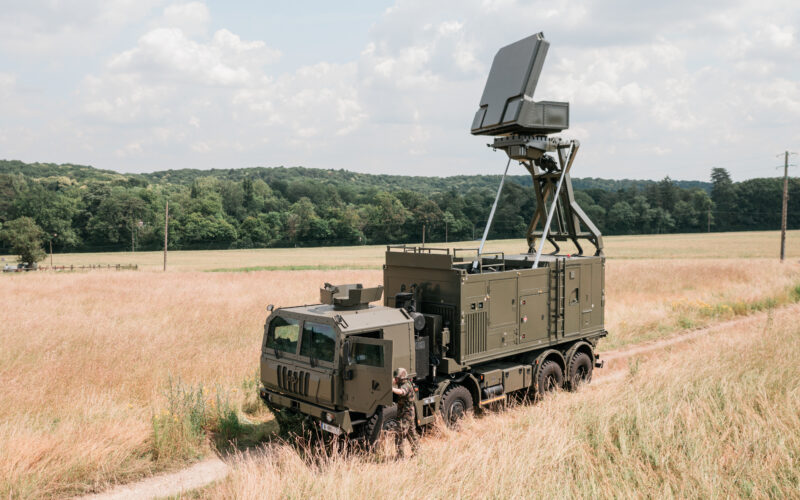
Thales S.A. (Euronext Paris: HO) has secured a strategically important Romanian order for twelve Ground Master 200 Multi-Mission All-in-one radars through a government-to-government agreement between Romania’s General Directorate for Armaments and France’s Direction Générale de l’Armement. The systems are intended to strengthen Romania’s ability to detect and track threats ranging from low-flying drones to aircraft and missiles, with the first delivery expected in 2027. The procurement is being supported through the European Union’s Security Action for Europe programme, linking Romania’s capability upgrade with a wider push for joint defence purchasing and faster European production. For Thales, the order reinforces a radar franchise already benefiting from stronger defence demand. The central test is whether the contract can be converted into an integrated operational network quickly enough to match the pace of change in the regional threat environment.
Romania is buying more than twelve pieces of surveillance hardware. It is investing in the detection and decision layer that connects airspace awareness with fighter aircraft, missile batteries, counter-drone systems and NATO command structures. That distinction matters because even advanced interceptors depend on timely and accurate sensor data before commanders can identify a target and select an appropriate response.
Why does Romania’s purchase of twelve Thales GM200 MM/A radars matter for NATO’s eastern flank?
Romania shares a long border with Ukraine and has repeatedly monitored aerial activity linked to attacks near the Danube and Black Sea region. Recent incidents have shown that the challenge is no longer limited to conventional combat aircraft. Small drones, cruise missiles and low-altitude flight profiles can expose gaps between strategic early-warning systems and short-range defensive weapons.
The twelve mobile radars can help Romania add coverage, resilience and deployment flexibility. Commanders could use them to reinforce sensitive regions, protect military formations or critical infrastructure, and replace coverage lost through maintenance or disruption. Mobility also makes the surveillance network harder to predict and target than a system dependent on a small number of fixed sites.
The order should also strengthen Romania’s contribution to NATO’s common air picture. Allied aircraft and multinational forces already operate in the country, making secure data exchange and command interoperability central to the programme’s value. The first delivery in 2027 creates a near-term milestone, while Romanian defence reporting indicates that SAFE-backed equipment is expected to be delivered by 2030.
What operational capability will the Ground Master 200 Multi-Mission All-in-one radar add?
The Ground Master 200 Multi-Mission All-in-one is a mobile medium-range 4D active electronically scanned array radar designed for air surveillance and ground-based air defence. Thales said it can detect and track targets at distances of up to 350 kilometres, including drones, helicopters, aircraft and missiles. It is also designed to support surface surveillance, weapon coordination and rocket, artillery and mortar warning functions.
The All-in-one configuration combines the radar with an integrated command-and-control shelter and a mast intended to improve low-altitude visibility. That is important because terrain, buildings and the curvature of the Earth can reduce line of sight against low-flying targets. Deployment location and network design will therefore matter as much as headline range.
Its multi-mission architecture could reduce the need for separate sensors for every task, simplifying training, maintenance and software support. However, catalogue specifications do not guarantee battlefield performance. Romania’s acceptance tests and later operational exercises will be the real measure of detection quality, classification speed, resistance to electronic interference and compatibility with existing systems.

How does European Union SAFE financing change the economics of Romania’s radar programme?
The Security Action for Europe programme provides up to €150 billion in European Union-backed loans to help member states accelerate defence investment through common procurement. The instrument is designed to aggregate demand, improve financing terms and strengthen the European defence industrial base.
For Romania, the structure can reduce the immediate budgetary pressure of acquiring several major capabilities at once. It also creates a state-to-state procurement channel through France’s Direction Générale de l’Armement rather than treating the radar requirement as an isolated national tender.
For Thales, SAFE can convert political commitments into funded contracts with clearer delivery schedules. The Romanian agreement is evidence that Europe’s defence financing architecture is beginning to move from policy into equipment procurement.
The constraint now shifts from funding to execution. Loans can support orders, but they cannot instantly create engineers, specialised electronics, test facilities or qualified suppliers. If multiple countries order similar radar and air-defence systems simultaneously, manufacturers must expand production without weakening quality or pushing deliveries beyond the period of greatest strategic need.
How financially significant is the Romania GM200 order after Thales’s strong first-half results?
Thales did not disclose a contract value in its July 24 announcement. Romanian and French defence publications have placed the package at approximately €247 million to €258 million, although those figures are not company-confirmed. At that level, the programme would be meaningful for Thales’s land-radar business but not transformational for a group that generated €22.1 billion in 2025 sales.
The order arrives after a strong first half of 2026. Thales reported €12.47 billion of order intake, up 21 percent, along with €10.95 billion of sales and €1.37 billion of adjusted earnings before interest and tax. Free operating cash flow reached €1.87 billion, while the group maintained guidance for organic sales growth of 6 percent to 7 percent and an adjusted operating margin of 12.6 percent to 12.8 percent.
Defence generated more than half of group sales and recorded organic sales growth of 13.1 percent. The Romanian contract therefore extends an existing demand trend rather than compensating for weakness in the defence portfolio.
Because the agreement was signed after the end of June, it would ordinarily be expected to support second-half order intake, although Thales has not disclosed the exact booking date. If the reported value is broadly accurate, it would equal roughly 2 percent of first-half group order intake. The more important financial issue is how quickly Thales converts the order into revenue and cash while protecting margins during the production ramp.
Why could Romania strengthen Thales’s position in Europe’s mobile radar market?
Radar procurement creates a platform effect. Once a country trains operators, establishes maintenance procedures and integrates data interfaces around one sensor family, future upgrades and follow-on orders can become easier than switching to a new architecture.
The GM200 family has already been selected in different configurations by several European and NATO-aligned customers. Romania adds geographic and operational credibility because a system deployed on NATO’s eastern flank will be judged against demanding conditions involving drones, electronic interference, high alert levels and alliance integration.
Successful delivery could strengthen Thales in other Central and Eastern European competitions. Delays or integration problems would have the opposite effect because defence ministries increasingly compare production reliability and field support alongside technical specifications.
Competition remains intense, with European governments able to choose among European, United States, Israeli and South Korean suppliers. Thales’s advantage is its established radar portfolio and European industrial base. Its challenge is to prove that European strategic autonomy can also deliver competitive lead times, software support and lifecycle reliability.
What integration and delivery risks will determine whether Romania gains the expected protection?
Romania must select deployment sites, prepare infrastructure, train operators, establish maintenance arrangements and connect the radars to national and allied command networks. It must also define how data from the new systems will support fighters, Patriot batteries, shorter-range air defences and civil-military airspace coordination.
Modern air defence works as a network rather than a collection of standalone platforms. A radar may detect a target, but the operational chain still requires identification, threat evaluation, command authorisation and assignment of an interceptor. Weak integration anywhere in that chain can reduce the value of the sensor.
Thales must also manage production capacity as orders rise across Europe and other regions. A growing backlog supports revenue visibility, but it also increases pressure on components, engineering resources and testing facilities. The first-delivery target in 2027 will be an early indicator of whether the company’s industrial expansion is keeping pace with demand.
Local support will matter after delivery. Thales has indicated that it intends to strengthen Romanian engineering capability and industrial partnerships, but detailed localisation commitments were not disclosed. Romania will gain greater resilience if maintenance knowledge, training and selected support functions are developed domestically rather than remaining dependent on external teams.
What does the latest Thales share-price performance reveal about investor sentiment?
Thales shares closed at €237.80 on July 23, 2026, up 4.85 percent for the session and about 8 percent over five trading days. The stock was approximately 4.3 percent higher over one month and remained within a 52-week range of €212.60 to €279.30.
The timing matters. The July 23 rise followed stronger-than-expected first-half orders, profitability and cash generation. The Romania radar announcement was released before the Euronext Paris market opened on July 24, so it did not cause the previous day’s move.
Sentiment appears supportive of Thales’s defence exposure, but the stock remains below its 52-week high. That suggests investors recognise the strength of the order environment while still requiring evidence that backlog growth can produce sustained revenue, margins and cash. The Romanian agreement reinforces the positive demand narrative, but it is unlikely to change group valuation by itself.
What measurable milestones come next for Thales and Romania after the GM200 radar agreement?
The next measurable milestone is the first delivery expected in 2027. Before then, evidence of production progress, Romanian site preparation, operator training, local support arrangements and systems-integration testing will matter more than another round of contract publicity.
For Romania, success means that the twelve radars are distributed intelligently, connected securely and exercised with the wider air-defence network. Their value will be demonstrated when they improve coverage, shorten decision time and support a coordinated response to real or simulated threats.
For Thales, the agreement adds a strategically visible NATO customer, expands the GM200 installed base and aligns the company with Europe’s shift toward financed common procurement. The decisive proof point will be operational: a first radar delivered on schedule in 2027 and successfully connected to Romania’s national and allied air picture.
Key takeaways on the Thales Romania GM200 radar order and NATO air defence strategy
- Thales will supply Romania with twelve Ground Master 200 Multi-Mission All-in-one radars through a government-to-government agreement involving French and Romanian procurement authorities.
- The first delivery is expected in 2027, creating an early test of Thales’s ability to convert defence demand into timely production.
- The GM200 MM/A is designed for medium-range air surveillance, ground-based air defence, weapon coordination and warning missions.
- Thales said the radar can track targets at up to 350 kilometres, subject to target characteristics and operating conditions.
- European Union SAFE financing links the order to a €150 billion programme supporting common defence procurement.
- Thales did not disclose the contract value, while defence publications estimate the package at approximately €247 million to €258 million.
- The order follows a strong first half in which Thales reported €12.47 billion of order intake and €1.87 billion of free operating cash flow.
- Romania must integrate the radars with fighters, missile systems, shorter-range defences and NATO networks to capture their full value.
- Thales shares rose after first-half results on July 23, before the Romania contract announcement was released.
- The strongest proof point will be the on-time delivery and successful operational integration of the first radar in 2027.
Discover more from Business-News-Today.com
Subscribe to get the latest posts sent to your email.