

Why is Tata Consultancy Services doubling down on manufacturing IT services across Europe in 2025?
Tata Consultancy Services (NSE: TCS), India’s largest IT services exporter by revenue, is intensifying its focus on the manufacturing sector as it seeks to defend and grow its dominant position in Europe. The technology services giant is banking on its proprietary platforms—including TCS Cognix and the Machine First Delivery Model—to expand its relevance in an industrial landscape being reshaped by cloud modernization, digital twins, and AI-native supply chain orchestration.
In recent months, Tata Consultancy Services has rolled out several key initiatives and secured landmark contracts with European manufacturers and telecom operators with heavy industrial footprints. These include a delivery center expansion in Toulouse, France; the launch of digital twin demonstrators at Hannover Messe 2025; and a strategic partnership with UPM, a Finnish bioforestry group undergoing large-scale IT transformation. These moves come as the global manufacturing industry faces a high-stakes evolution toward automation, predictive maintenance, and sovereign cloud-based control systems, especially in Europe’s regulated and ESG-aligned markets.
How has Tata Consultancy Services historically positioned itself in manufacturing and industrial cloud services?
Tata Consultancy Services has long been a strategic IT partner to global manufacturers, with a portfolio spanning aerospace, automotive, process manufacturing, industrial machinery, and telecommunications infrastructure. Historically, its differentiation stemmed from its ability to combine application management with scalable engineering services, infrastructure modernization, and cybersecurity. However, over the past five years, the Mumbai-based digital services provider has evolved that model into a platform-centric approach, encapsulated by the TCS Cognix platform.
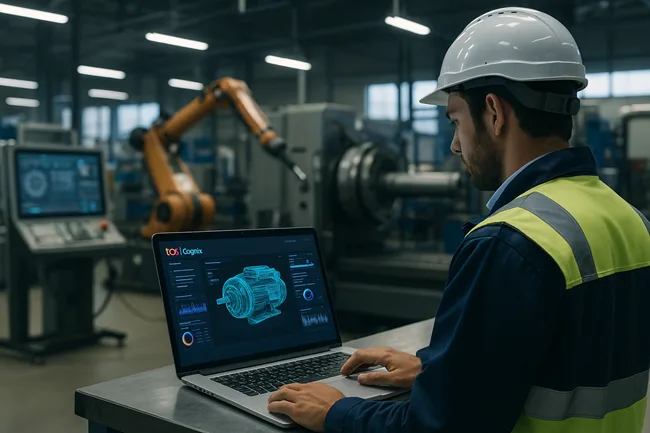
Cognix, which applies AI and ML to service delivery and infrastructure orchestration, has become central to the company’s manufacturing cloud strategy. It supports digital twin modeling, container orchestration, and enterprise observability through plug-and-play modules. This aligns with broader European policy trends around Industry 5.0, where manufacturers are being encouraged to combine advanced technologies with worker-centric design, energy efficiency, and compliance traceability.
Tata Consultancy Services’ Machine First Delivery Model complements Cognix by embedding automation at every delivery layer. It has allowed the firm to secure several pan-European contracts, particularly in telecom-manufacturing convergence zones, where network resilience and low-latency compute are essential for factory and plant environments.
What new cloud and digital twin initiatives has Tata Consultancy Services launched in Europe in 2025?
At Hannover Messe 2025, Tata Consultancy Services unveiled an integrated digital twin platform designed to support real-time production optimization, equipment lifecycle modeling, and predictive failure analytics. Executives showcased AI-powered neural plant frameworks that enable European manufacturers to process operations visibility using real-time data streaming and AI-led simulation feedback loops. These technologies were developed through Tata Consultancy Services’ innovation centers and its R&D partnerships with hyperscalers and engineering OEMs.
In parallel, Tata Consultancy Services expanded its delivery footprint in Toulouse by launching an AI-focused operations hub serving aerospace, automotive, and defense clients. This builds on its multi-decade presence in continental Europe and positions the firm to meet rising demand for nearshore, sovereign cloud-compliant delivery in regulated industries. With over 60,000 employees serving the region, Tata Consultancy Services maintains one of the deepest operational benches among Indian IT firms in Europe.
The company also continued to deepen its partnership with Google Cloud, launching new AI-native network transformation modules as part of its Cognix platform offering. These modules target manufacturing clients undergoing 5G rollout and edge-cloud convergence, providing intelligent container scheduling, secure remote diagnostics, and zero-trust compliance telemetry.
What recent European client wins and strategic deals are reinforcing Tata Consultancy Services’ industrial dominance?
Among the most significant European client wins in 2025 is Tata Consultancy Services’ engagement with UPM, the Finland-based materials innovation group. The scope includes full-stack IT transformation centered on AI-first operations, cloud-native infrastructure design, and regulatory monitoring across UPM’s global supply chain footprint.
The deal was widely noted by analysts as a signal that Tata Consultancy Services is capturing high-value, ESG-aligned transformation mandates in Europe—especially those involving manufacturing adjacency, bio-economy, and sustainability-linked digital systems.
Another landmark relationship is with Nuuday, Denmark’s leading telecom and technology firm. Although primarily a telecom rollout, the hybrid cloud and digital operations design have direct implications for Nuuday’s industrial clients and IoT partner ecosystems. The project includes Cognix-powered network observability, infrastructure-as-code automation, and low-latency workload migration across sovereign regions.
How does Tata Consultancy Services compare to Infosys and Wipro in manufacturing IT leadership?
Compared to Infosys and Wipro, Tata Consultancy Services leads in absolute scale, platform maturity, and European headcount in the manufacturing vertical. Infosys has made notable gains, especially in cloud-native HR transformation and aftermarket compliance-heavy deployments such as its Infosys Cobalt–powered LKQ Europe platform rollout. Infosys also brings strong Topaz integration for AI-native automation, particularly in supply chain resilience modeling.
Wipro, while smaller in scale, has carved a distinctive edge through its focus on sustainable IT, developer-first cloud platforms, and acquisitions such as Capco, which lend domain consulting depth in energy and utilities.
Tata Consultancy Services’ differentiation lies in its combined industrial legacy, infrastructure capability, and domain-specific automation. However, it faces increasing pressure to adopt the UX and developer tooling maturity found in more agile platforms used by Infosys and Wipro in their newer industrial deployments.
What is the current financial outlook for Tata Consultancy Services in the manufacturing vertical?
For the fiscal year ending March 2025, Tata Consultancy Services posted consolidated revenues exceeding USD 29 billion, with approximately 30 percent sourced from Europe. Within that, manufacturing, automotive, and engineering services contributed more than USD 8.5 billion, underscoring the centrality of industrial IT to the firm’s growth trajectory.
Operating margins remain among the best in class for Indian IT services providers, with Tata Consultancy Services reporting EBIT margins near 24.6 percent. Analysts note that Cognix-based transformation deals now comprise more than 20 percent of new digital pipeline wins in Europe, including several seven-year, multi-million-dollar managed service agreements.
Investor sentiment remains broadly positive. Institutional flows favor Tata Consultancy Services for its long-cycle deal resilience, high client stickiness, and ability to defend its market share in regions where IT modernization intersects with data localization and ESG mandates. Analysts tracking the stock continue to issue overweight ratings, citing manufacturing pipeline strength and generative AI roadmap alignment as core catalysts.
What are the future risks and opportunities for Tata Consultancy Services in manufacturing IT?
As the European Union pushes further into digital sovereignty, green industrial policy, and AI regulation, Tata Consultancy Services must ensure its platforms remain compliant, localized, and edge-capable. Clients are increasingly demanding native support for EU AI Act provisions, carbon-aware workload scheduling, and sustainability-linked metrics within IT service contracts.
At the same time, the firm has a clear opportunity to scale digital twin adoption across automotive, aerospace, and smart materials clients—particularly where predictive analytics, factory automation, and compliance tracking intersect.
If Tata Consultancy Services can continue enhancing Cognix with generative AI, co-pilot-driven automation, and container-first edge intelligence, it is well positioned to sustain its manufacturing IT leadership across Europe. Failure to accelerate innovation or respond to cloud-native mid-market disruptors, however, could erode its current advantage.
Discover more from Business-News-Today.com
Subscribe to get the latest posts sent to your email.