





Super Micro Computer Inc. (Supermicro, NASDAQ: SMCI) has added a new high-density server to its AMD lineup, unveiling a 6U MicroBlade system powered by the latest AMD EPYC 4005 Series processors. This launch, announced on October 23, 2025, is positioned to target the growing market for cloud-native computing, AI inference, and cost-effective data center workloads. Supermicro’s new platform is designed for cloud service providers, virtual desktop infrastructure (VDI), dedicated hosting, and online gaming environments, reinforcing the company’s strategy of aligning product development with scalable infrastructure demand.
The stock closed at USD 48.29 on October 24, gaining 0.77% intraday, and moved modestly higher to USD 48.50 in after-hours trading, according to Nasdaq data. While the broader market remains fixated on AI infrastructure plays, investors are increasingly assessing how server density, power efficiency, and CPU-GPU pairing will define competitive advantage in 2026 and beyond.
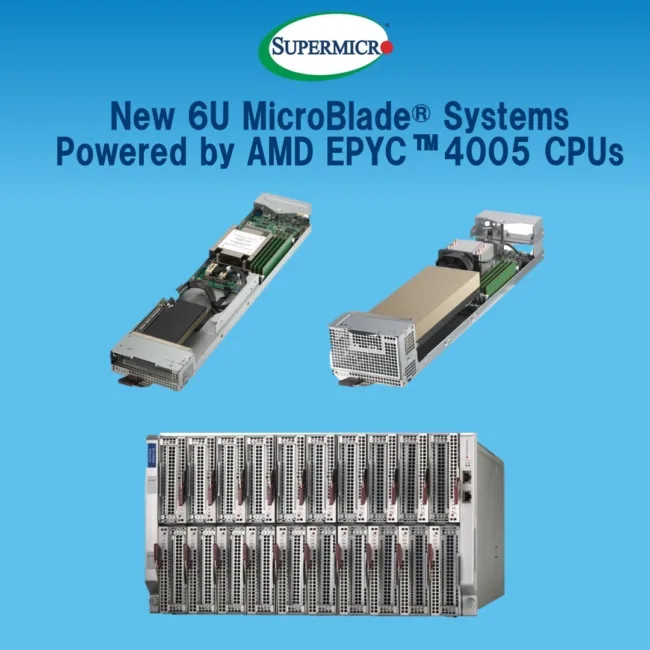
What are the key features of the AMD EPYC 4005-powered MicroBlade and why do they matter?
Supermicro claims that its new 6U MicroBlade solution offers 3.3 times the server density of traditional 1U servers. A single 48U rack using this system can support up to 160 servers, 16 Ethernet switches, and a centralized power and cooling management module. Each blade server includes an AMD EPYC 4005 processor with up to 16 cores, 192GB of DDR5 RAM, and optional dual-slot FHFL GPUs, optimized for mid-range compute-heavy tasks such as AI inference and cloud rendering.
Power efficiency is a central theme. The chassis includes 96% efficient Titanium Level power supplies, N+N redundancy, and built-in networking via dual-port 10GbE switches. This eliminates the need for sprawling cable systems while reducing energy and cooling costs. Supermicro estimates these systems can deliver up to 70% space savings, 30% power reduction, and 95% cabling elimination over traditional setups.
The system is designed to be “future-proof”, according to Charles Liang, President and CEO of Super Micro Computer Inc., who emphasized its scalability for emerging enterprise workloads. Its chassis management features include redundant management modules, open-standard IPMI interfaces, and support for Redfish APIs, simplifying the administration of large-scale deployments.
How is Supermicro positioning itself in the AI infrastructure ecosystem?
Super Micro Computer Inc. continues to strengthen its standing as a flexible, modular, and first-to-market server manufacturer serving the AI, 5G, and cloud segments. Its approach differs from that of traditional OEMs like Dell Technologies Inc. or Hewlett Packard Enterprise Co., which often rely on standardized product lifecycles. Supermicro leverages its building block architecture, allowing it to rapidly deploy custom hardware solutions optimized for a wide range of compute-intensive applications.
The addition of the AMD EPYC 4005 platform deepens Supermicro’s multi-silicon strategy. The company is also tightly aligned with NVIDIA Corporation, having already launched high-performance systems using NVIDIA HGX, Grace Hopper, and Blackwell architecture GPUs. With AMD’s entry into this product segment, Supermicro is extending its addressable market by catering to customers looking for cost-effective CPU-centric AI inference rather than GPU-heavy training workloads.
The move aligns with a broader trend where AI workloads are moving to the edge and inference-based applications are scaling faster than core training deployments. Super Micro Computer Inc. is betting that its power-efficient, rack-dense MicroBlade solution will gain traction among hyperscalers, content delivery networks, and AI-based SaaS platforms needing fast, repeatable compute cycles.
What differentiates the AMD EPYC 4005 platform in terms of technical architecture?
The AMD EPYC 4005 Series represents AMD’s latest offering in the Zen 5 CPU generation, engineered to offer a blend of performance and efficiency for enterprise deployments. With up to 16 cores and 32 threads, and configurable TDP as low as 65W, the chips cater to environments where density and energy costs are tightly managed. These CPUs are expected to perform well in web hosting, cloud orchestration, and low-latency compute tasks.
AMD’s Enterprise and HPC Business Vice President Derek Dicker emphasized the processor family’s versatility and cost-effectiveness. He noted that AMD worked with system partners like Super Micro Computer Inc. to design platforms that provide the flexibility and reliability required for modern workloads while remaining accessible for mid-sized enterprise and cloud businesses.
Importantly, the EPYC 4005 integrates AMD Infinity Guard security features and supports TPM 2.0, aligning with current enterprise compliance and cybersecurity expectations. This positions the platform as an appealing choice for use in multi-tenant environments, where data integrity and isolation are critical.
How are institutional investors evaluating Super Micro Computer Inc.’s AMD server launch in the context of hyperscale AI demand, margin expansion, and FY26 growth visibility?
Institutional investors are watching how quickly Supermicro can convert this hardware innovation into customer contracts—particularly in the cloud service provider segment where server refresh cycles are often tied to new AI service rollouts. While the stock rose slightly following the announcement, sentiment remains cautious amid broader macroeconomic concerns, rising interest rates, and delays in GPU shipment timelines.
Analysts are also tracking whether Supermicro’s product mix can support higher gross margins in future quarters. The AMD EPYC 4005-powered MicroBlade may offer a more attractive margin profile than GPU-centric servers given its lower BOM (bill of materials), smaller power draw, and lower thermal footprint. Some analysts suggest that the product’s performance-per-watt and rack-level consolidation benefits could become key differentiators if enterprise cloud budgets tighten in 2026.
Supermicro’s historical ability to scale revenue by quickly absorbing next-gen silicon into modular enclosures is seen as a bullish indicator. However, competition from Whitebox manufacturers in Asia, pricing pressure from larger OEMs, and potential supply chain disruptions remain risk factors.
How are traders interpreting the recent share price movement of Super Micro Computer Inc. and which forward indicators are being monitored for momentum into upcoming earnings and FY26 guidance?
Super Micro Computer Inc.’s share price action following the announcement has been relatively muted. The stock ended the trading session on October 24 at USD 48.29, reflecting a modest 0.77% gain, with after-hours trading pushing it to USD 48.50. Despite intraday volatility and some institutional rotation, trading volumes remain stable.
Market watchers are closely monitoring the company’s upcoming earnings call, guidance updates for FY26, and any commentary on order book conversion rates related to the new MicroBlade product. Any uptick in server shipment volumes, especially in Asia-Pacific or European cloud data centers, could shift sentiment toward a more bullish stance.
Traders are also watching for signs of capital expenditure alignment from AMD’s cloud customers, which could indirectly influence demand for AMD-powered Supermicro systems. If cloud-native workloads, particularly around inference and real-time content delivery, continue to outpace training investments, Super Micro Computer Inc. could see upside from this architecture shift.
What is the strategic outlook for Supermicro’s AI and cloud infrastructure roadmap?
Supermicro appears committed to broadening its product base while maintaining high velocity in integrating next-generation chipsets. The addition of the 6U AMD EPYC 4005-based MicroBlade extends its reach into energy-efficient inference workloads, a category expected to grow rapidly over the next three years.
Looking forward, the success of this platform will depend on its adoption among mid-tier cloud players, dedicated hosters, and edge-AI use cases. Supermicro’s continued investments in modular architecture, in-house manufacturing, and vertical integration position it well to capitalize on AI infrastructure growth in both mature and emerging markets.
Investors and technology buyers will also look for additional product SKUs in this line, potential GPU-integrated variants, and broader availability of Redfish-compatible management tools, which could tip the scales in competitive bid scenarios.
Key takeaways from Super Micro Computer Inc.’s AMD EPYC 4005 MicroBlade launch and investor response
- Super Micro Computer Inc. (NASDAQ: SMCI) has launched a new 6U MicroBlade server system powered by AMD’s EPYC 4005 Series, targeting dense, cost-effective compute for cloud service providers and AI inference workloads.
- The MicroBlade system supports up to 160 servers per 48U rack, offering 3.3x density versus traditional 1U servers, along with up to 30% energy savings, 70% space reduction, and 95% cable elimination.
- Each blade is powered by AMD EPYC 4005 CPUs featuring Zen 5 architecture, up to 16 cores, 192GB DDR5 memory, and optional dual-slot GPUs, optimized for modern, cost-sensitive AI and enterprise tasks.
- Supermicro aims to consolidate compute, power, and networking at rack scale, offering integrated 10GbE switching, Titanium Level power supplies, and Redfish-compatible management modules.
- Institutional investors are watching how quickly this platform converts to orders in hyperscale and enterprise markets, especially given recent macro headwinds and GPU inventory dynamics.
- SMCI’s stock closed at USD 48.29 on October 24, with modest after-hours movement, indicating measured sentiment as traders await FY26 guidance and earnings clarity.
- Analysts are tracking whether Supermicro’s diversification toward CPU-powered inference solutions could drive higher margin profiles and broader market share gains against Dell, HPE, and white-box vendors.
- The AMD EPYC 4005-based MicroBlade platform extends Supermicro’s position in modular, energy-efficient server solutions, a key theme for cloud-native and AI infrastructure growth heading into 2026.
Discover more from Business-News-Today.com
Subscribe to get the latest posts sent to your email.

