



State Bank of India became one of the most watched banking stocks on the National Stock Exchange after its shares fell sharply on May 8, 2026, despite reporting higher quarterly profit. The stock closed at ₹1,019.30, down 6.66 percent, as investors focused on weaker operating profit, domestic net interest margin pressure, and the sustainability of earnings into FY27. For retail investors landing on SBIN after the selloff, the immediate event to track is the ₹17.35 per share dividend record date on May 16, 2026, but the bigger test is whether India’s largest public sector lender can defend margins while continuing to grow advances and deposits.
Why did State Bank of India shares fall after Q4 FY26 despite higher net profit?
State Bank of India’s Q4 FY26 result created a classic earnings-day contradiction for retail investors. Standalone net profit rose to ₹19,684 crore for the March quarter, while full-year FY26 profit reached ₹80,032 crore. On a simple headline basis, that looked like a strong finish for India’s largest public sector bank.
The market reaction was harsher because investors looked below the net profit line. Operating profit fell to ₹27,704 crore from ₹31,286 crore a year earlier, while domestic net interest margin declined to 2.93 percent. For a bank of this scale, margin compression is not a small footnote. It directly shapes how investors judge the quality and repeatability of earnings.
The selloff therefore was not only about whether State Bank of India made money. It was about how it made that money. Lower provisions can support reported profit when asset quality is stable, but investors usually reward banks more when core lending income, operating profit, and margins are moving in the same direction. SBIN’s May 8 fall shows that retail investors now need to watch the operating engine more closely than the headline profit figure.
What does State Bank of India do and why does its banking scale matter to shareholders?
State Bank of India is the country’s largest public sector lender and one of the most important financial institutions in India’s banking system. Its business spans retail banking, corporate lending, agriculture credit, home loans, deposits, treasury operations, cards, insurance, mutual funds, and digital banking. That makes SBIN a proxy for India’s credit cycle rather than just another standalone banking stock.
The bank’s scale is its biggest advantage. Total business crossed ₹109 lakh crore in FY26, with deposits of nearly ₹59.75 lakh crore and advances of about ₹49.32 lakh crore. Few Indian financial institutions can match that combination of funding reach, customer base, branch network, digital distribution, and public sector trust.
For shareholders, this scale creates both comfort and complexity. The comfort comes from SBIN’s systemic importance, liquidity, dividend record, and deep role in India’s economy. The complexity is that a bank this large cannot easily escape system-wide pressure on deposit costs, interest rates, credit demand, or policy cycles. That is why the stock can look fundamentally strong and still correct sharply when margins disappoint.
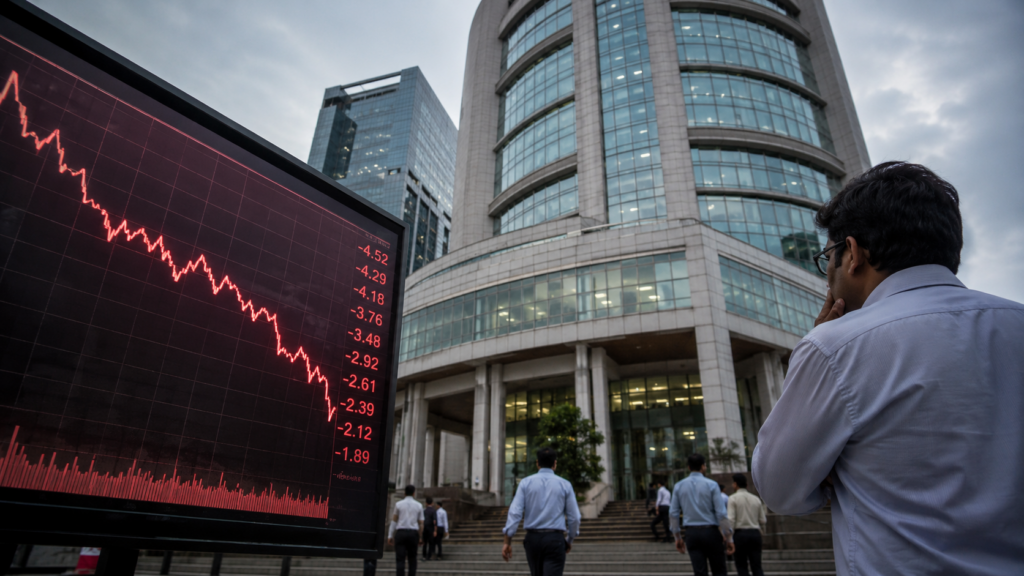
How is the market pricing SBIN after the May 8 share price correction?
SBIN closed at ₹1,019.30 on May 8 after a 6.66 percent fall, placing it below its 52-week high of ₹1,234.70 but still comfortably above its 52-week low of ₹755.50. That range matters because the stock is not trading like a distressed lender. It is trading like a large public sector bank whose earlier optimism has been tested by a weaker operating signal.
The market capitalisation remains in the ₹9 lakh crore plus zone, keeping State Bank of India among India’s most valuable listed financial institutions. That size gives the stock strong institutional ownership, index relevance, and high retail visibility. It also means that any earnings concern attracts immediate attention from mutual funds, foreign institutional investors, traders, and long-term shareholders.
Retail investors should read the correction as a valuation reset rather than a simple rejection of the bank. The stock had benefited from optimism around asset quality, public sector bank rerating, loan growth, and dividend appeal. The Q4 FY26 result did not remove those positives, but it forced the market to ask whether the earnings base deserves the same valuation if margins stay under pressure in FY27.
What are the next catalysts for State Bank of India investors after the dividend date?
The immediate confirmed catalyst is the dividend record date on May 16, 2026. State Bank of India declared a dividend of ₹17.35 per share for FY26, giving income-focused investors a near-term reason to track the stock after the price fall. However, the dividend is only the first checkpoint, not the main investment case.
The next major catalyst is management’s ability to show margin stability in the coming quarters. Investors will be watching domestic net interest margin, deposit cost trends, loan yield movements, treasury contribution, and operating profit growth. The Q1 FY27 result will matter because it will show whether Q4 FY26 was a temporary pressure point or the start of a more difficult earnings phase.
The milestone path is therefore clear. First comes the dividend record date. Then investors will track post-result commentary and analyst estimate revisions. After that, Q1 FY27 numbers will decide whether SBIN can regain confidence. If margins stabilise and credit growth remains healthy, the May 8 decline may begin to look excessive. If margins weaken further, the stock could stay under pressure despite its strong franchise.
How do interest rates and deposit competition affect the SBIN investment case in FY27?
State Bank of India’s FY27 investment case depends heavily on the interest rate and deposit environment. Banks earn a large part of their income from the spread between lending yields and funding costs. When deposit competition increases or lending yields soften, net interest margin comes under pressure. That is the core reason SBIN’s margin decline became the headline issue for the market.
India’s banking system has seen strong demand for loans across retail, corporate, infrastructure, and working capital segments. However, deposit growth has become more competitive, forcing banks to work harder to protect low-cost funding. For a bank as large as State Bank of India, even a small change in deposit costs can have a large impact because the balance sheet is massive.
The positive offset is that asset quality remains far healthier than in earlier public sector bank cycles. Lower provisions helped support profit in Q4 FY26, and that reflects a cleaner credit book. However, retail investors should not confuse lower credit costs with unlimited earnings strength. The real FY27 question is whether SBIN can grow loans without sacrificing spreads, because margin pressure can quickly dilute the benefit of scale.
Why are retail investors debating whether SBIN is a value buy or a value trap?
SBIN naturally attracts retail debate because it combines size, dividend appeal, public sector stability, and cyclical earnings sensitivity. After a steep one-day fall, one side of the market sees an opportunity to buy India’s largest bank at a discount to its recent high. The other side sees a warning sign that the best phase of margin-led earnings momentum may be behind the stock for now.
The bullish argument is straightforward. State Bank of India remains profitable, well capitalised, systemically important, and deeply embedded in India’s financial system. Its loan book is large, deposits are sticky relative to many smaller lenders, and improved asset quality gives the bank a stronger base than previous public sector banking cycles.
The cautious argument is equally important. A bank can look cheap only if earnings expectations hold. If operating profit stays weak or margins remain below investor comfort levels, the stock may not rerate quickly even if reported profit remains high. For retail investors, this makes SBIN a watchlist stock rather than a blind dip-buy. The next two quarters need to prove that the Q4 margin concern is manageable.
What execution risks should SBIN shareholders watch before expecting a rebound?
The first execution risk is margin defence. Domestic net interest margin at 2.93 percent is now the number investors will track most closely. If deposit costs remain elevated or loan pricing weakens, SBIN may struggle to convince the market that FY27 earnings can grow cleanly.
The second risk is operating profit weakness. Net profit can be supported by lower provisions, but operating profit tells investors more about the core banking engine. If operating profit does not recover, the market may continue to question the quality of earnings even if headline profit remains large.
The third risk is sector sentiment. Public sector banks have enjoyed a strong rerating in recent years as balance sheets improved and credit costs moderated. That rerating depends on continued evidence of discipline, profitability, and growth. If investors begin to believe that margin pressure is spreading across the banking system, SBIN could be affected even if its own asset quality remains stable.
Why does SBIN still deserve a place on retail investor watchlists after the selloff?
SBIN still deserves attention because the story has not ended with the May 8 correction. The stock remains one of the most liquid, visible, and widely held banking names in India. It sits at the intersection of dividend income, loan growth, public sector banking sentiment, and macroeconomic confidence.
The fall has also made the investment debate more useful. Before the correction, the stock was mainly a rerating story built on improved public sector bank credibility. After the correction, it has become a test of whether State Bank of India can defend its earnings quality in a tougher spread environment. That is a more serious question, but also a better one for long-term investors.
For retail investors, the cleaner approach is to watch the next data points rather than react emotionally to one session. The dividend record date may bring near-term attention, but the more important signals will come from Q1 FY27 margins, operating profit, loan growth, and deposit trends. If those numbers improve, SBIN could rebuild momentum. If they do not, the stock may need more time before the next meaningful rerating.
Key takeaways for retail investors tracking State Bank of India (NSE: SBIN)
- State Bank of India fell 6.66 percent on May 8, 2026, even though Q4 FY26 net profit rose, because investors focused on weaker operating profit and lower domestic net interest margin.
- SBIN closed at ₹1,019.30, below its 52-week high of ₹1,234.70 but still well above its 52-week low of ₹755.50, making the correction a valuation reset rather than a distress signal.
- The immediate catalyst is the ₹17.35 per share dividend record date on May 16, 2026, but the larger FY27 catalyst is whether margins stabilise.
- Domestic net interest margin at 2.93 percent is the key number to watch because it will shape investor confidence in the bank’s earnings quality.
- State Bank of India’s scale remains a major strength, with total business above ₹109 lakh crore, but that scale also makes deposit cost and margin pressure highly material.
- The stock remains important for retail investors because it combines dividend appeal, public sector bank exposure, macro sensitivity, and high liquidity.
- The next two quarters will decide whether the May 8 selloff was an overreaction or the start of a slower rerating phase for SBIN.
Discover more from Business-News-Today.com
Subscribe to get the latest posts sent to your email.