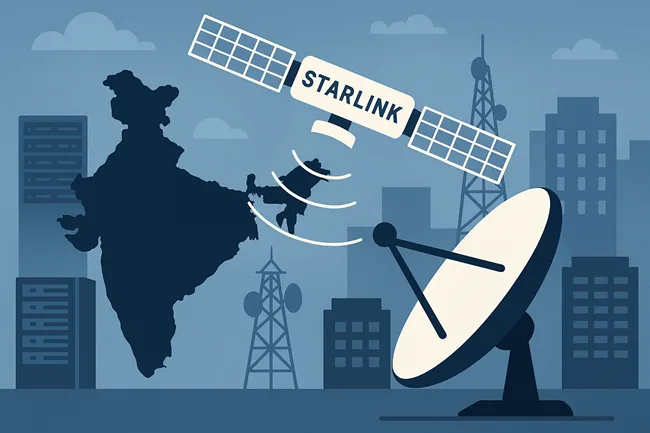
Starlink, the satellite broadband arm of SpaceX founded by Elon Musk, has accelerated its India entry strategy after receiving the green light from the Department of Telecommunications. The company has begun advanced discussions with Indian data centre operators, internet exchanges, and leading telecom companies, marking its most aggressive move yet toward establishing a nationwide presence. With plans to spend at least ₹500 crore in the initial phase, Starlink is positioning itself to deliver high-speed satellite internet across underserved and remote areas, potentially transforming India’s connectivity landscape.
Industry sources confirm that Starlink is in talks with data centre majors such as Sify Technologies, STT, Equinix, and CtrlS, as well as internet exchanges like DE-CIX and Extreme. The company is also exploring arrangements with fiber backbone provider Microscan and distribution partnerships with Bharti Airtel, Reliance Jio, and Tata Communications. Seventeen ground-station sites have already been identified across the country to comply with regulatory requirements that satellite players must establish domestic terrestrial infrastructure.
Why has Starlink’s India launch gathered speed after regulatory clearance and what rules shape its operations?
The major breakthrough came in June 2025, when the Department of Telecommunications granted Starlink a licence to provide commercial satellite broadband services. The approval followed months of scrutiny over spectrum usage, compliance norms, and the company’s earlier regulatory missteps in 2021, when pre-orders were halted due to lack of approval.
Under the new licence, Starlink is required to comply with strict data sovereignty rules. All user data must be stored within India’s borders, with routing prohibited through overseas servers or mirrored storage facilities. According to telecom ministry officials cited in the Times of India, the government has made it clear that routing or storing data outside India will not be tolerated, even temporarily. This move aligns with India’s broader data localization policies designed to safeguard national security and user privacy.
The regulatory clearance also brings Starlink into direct competition with other global and domestic satellite internet players such as Eutelsat OneWeb, Reliance Jio-SES, and Amazon’s Project Kuiper. Apple has also partnered with Globalstar for satellite connectivity features in iPhones, adding another layer of rivalry in this emerging market.
How are partnerships with Reliance Jio and Bharti Airtel shaping Starlink’s entry strategy in India?
Perhaps the most striking development is Starlink’s collaboration with India’s largest telecom operators. Both Reliance Jio and Bharti Airtel have reportedly entered into partnership agreements with Starlink for distribution and infrastructure sharing. While these operators are competitors in the terrestrial 5G space, alignment with a satellite player offers them an opportunity to extend their reach into rural and hard-to-serve geographies.
Industry observers suggest these partnerships may serve as a hedge against each operator’s satellite joint ventures. Bharti Airtel has stakes in Eutelsat OneWeb, while Reliance Jio is aligned with Luxembourg-based SES. Despite these associations, both appear to be hedging bets by working with Starlink as well, reflecting the scale of demand in India’s connectivity market.
Institutional sentiment has been cautiously optimistic. Analysts note that partnering with Jio and Airtel will give Starlink distribution muscle, faster onboarding of subscribers, and a stronger political shield in India’s complex regulatory environment. However, questions remain on pricing, customer acquisition costs, and service affordability in a market dominated by low-cost mobile internet.
What role will ground stations, IXPs, and data centres play in Starlink’s hybrid model for India?
Unlike its operations in the United States and Europe, Starlink cannot simply rely on satellite constellations orbiting at low Earth altitude. Indian regulators require the company to establish local infrastructure for downlinking and data handling. This has led to its active negotiations with IXPs, data centres, and fiber players.
Seventeen potential sites for ground stations have already been mapped across the country. These stations will be crucial for linking satellites with India’s terrestrial internet backbone, ensuring compliance with routing rules and reducing latency.
Partnerships with IXPs such as DE-CIX India are equally significant. By linking into local exchanges, Starlink can deliver faster connections to content providers, cloud services, and enterprise clients. Data centre tie-ups with Sify, Equinix, and CtrlS, meanwhile, will help it establish secure colocation environments that comply with India’s stringent regulatory regime.
The hybrid model—combining satellites in orbit with domestic terrestrial nodes—underscores that Starlink is adapting its playbook for India rather than simply transplanting its U.S. approach.
Can Starlink overcome India’s price sensitivity and compete with low-cost mobile broadband?
India’s telecom market is notoriously price-sensitive. Mobile data costs are among the lowest in the world, thanks to intense competition among Reliance Jio, Bharti Airtel, and Vodafone Idea. Against this backdrop, satellite internet services, often priced at a premium, may struggle to attract mass-market users.
Industry analysts argue that Starlink’s target audience in India will initially be niche segments—rural households without access to 4G or 5G, small businesses in remote areas, defense and disaster recovery operations, and enterprise clients with redundancy requirements. For these segments, reliability and coverage matter more than rock-bottom prices.
Still, the company may need to localize its pricing strategy. Its global hardware kit costs around USD 499 (roughly ₹41,000) with monthly charges of USD 110 (around ₹9,000). For India, market watchers expect lower upfront pricing models, possible financing partnerships, and tiered service plans. Without such measures, mass adoption will remain a challenge.
What do experts say about the long-term impact of Starlink on India’s digital economy and telecom ecosystem?
Telecom experts believe Starlink’s entry will accelerate India’s digital inclusion goals under the government’s Digital India program. By connecting hard-to-reach areas, it could complement BharatNet, India’s state-backed rural broadband initiative.
However, they also caution that competition from OneWeb, Amazon Kuiper, and Jio-SES will prevent Starlink from enjoying first-mover monopoly advantages. Instead, the sector is likely to evolve into a multi-player environment, with partnerships, joint ventures, and government coordination shaping outcomes.
Investor sentiment has been mixed but leaning positive. Global funds tracking satellite broadband see India as one of the largest untapped growth markets. Domestic investors, however, highlight regulatory risks, price wars, and potential challenges in customer service delivery at scale.
Looking forward, experts suggest that Starlink’s ability to build trust—through compliance, local partnerships, and transparent pricing—will determine its long-term success. If executed effectively, the venture could reshape how India approaches last-mile connectivity, setting the stage for broader integration with 5G, cloud services, and AI-driven digital infrastructure.
Can Starlink redefine India’s connectivity future or will rivals blunt its impact?
The next 12 months will be critical for Starlink. With licences in hand, infrastructure build-out underway, and partnerships in motion, the company is closer than ever to launch. Yet, its ability to balance compliance, affordability, and execution will decide whether it becomes a disruptive force or a niche provider.
India’s satellite broadband sector is on the cusp of rapid growth, and Starlink’s early-mover positioning, combined with Musk’s global brand pull, makes it a headline player. If rural adoption accelerates and enterprise demand expands, the company could become a key pillar of India’s digital economy. But with OneWeb, Jio-SES, and Amazon Kuiper circling, the battle for India’s skies is only just beginning.
Discover more from Business-News-Today.com
Subscribe to get the latest posts sent to your email.