


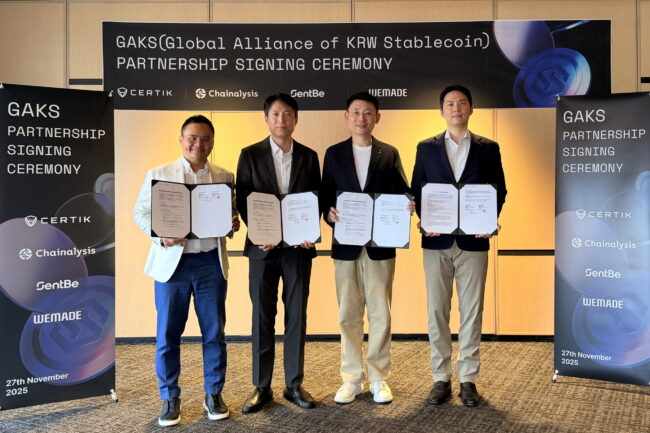
WEMADE, the South Korean gaming and blockchain infrastructure developer behind the WEMIX ecosystem, has launched a major initiative to scale its Korean won-backed stablecoin ambitions globally. On November 28, 2025, the firm formally announced the formation of the Global Alliance for Korean Won Stablecoin (GAKS), bringing together compliance, security, and fintech partners including Chainalysis, CertiK, and SentBe. The partnership is designed to anchor the next phase of WEMADE’s stablecoin strategy via its proprietary blockchain mainnet, StableNet.
The alliance’s objective is to develop a secure, fully auditable, and scalable digital infrastructure for Korean won stablecoins that aligns with international standards while responding to Korea’s growing momentum in stablecoin policy development. WEMADE’s goal is to transform its Layer-1 blockchain from a gaming-native protocol into a financial-grade settlement layer with compliance baked into its design. The partnership was signed in Singapore during a formal ceremony, accompanied by a fireside chat where representatives discussed roadmap strategies, infrastructure requirements, and global market potential for the KRW stablecoin.

Why has WEMADE partnered with Chainalysis, CertiK, and SentBe to build its stablecoin infrastructure?
The alliance serves as a strategic upgrade to WEMADE’s earlier blockchain efforts by integrating best-in-class capabilities across security, compliance, and payment interoperability. Each partner plays a distinct role in hardening and scaling StableNet’s infrastructure for global use cases.
Chainalysis, a recognized leader in blockchain transaction intelligence, will integrate several tools into StableNet including Hexagate for Web3 threat detection, Sentinel for transaction monitoring, and Alterya for AI-driven scam prevention. This three-tiered compliance and risk mitigation stack is expected to form the first line of defense for StableNet against illicit activity, a requirement for any stablecoin infrastructure seeking adoption by financial institutions and regulators.
CertiK will oversee technical validation of StableNet’s security framework. This includes full smart contract audits, real-time on-chain monitoring, and the deployment of a block explorer to improve transparency. CertiK will also continue to provide node validation and mainnet support services, ensuring that network performance and operational integrity remain institution-grade.
SentBe, a licensed Major Payment Institution in Singapore, brings the remittance execution layer. The company, which has facilitated over 10 billion dollars in cross-border transactions across 174 countries, will integrate its infrastructure into StableNet to enable fiat on- and off-ramp services. SentBe’s role will center around building real-world utility for the KRW stablecoin, especially in regulated money movement corridors across Asia and other emerging markets.
WEMIX Vice President Shane Kim, who also serves as CEO of WEMADE’s blockchain division, stated that the partnership marks a milestone in transforming StableNet from a proof-of-concept into a globally scalable stablecoin infrastructure. He noted that the integration of top-tier global partners reflects WEMADE’s commitment to building a digital asset framework that meets the expectations of both Korean regulators and international institutions.
How does StableNet position itself against global stablecoin competitors?
WEMADE is entering a competitive and increasingly regulated space where most major blockchain ecosystems are pursuing stablecoin strategies. Unlike crypto-native stablecoins like Tether (USDT) or USD Coin (USDC), which are primarily backed by fiat reserves and used in speculative trading, StableNet is being designed from the ground up as a compliance-first network aimed at real-world applications, particularly in remittances and Web3 commerce.
Analysts tracking the stablecoin sector believe that South Korea’s regulatory clarity around digital assets gives WEMADE a potential early mover advantage. The Financial Services Commission and Bank of Korea have signaled interest in tokenized assets, CBDCs, and stablecoins, and several pilot projects are already underway in Korea’s fintech ecosystem. WEMADE’s partnership with SentBe allows it to directly tap into licensed payment infrastructure, creating a potentially frictionless corridor for stablecoin-based money movement between Korean banks and overseas markets.
Chainalysis Vice President for Asia Pacific James Ang emphasized that durable stablecoin ecosystems require deep-rooted compliance, real-time threat detection, and transparent transaction monitoring. He said that Chainalysis’s involvement is focused on ensuring StableNet is architected with compliance at its core from the outset, enabling safe adoption at scale without compromising regulatory obligations.
CertiK’s co-founder Ronghui Gu noted that the security firm has been working with WEMIX for several years and sees StableNet as a natural extension of WEMADE’s evolution from Web3 gaming to financial infrastructure. Gu stated that the alliance will allow CertiK to deepen its security role and help Korea build a transparent and competitive digital asset environment capable of interfacing with the broader global financial system.
What does this mean for the future of blockchain-enabled remittances and real-world asset tokenization?
The inclusion of SentBe in the alliance signals a clear pivot from theoretical utility to practical use cases. Unlike many blockchain projects that remain in development stages or face adoption bottlenecks due to regulatory complexity, WEMADE is aiming to solve an immediate, high-friction pain point: cross-border remittance efficiency.
SentBe’s ability to execute multi-currency transfers at scale and its regulatory positioning in Singapore make it a vital enabler of WEMADE’s vision for stablecoin-powered remittances. By anchoring the KRW stablecoin in real transaction flows, WEMADE hopes to build a liquidity foundation that can later support tokenized bonds, central bank settlement pilots, and digital wallets for gaming and commerce.
Industry observers suggest that this design could allow WEMADE to gradually extend StableNet’s role into broader real-world asset tokenization applications, including synthetic FX, e-commerce payments, and eventually institutional-grade digital asset custody solutions.
What is the development timeline and when will the StableNet mainnet go live?
WEMADE publicly released the testnet source code for StableNet in October 2025. A public testnet is expected to go live in December, with a mainnet launch tentatively scheduled for early 2026 following a stability verification phase. The roadmap aligns with the alliance’s stated goal of delivering production-grade infrastructure that can immediately support regulatory-compliant remittance flows.
The launch schedule is seen as aggressive but achievable given the pre-existing maturity of WEMADE’s blockchain ecosystem. WEMIX already operates a high-throughput Layer-1 chain and supports a variety of tokenized in-game assets, NFTs, and DeFi products, which could be ported into StableNet or linked via cross-chain bridges.
How are markets and institutional observers reacting to WEMADE’s move into stablecoin finance?
While WEMADE is not publicly listed, its influence within South Korea’s Web3 and gaming sectors has grown steadily in recent years. Institutional sentiment toward stablecoin infrastructure remains cautious but optimistic, with analysts citing the need for compliance-first blockchain products that can serve real economic functions beyond speculation.
GAKS is being closely watched as a potential test case for national currency stablecoins that are not central bank issued but operate within regulatory guardrails. Observers point to StableNet’s potential role in facilitating regional trade settlement, diaspora remittances, and e-commerce payments, all of which are critical to building a functional digital currency system anchored in fiat currency trust.
Market analysts believe the alliance model could be replicated for other currency-backed stablecoins in Asia and Latin America, especially where compliance concerns and remittance dependencies are high. The strategic depth of WEMADE’s partner network gives StableNet credibility as it prepares for launch, and its early focus on transparency, auditability, and utility makes it a rare example of a stablecoin initiative with institutional design from inception.
What are the long-term implications for South Korea’s role in global Web3 finance?
South Korea is fast becoming a policy laboratory for stablecoin regulation and Web3 finance innovation. If StableNet and GAKS succeed in executing their joint roadmap, they could set a precedent for how private sector-led stablecoin infrastructure can gain legitimacy without bypassing regulatory frameworks.
WEMADE’s dual identity as a AAA gaming developer and blockchain infrastructure builder gives it unique access to both consumer and institutional ecosystems. If its stablecoin ambitions align with South Korea’s emerging fintech strategy, StableNet could become a cornerstone for the country’s broader digital financial infrastructure.
The coming months will reveal whether the alliance can move beyond press releases and turn infrastructure into adoption. The involvement of Chainalysis, CertiK, and SentBe significantly raises expectations, and investors across the digital asset ecosystem will be watching closely as WEMADE attempts to redefine what it means to build a national stablecoin with global ambitions.
What are the key takeaways from WEMADE’s KRW stablecoin alliance with Chainalysis, CertiK, and SentBe?
- WEMADE has launched the Global Alliance for Korean Won Stablecoin (GAKS), partnering with Chainalysis, CertiK, and SentBe to scale its KRW-backed stablecoin ecosystem.
- The initiative centers around StableNet, WEMADE’s Layer-1 mainnet purpose-built for compliance-first stablecoin issuance and cross-border utility.
- Chainalysis will provide advanced compliance tools including threat detection (Hexagate), transaction monitoring (Sentinel), and scam prevention (Alterya).
- CertiK will oversee full security audits, node validation, on-chain monitoring, and provide a public block explorer to support infrastructure transparency.
- SentBe will contribute licensed remittance capabilities and on/off-ramp infrastructure, enabling real-world cross-border payment use cases for the KRW stablecoin.
- The alliance aligns with South Korea’s growing regulatory clarity around digital assets and stablecoins, with institutional observers viewing it as a model for future compliant stablecoin ecosystems.
- StableNet’s public testnet is expected to go live in December 2025, with mainnet launch planned for early 2026 after stability checks.
- Analysts say the initiative could evolve into a broader real-world asset tokenization platform with regional trade, payment, and gaming integrations.
- WEMADE is positioning itself beyond gaming, building financial-grade blockchain infrastructure that could interface with central banks, fintech platforms, and regulators.
- The project is being closely watched as a blueprint for how private sector stablecoins can gain global relevance while meeting institutional compliance standards.
Discover more from Business-News-Today.com
Subscribe to get the latest posts sent to your email.