




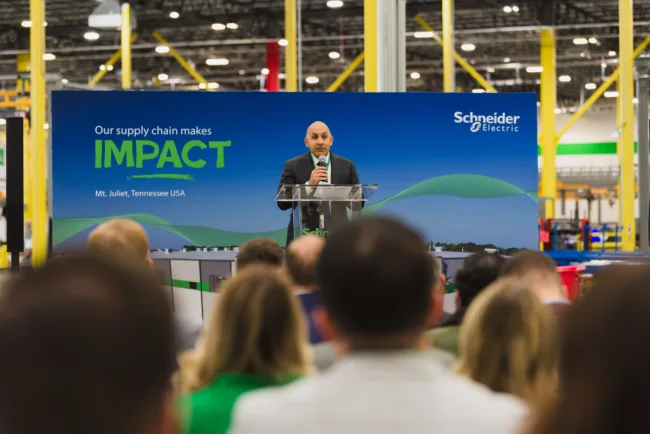
Schneider Electric has officially opened its first manufacturing facility in Mt. Juliet, Tennessee, marking a significant milestone in the company’s long-term U.S. expansion strategy and commitment to resilient energy infrastructure. The newly launched 500,000+ square foot facility is part of a larger two-building campus located near Nashville, with a second 540,000+ square foot facility currently under construction.
The new site will manufacture custom medium-voltage power distribution products critical for enhancing grid reliability, particularly in the context of rising demand from sectors such as data centers, advanced manufacturing, and critical infrastructure. Schneider Electric, which is headquartered in France and operates in over 100 countries, sees this Tennessee buildout as a central pillar of its North American growth and localization agenda.
The launch event, held on U.S. Veterans Day, not only celebrated the facility’s opening but also spotlighted Schneider Electric’s ongoing veteran hiring initiatives, aligning with its recent 2026 Gold Military Friendly Employer recognition. The company has also launched a broader veteran hiring campaign focused on strengthening mission-ready workforces for critical infrastructure.
How does the Mt. Juliet facility fit into Schneider Electric’s U.S. manufacturing roadmap?
The Mt. Juliet site is Schneider Electric’s first manufacturing facility in this part of Tennessee, but it’s far from an isolated investment. It complements the company’s existing R&D and production footprint in Franklin and Smyrna, creating a regional manufacturing hub designed to serve expanding demand across the U.S. and North America. The full campus, once both buildings are operational, will exceed one million square feet in total manufacturing space.
According to Schneider Electric, the Mt. Juliet plant will focus on producing air-insulated switchgear, gas-insulated switchgear, and shielded solid insulation systems. These medium-voltage products are essential components for utilities, commercial buildings, and energy-intensive industries aiming to increase energy reliability and grid resilience.
The project also aligns with national infrastructure initiatives, including the Bipartisan Infrastructure Law and Inflation Reduction Act, which prioritize energy modernization, domestic manufacturing, and decarbonization. By scaling domestic production of energy distribution technologies, Schneider Electric is positioning itself to capture a larger share of public and private investment flows in the sector.
Notably, the Mt. Juliet campus is strategically located near the future home of the Tennessee Titans—Nissan Stadium—where Schneider Electric has also been named the official energy management partner. That partnership, combined with this manufacturing push, reinforces the company’s integration into both local economies and national critical infrastructure.
What does this expansion signal about Schneider Electric’s localization and sustainability strategy?
Schneider Electric’s decision to deepen its U.S. manufacturing base ties into two broader corporate themes: sustainability leadership and regional supply chain control. The company has long championed energy efficiency, sustainability, and net-zero initiatives across its global footprint, and it continues to be recognized for those efforts. In 2025, Schneider Electric was named “World’s Most Sustainable Company” by both TIME Magazine and Statista for the second consecutive year.
Moreover, this physical expansion in Tennessee follows a clear operational shift toward reducing reliance on international supply chains and bringing production closer to key end markets. Analysts tracking the energy technology sector believe Schneider Electric’s U.S. moves are a hedge against future supply shocks, geopolitical instability, and lead time risks.
The company’s presence now extends across multiple U.S. states, employing more than 23,000 workers and partnering with nearly 40% of the Fortune 500. According to internal estimates, Schneider Electric’s technologies are found in four out of 10 U.S. homes, 40% of global hospitals, and over 40,000 water and wastewater installations across 150 countries.
Industry observers say the Tennessee expansion also reflects increasing urgency to localize the manufacture of components needed for data center energy redundancy, AI workloads, electric vehicle charging, and critical grid upgrades—all of which are growing faster than legacy supply chains can accommodate.
How is Schneider Electric leveraging its workforce, veteran programs, and employer branding?
The facility’s opening was not only a manufacturing milestone but also a branding moment. The ribbon-cutting ceremony included recognition of more than 100 Schneider Electric employees in Tennessee who are U.S. military veterans. The company used the opportunity to highlight its 2026 Gold Military Friendly Employer designation and launched a new hiring initiative focused on veterans and former service members.
Schneider Electric North America President Aamir Paul emphasized the dual mission of supporting energy resilience and empowering a diverse workforce. He noted that accelerating deployment of innovative technologies is central to serving AI infrastructure, sustainable buildings, and critical systems, and that human capital is a major enabler of those goals.
Tennessee Governor Bill Lee, who attended the ceremony, echoed this sentiment, describing the Mt. Juliet project as both an innovation milestone and a jobs engine for the state. He credited Schneider Electric for strengthening the infrastructure backbone and supporting economic mobility across middle Tennessee.
From a recruitment and retention standpoint, Schneider Electric has also benefited from favorable employer rankings. It was listed on Glassdoor’s Best Places to Work for 2025 and has continued to build out internship, apprenticeship, and veteran-to-civilian workforce pipelines nationwide.
What are institutional signals and investor takeaways from this U.S. footprint expansion?
While Schneider Electric is privately headquartered in France, it remains a key supplier for public sector contracts, energy utilities, and large-cap firms globally—making its U.S. expansion a point of interest for institutional stakeholders in infrastructure, energy, and manufacturing ETFs.
Analysts see the Tennessee buildout as a bullish indicator of confidence in U.S. demand cycles for medium-voltage products and digital energy management systems. The project’s proximity to key customers like Nissan Stadium and regional utilities also suggests Schneider Electric is pursuing location-based co-investment opportunities.
Investors watching the reshoring trend in industrials have also flagged this as part of a broader shift among European manufacturers, alongside Siemens and ABB, toward deeper U.S. engagement amid IRA incentives, grid modernization priorities, and AI power consumption pressures.
Although Schneider Electric does not trade on a U.S. exchange, its American Depositary Receipts (ADRs) and exposure via mutual funds and sustainability ETFs could see renewed interest as institutions realign around infrastructure resilience and supply chain reliability themes.
What’s next for Schneider Electric’s Mt. Juliet campus and U.S. industrial growth?
With the second 540,000-square-foot facility still under construction, the Mt. Juliet site is poised to double its footprint in the coming quarters. When fully completed, the dual-campus setup is expected to become one of the most advanced medium-voltage equipment manufacturing hubs in North America.
Analysts expect the next phase of construction to further ramp output of energy-efficient components and AI-ready infrastructure systems, especially for sectors like hyperscale data centers, electric utilities, and water infrastructure.
The buildout is also likely to create additional downstream opportunities for local suppliers, training institutions, and logistics providers. From a policy perspective, it strengthens Tennessee’s positioning as a Southern U.S. energy-tech corridor, joining peers like Georgia, North Carolina, and Texas in attracting long-term industrial investment.
As the energy transition accelerates, Schneider Electric’s U.S. strategy appears calibrated to meet not just current demand, but future resilience standards, one medium-voltage panel at a time.
Key takeaways from Schneider Electric’s new Tennessee facility and veteran hiring strategy
- Schneider Electric opened its first Mt. Juliet, Tennessee manufacturing facility on November 11, 2025, covering over 500,000 square feet.
- A second 540,000+ square foot facility is under construction at the same campus, forming a major U.S. manufacturing hub.
- The site will produce medium-voltage power distribution products for data centers, infrastructure, and buildings.
- The launch event also honored 100+ Schneider Electric veteran employees and introduced a new hiring campaign for former service members.
- Schneider Electric employs 23,000 people in the U.S. and serves 40% of the Fortune 500.
- The project aligns with Schneider Electric’s sustainability and localization strategy, amid supply chain rebalancing.
- Industry analysts view the investment as part of a broader reshoring trend by global energy-tech companies.
- The facility supports regional customers including Nissan Stadium, where Schneider Electric is the energy management partner.
- The full Mt. Juliet campus is expected to play a key role in U.S. energy resilience and grid modernization efforts.
Discover more from Business-News-Today.com
Subscribe to get the latest posts sent to your email.