OpenAI, Oracle Corporation and Vantage Data Centers have confirmed the development of a massive hyperscale data infrastructure campus in Port Washington, Wisconsin, with total projected investment exceeding $15 billion. Branded as the “Lighthouse” campus, the project is part of the broader Stargate initiative—a multigigawatt AI capacity expansion originally announced by OpenAI and Oracle in 2025.
The new campus will be operated by Vantage Data Centers in partnership with Oracle Corporation and is expected to deliver close to one gigawatt of artificial intelligence compute power. Construction will begin shortly and the facility is slated to become operational by 2028. Beyond being one of the largest data center projects in the region’s history, the initiative positions Wisconsin as a vital link in the growing AI infrastructure race currently underway across North America.
This announcement marks the latest strategic deployment under OpenAI’s Stargate expansion plan, which aims to build out up to 4.5 gigawatts of compute capacity through a combination of purpose-built hyperscale campuses across multiple U.S. locations.
Why are OpenAI, Oracle and Vantage investing in Port Washington, Wisconsin?
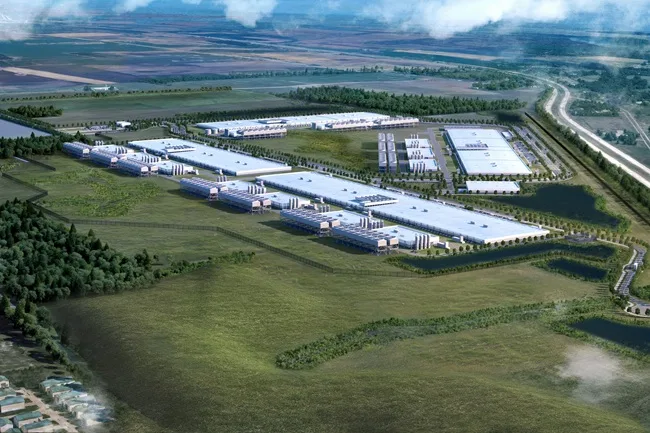
The Lighthouse project’s location in Port Washington was selected due to a combination of favorable infrastructure, proximity to clean energy sources, water availability, and access to skilled labor. The 672-acre site will host four high-density data centers, with Vantage Data Centers confirming that nearly 500 acres will be developed while preserving significant green space to support biodiversity and community aesthetics.
Wisconsin’s central position in the Midwest provides geographic advantages for AI data transmission and redundancy while also diversifying the country’s AI compute footprint beyond traditional hubs like Northern Virginia, Dallas, or Silicon Valley.
Oracle Corporation, which has steadily expanded its cloud infrastructure footprint, sees the collaboration as part of its long-term strategy to meet the growing demand for AI-specific workloads. The Lighthouse campus will be deeply integrated with Oracle Cloud Infrastructure (OCI), allowing clients—including OpenAI—to scale training and inference workloads seamlessly.
What sustainability measures are being built into the Lighthouse campus design?
The infrastructure vision for the Lighthouse campus reflects a full-stack commitment to environmental responsibility. Vantage Data Centers confirmed that 100% of energy consumed on site will be matched annually with zero-emission sources. Around 70% of newly developed renewable energy capacity—including solar, wind, and battery storage—will be allocated directly to the Lighthouse facility. The remaining 30% will be made available to Wisconsin consumers, creating a tangible public benefit.
The site will use a closed-loop liquid cooling system to reduce water usage, and Vantage is investing in water restoration projects to ensure that more water is returned to freshwater sources than the campus consumes—a move toward “water-positive” operations.
In addition, the campus will pursue LEED certification, enhance wetlands, install over 2,000 native trees, and build an eight-foot planted berm for sound mitigation, establishing a biodiversity net gain.
Vantage Data Centers’ North America President Dana Adams noted that the project reflects growing institutional demand for AI infrastructure that is not only high-capacity but also sustainable, decentralized and community-integrated.
What is the job creation and economic impact forecast for the OpenAI, Oracle and Vantage campus in Port Washington?
From a macroeconomic standpoint, the Lighthouse campus is expected to inject more than $2.7 billion into regional gross domestic product (GDP). More than 4,000 skilled construction jobs will be created during the build phase—most of which will be union roles. Once operational, the project is anticipated to support over 1,000 long-term jobs directly at the site, with additional indirect employment across local businesses, logistics, and service providers.
Port Washington Mayor Ted Neitzke IV emphasized that this “once-in-a-generation” investment would significantly uplift public services, strengthen community development, and enhance the local quality of life. The project’s multiplier effect is expected to benefit women-owned, minority-owned, and veteran-owned small businesses, with regional supply chains integrated into the build.
Milwaukee 7 Executive Director Rebecca Gries echoed that the impact would ripple beyond the immediate vicinity. She called it “a catalyst for regional transformation” that could reshape the seven-county economy by boosting innovation, housing, education, and entrepreneurship.
What infrastructure upgrades are included in the Port Washington data centre project and who will cover the costs?
Vantage Data Centers has committed a minimum of $175 million toward upgrading local infrastructure, which includes enhancements to water treatment facilities, expansion of sewer lines and water mains, the construction of a new water tower, and improvements in electric utility systems.
Importantly, none of these costs will be passed on to existing utility customers. WEC Energy Group, through its utility We Energies, has confirmed that Vantage is underwriting 100% of the investment into power infrastructure. A dedicated electricity rate has been proposed to serve the Lighthouse campus, designed to insulate residential and commercial customers from price hikes typically associated with large-scale infrastructure deployment.
Scott Lauber, President and Chief Executive Officer of WEC Energy Group, highlighted the dual benefit of this strategy: delivering nearly two gigawatts of new clean energy capacity while supporting community growth without rate increases.
How does this project fit into OpenAI’s broader compute capacity expansion plans?
OpenAI’s Vice President of Industrial Compute, Peter Hoeschele, stated that the expansion into Wisconsin is a “major step” toward building the infrastructure needed to support the growing societal impact of artificial intelligence. The Lighthouse site is part of the multistate Stargate initiative, which aims to resolve compute bottlenecks that have been cited as limiting factors in OpenAI’s ability to roll out advanced models.
As demand grows for high-performance generative AI systems and large-scale training clusters, OpenAI’s strategic alignment with Oracle Corporation and Vantage Data Centers reflects a shift from leasing space in legacy data centers to building dedicated hyperscale AI facilities.
Together with its Texas campus—“Frontier” in Shackelford County—and other Stargate locations, Vantage’s total infrastructure investment now exceeds $40 billion. Key institutional backers of Vantage’s North American platform include DigitalBridge Group, Inc. and Silver Lake, both of which are major players in digital infrastructure and technology investment.
How are markets reacting to Oracle and OpenAI’s Stargate expansion, and what key metrics are investors tracking?
Oracle Corporation (NYSE: ORCL) shares recently traded at USD 280.07, with a moderate gain of 2.7% in the previous session. The stock continues to benefit from growing institutional conviction in AI infrastructure exposure, even amid volatility in broader tech equities. Investors are closely tracking the monetization curve of Oracle’s AI infrastructure build-out—particularly how well Oracle Cloud Infrastructure (OCI) converts high-capacity leasing into recurring cloud revenues.
Institutional sentiment around hyperscale AI projects remains cautiously optimistic. While some analysts have noted concerns around cost intensity, debt structuring, and potential delays, the long-term strategic alignment between AI model developers, cloud providers and infrastructure operators is seen as critical to sustaining U.S. competitiveness in the AI era.
As for OpenAI, which remains private, the Port Washington project highlights its ongoing challenge to secure enough compute power to meet internal demand, especially as new versions of its models continue to grow in size and complexity.
What are the key risks facing the Port Washington AI data center project and what should stakeholders monitor?
Despite the strong economic, environmental and political backing, large data center builds carry execution risks. These include permitting delays, grid interconnection issues, land-use objections, and unforeseen environmental compliance requirements.
Local public discussion has already begun regarding transmission line capacity and land use planning. Stakeholders will need to ensure close coordination between utility operators, municipal agencies, and private developers to meet the ambitious 2028 go-live timeline.
Environmental impact assessments, water and power resource usage filings, and community engagement milestones will serve as key indicators of the project’s forward momentum. Investors, analysts and infrastructure watchers are advised to monitor these updates closely in the coming quarters.
What are the key takeaways from the $15 billion OpenAI, Oracle and Vantage data center announcement?
- OpenAI, Oracle Corporation and Vantage Data Centers have launched a $15 billion AI infrastructure project in Port Washington, Wisconsin, called the “Lighthouse” campus.
- The campus will house four hyperscale data centers delivering close to 1 GW of AI compute capacity, with completion targeted for 2028.
- The initiative is part of the broader Stargate program, aimed at deploying up to 4.5 GW of AI-specific infrastructure across the U.S.
- Over 4,000 union construction jobs will be created during the buildout phase, with more than 1,000 long-term jobs expected post-completion.
- The campus will operate on 100% matched zero-emission energy and employ a closed-loop liquid cooling system for water conservation.
- Vantage Data Centers is investing at least $175 million in local infrastructure upgrades without passing costs to existing utility customers.
- Oracle Cloud Infrastructure will integrate with the campus, aligning the project with its expanding AI cloud services strategy.
- Institutional sentiment around Oracle Corporation remains positive, with shares reflecting optimism tied to long-term AI infrastructure monetization.
- Stakeholders are watching closely for permitting progress, utility coordination, and environmental impact assessments to stay on timeline.
- The project positions Wisconsin as a key national hub in the AI infrastructure race, alongside other Stargate sites like Texas’s Frontier campus.
Discover more from Business-News-Today.com
Subscribe to get the latest posts sent to your email.