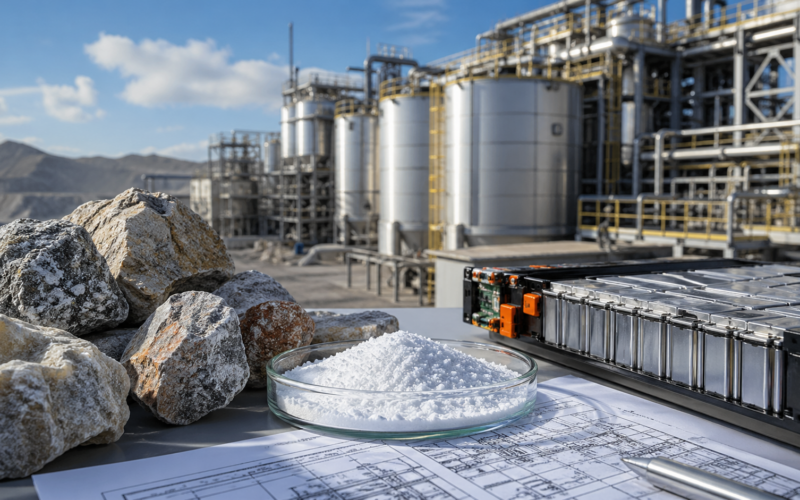
North America is trying to build a lithium supply chain that can move from mine development to battery-grade chemicals without depending on China’s dominant processing network. The United States and Canada have strategic projects, public financing tools, automotive customers and critical minerals policies, but the region still faces a difficult gap between mineral ownership and industrial-scale refining. Lithium Americas Corp.’s Thacker Pass project in Nevada, Rock Tech Lithium Inc.’s Red Rock Converter and Georgia Lake project in Ontario, and emerging Canadian refining capacity show how the continent is moving from raw material ambition toward battery materials integration. The strategic question is no longer whether North America has lithium resources; it is whether it can finance, permit, process and qualify them quickly enough to support electric vehicle manufacturing and reduce exposure to Chinese processing power.
Why is North America trying to localize the lithium supply chain now?
North America’s lithium localization push is being driven by a mix of industrial policy, energy security and supply-chain anxiety. Electric vehicle manufacturing, battery gigafactories, grid storage systems, defence technologies and advanced manufacturing all depend on critical minerals. Lithium sits at the centre of that stack because it remains a core input for many battery chemistries used in electric vehicles and energy storage systems.
The problem is that mining lithium is only one part of the supply chain. The more difficult strategic vulnerability lies in processing and conversion. China’s control over critical minerals processing has made policymakers in the United States, Canada and Europe increasingly uncomfortable, especially as trade tensions and export controls turn minerals into geopolitical leverage. The United States and European Union have now signed a critical minerals cooperation framework aimed at coordinating trade policies, investment, stockpiling, standards and tools such as border-adjusted price floors to counter non-market distortions in mineral supply chains.
That transatlantic cooperation matters for North America because it shows the lithium issue is no longer being treated as a niche mining concern. It is becoming part of economic security strategy. If the United States and Canada want local electric vehicle production to be resilient, they need a domestic or allied chain that covers extraction, refining, lithium hydroxide or carbonate production, battery manufacturing and recycling.
The challenge is timing. Battery factories can be announced faster than mines can be permitted, and mines can be developed faster than full chemical conversion ecosystems can be built. North America’s task is therefore not simply to produce more lithium. It must create a coordinated industrial chain where feedstock, refining, customers, capital and policy support move together. That is much harder than the “domestic lithium” slogan suggests.

How does Thacker Pass anchor the United States lithium supply-chain strategy?
Lithium Americas Corp.’s Thacker Pass project in Humboldt County, Nevada has become the flagship United States lithium development because it combines scale, domestic location, public financing and automotive-sector alignment. The project is structured through Lithium Nevada Ventures LLC, in which Lithium Americas Corp. owns 62% and General Motors Holdings LLC owns 38%. That ownership structure already says a lot about where the market is heading: automakers are no longer just buying batteries; they are trying to secure upstream and midstream materials exposure.
Thacker Pass is targeting Phase 1 production of 40,000 tonnes per year of battery-grade lithium carbonate. Lithium Americas Corp. has guided 2026 capital expenditure of $1.3 billion to $1.6 billion for Phase 1, including $1.2 billion to $1.5 billion in construction costs, other capitalized development costs and capitalized interest on the United States Department of Energy loan.
The financing stack is the most important part of the Thacker Pass story. Lithium Americas Corp. previously secured $2.23 billion in financing from the United States Department of Energy’s loan programme, supplemented by strategic investments from General Motors Company and Orion Resource Partners. Reuters also reported that the United States Department of Energy took a 5% stake in Lithium Americas Corp. and a separate 5% stake in the Thacker Pass project.
That structure turns Thacker Pass into more than a mining project. It is a template for how the United States may try to build strategic mineral capacity through public-private risk sharing. The government provides financing support, the automaker helps anchor demand and the developer executes the project. The risk, of course, is that this model depends on construction discipline, stable policy support and lithium market conditions that do not destroy project economics before production ramps up.
Why does Canada’s lithium opportunity depend on processing rather than just resource ownership?
Canada has an obvious role in North America’s lithium strategy because it combines mineral resources, clean power potential, proximity to United States automotive and battery markets, and a policy framework aligned with critical minerals development. But Canada’s opportunity will not be captured simply by exporting ore or concentrate. The more valuable strategic position is in processing, conversion and battery-grade materials.
Rock Tech Lithium Inc.’s Ontario strategy shows the direction of travel. The company is advancing an integrated platform that links its Georgia Lake project with the proposed Red Rock Converter in Ontario. The Red Rock project is positioned as a domestic, Inflation Reduction Act and Canada-United States-Mexico Agreement-aligned supply chain from mine to battery-grade lithium salts.
That matters because a mine-to-converter structure gives Canada a stronger role in the battery value chain. If Georgia Lake supplies feedstock and Red Rock converts it into battery-grade lithium products, the value creation stays closer to North American customers. Rock Tech Lithium Inc. has described Red Rock as a key project for Canada’s domestic critical minerals processing capacity, with the company framing the Ontario platform as a “rock to battery-grade lithium” chain.
The recent partnership between Rock Tech Lithium Inc. and BMI Group adds a financing dimension. Under the proposed structure, BMI Group would act as lead limited partner and anchor investor, while Rock Tech Lithium Inc. would retain control over project development, engineering, operations and key strategic decisions. This is important because lithium conversion facilities require capital structures that look more like industrial infrastructure than junior mining exploration.
For Canada, the larger opportunity is to become more than a resource warehouse. Clean electricity, industrial land, Indigenous partnerships, automotive proximity and trade alignment with the United States can all support a battery materials ecosystem. But the execution burden is high. Canada must connect mines, converters, refiners, battery manufacturers and customers before other regions capture the processing layer.
What role could Red Rock and Georgia Lake play in a North American battery materials corridor?
Rock Tech Lithium Inc.’s Red Rock and Georgia Lake pairing is useful because it shows how a regional lithium corridor could work in practice. Georgia Lake provides upstream resource exposure in Ontario, while Red Rock would create downstream conversion capacity. The physical proximity between the two assets is strategically relevant because transport costs, feedstock security and operational coordination matter in battery materials supply chains.
The Red Rock Converter is being positioned as Ontario’s first lithium conversion facility. If developed successfully, it could help Canada capture more value from its lithium resource base instead of exporting raw or semi-processed material into foreign refining systems. This is the exact supply-chain gap North America is trying to close. Mining provides the resource, but conversion creates the battery-grade product that customers actually need.
The project also fits into a wider North American industrial policy framework. Canada benefits from its alignment with United States trade rules and automotive supply chains, while the United States needs allied sources of critical minerals to support electric vehicle manufacturing and battery production. A Canadian converter that serves North American customers can therefore contribute to both Canadian industrial policy and United States supply-chain security.
However, the corridor concept depends on practical execution. Rock Tech Lithium Inc. still needs to secure financing, complete development milestones, validate project economics and demonstrate that its conversion strategy can compete through the lithium price cycle. The logic is strong, but investors will not value the corridor on logic alone. They will look for binding capital, customers, timelines and cost visibility.
Why is China’s processing dominance still the biggest strategic obstacle?
China remains the central strategic obstacle because North America’s lithium ambitions are competing against an existing processing ecosystem that is already scaled, cost-competitive and deeply integrated with battery manufacturing. Even if the United States and Canada develop more mines, the continent remains vulnerable if raw material still has to flow into Chinese-controlled processing chains.
That is why recent United States-European Union cooperation matters. The joint action plan is designed to address non-market practices, coordinate trade tools and potentially build standards-based markets for critical minerals. Officials have discussed mechanisms such as border-adjusted price floors, coordinated investments, offtake arrangements, crisis response and stockpiling. These ideas reflect a recognition that free-market pricing alone may not create resilient critical minerals supply chains when one country dominates processing capacity.
The risk for North America is that domestic projects may be strategically desirable but economically fragile. If lower-cost Chinese processing or oversupply depresses lithium prices, North American projects can struggle to attract financing. This is especially relevant for converters and refineries, which require large upfront capital and long payback periods. A mine can sometimes wait out a cycle. A partially built processing plant has less room for error.
Reducing China dependence therefore requires more than nationalism or procurement slogans. It requires a real industrial toolkit: public financing, private capital, long-term offtake contracts, trade coordination, permitting reform, price-risk management and customer willingness to pay for supply security. Otherwise, North America may remain dependent on the very processing system it is trying to escape.
Can public financing and automaker investment make lithium projects bankable?
Public financing and automaker investment are becoming essential because lithium projects face a difficult mix of strategic importance and commercial uncertainty. The Thacker Pass financing structure shows how this model can work. United States Department of Energy financing lowers the capital burden, General Motors Company’s participation links the project to downstream demand, and Lithium Americas Corp. provides the project development vehicle.
This model is likely to become more common. Automakers need secure battery material supply, but they are not naturally mining companies. Governments want supply-chain resilience, but they do not want to own every project outright. Developers need capital, but public equity markets can be volatile. Public-private structures can spread risk across stakeholders with different incentives.
Rock Tech Lithium Inc.’s Red Rock strategy points to another variation. Instead of relying only on public markets, the company is pursuing a general partner, limited partner structure with BMI Group as an anchor investor. That kind of structure may appeal to infrastructure-oriented capital because converters have project-finance characteristics if they can secure feedstock, customers and stable operating assumptions.
The unresolved issue is whether these capital structures can survive lithium price volatility. Investors may support critical minerals projects when policy momentum is high, but funding becomes harder when commodity prices weaken. For North America, the strongest projects will likely be those that combine strategic status with practical protections: contracted demand, financing support, cost discipline and credible construction plans.
What are the biggest execution risks for North America’s lithium buildout?
The first execution risk is permitting and community acceptance. Mines and processing plants require land, water, energy, infrastructure and local support. Even strategically important projects can face delays if communities, Indigenous groups, environmental regulators or local stakeholders are not aligned. A lithium supply chain cannot be built only in federal policy documents. It must be built in actual places.
The second risk is capital intensity. Thacker Pass alone is guiding $1.3 billion to $1.6 billion in 2026 capital expenditure for Phase 1. Converter projects also require significant funding before revenue arrives. If capital markets tighten or lithium prices weaken, developers may need to raise money on difficult terms. That can dilute shareholders and delay construction.
The third risk is technology and qualification. Battery-grade lithium is not a generic commodity in the way casual investors sometimes assume. Customers require consistent purity, reliable supply and qualified processes. A project can be strategically important and still fail to meet downstream specifications at scale. Qualification timelines can slow commercialization and affect revenue visibility.
The fourth risk is fragmented execution. North America has many pieces of the battery supply chain, but they do not automatically connect. Mines, converters, battery plants, automakers, recyclers and grid infrastructure need coordination. If one part of the chain moves faster than another, bottlenecks appear. The United States may build battery factories before enough domestic lithium chemicals are available. Canada may develop resource projects before conversion capacity is ready. The whole system has to synchronize, which is why this sector is more complicated than a standard mining cycle.
How should investors compare North American lithium supply-chain companies?
Investors should first separate resource ownership from supply-chain control. A lithium deposit is valuable, but the strategic premium increasingly belongs to companies that can move material toward battery-grade supply. That means mining assets must be evaluated alongside processing plans, conversion technology, financing pathways and customer relationships.
Lithium Americas Corp. offers a United States domestic production story anchored by Thacker Pass, public financing and General Motors Company participation. That makes it one of the most strategically visible lithium projects in North America. The investment case, however, remains tied to construction execution, capital discipline and the ability to bring Phase 1 production online at expected cost and quality.
Rock Tech Lithium Inc. offers a different profile. Its Ontario platform links Georgia Lake with the Red Rock Converter, while its broader strategy also includes European lithium conversion through Guben. That gives the company a transatlantic lithium processing angle. The opportunity is meaningful, but the company must prove that it can finance and execute converter projects while avoiding excessive dilution or delays.
Other Canadian and North American lithium refining initiatives, including newer electrochemical refining approaches such as Mangrove Lithium’s commercial facility in Delta, British Columbia, show that innovation may also shape the processing landscape. North America’s lithium buildout will not be one-size-fits-all. It will include mines, converters, direct lithium extraction technologies, chemical refineries, recycling facilities and customer-linked joint ventures.
For investors, the best question is not simply “Who has lithium?” The better question is “Who can deliver battery-grade lithium into a qualified North American supply chain at competitive cost?” That question cuts through hype and forces attention back to execution.
What happens if North America succeeds or fails in building a mine-to-battery lithium chain?
If North America succeeds, the region could reduce dependence on Chinese processing, strengthen electric vehicle manufacturing, improve supply-chain resilience and create a new industrial base around battery materials. Canada could become a major processing and refining partner for United States automotive and battery markets. The United States could anchor domestic lithium carbonate supply through Thacker Pass and additional projects. Together, the continent could move from resource potential to strategic material production.
If North America fails, the consequences are clear. Electric vehicle factories may remain dependent on imported refined materials. Automakers may face supply-chain exposure despite local assembly. Battery incentives may leak value to foreign processing hubs. Critical minerals policy could become a paperwork success but an industrial disappointment.
The most likely outcome sits between those extremes. North America will probably build meaningful capacity, but not quickly enough to eliminate dependence in the near term. The next decade will be defined by a race between project development timelines and geopolitical urgency. Every delay in permitting, financing or processing strengthens the position of incumbent suppliers.
That is why Thacker Pass, Red Rock and Georgia Lake matter as more than individual projects. They are test cases for whether North America can build an integrated lithium ecosystem that moves from mine to chemical to battery. The continent has the policy momentum. It has the resource base. It has the customer demand. Now it has to prove that it can connect the pieces before the bottleneck becomes permanent.
Key takeaways on North America’s lithium supply-chain strategy and China dependence
- North America’s lithium challenge is no longer only about mining; the harder bottleneck is battery-grade processing and conversion.
- Lithium Americas Corp.’s Thacker Pass project is the most visible United States test case for publicly backed domestic lithium production.
- Thacker Pass Phase 1 is targeting 40,000 tonnes per year of battery-grade lithium carbonate, with 2026 capital expenditure guidance of $1.3 billion to $1.6 billion.
- The United States Department of Energy, General Motors Company and Orion Resource Partners financing structure shows how strategic mineral projects may need public-private risk sharing.
- Rock Tech Lithium Inc.’s Red Rock Converter and Georgia Lake project show how Canada could move from lithium resource ownership toward integrated processing.
- Canada’s clean power, trade alignment and proximity to United States automotive markets give it a natural role in North America’s battery materials chain.
- China’s processing dominance remains the main strategic obstacle because mining outside China does not guarantee supply-chain independence.
- United States-European Union critical minerals cooperation signals that the lithium supply chain is now part of broader economic security policy.
- Investors should evaluate lithium companies by processing capability, customer qualification, financing structure and execution credibility, not just resource size.
- North America can build a mine-to-battery lithium chain, but only if projects move from policy alignment to financed, permitted and operating capacity.
Discover more from Business-News-Today.com
Subscribe to get the latest posts sent to your email.