




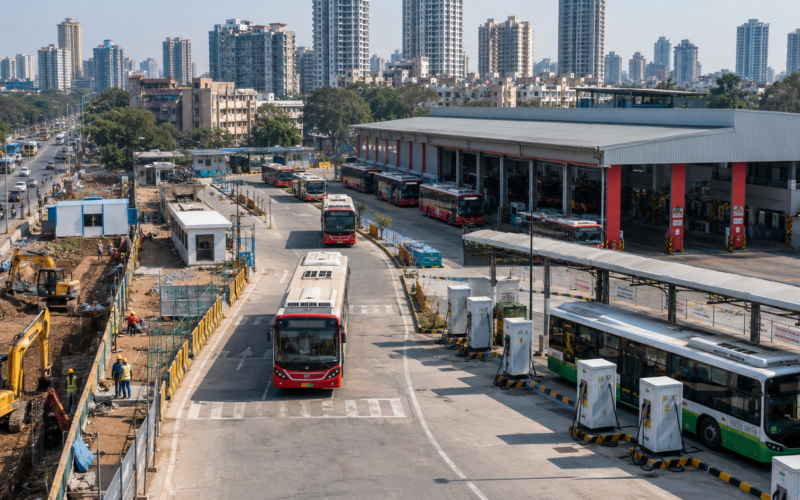
The Maharashtra government has directed authorities to prepare a long-term redevelopment blueprint for the Brihanmumbai Electric Supply and Transport undertaking, with 7,000 additional buses, electric vehicle charging infrastructure, depot modernisation, staff housing, public parking and commercial facilities forming the core of the proposed revival plan. The initiative is being framed as a way to strengthen Mumbai’s public transport network while using BEST-owned properties more efficiently under a structured redevelopment model. The government has also indicated that BEST land will not be sold, a clarification that matters because bus depots in Mumbai sit on some of the city’s most strategically valuable urban land. The plan could become one of Mumbai’s most consequential transport infrastructure decisions if it improves fleet capacity, depot operations and commuter reliability without weakening public ownership or reducing operating flexibility.
Why does the Mumbai BEST redevelopment plan matter for public transport and urban infrastructure?
The BEST redevelopment plan matters because Mumbai’s bus system is no longer only a transport issue. It is now a land-use, energy, housing, civic finance and climate infrastructure question rolled into one. A plan that proposes 7,000 additional buses cannot succeed unless depots are redesigned for parking, maintenance, charging, route management and staff facilities. In a city where road congestion, suburban rail crowding and last-mile connectivity remain chronic challenges, strengthening BEST is not optional urban decoration. It is part of Mumbai’s basic operating system.
The plan also matters because bus depots are among the few large publicly controlled urban assets still available across the city. Their redevelopment can unlock better commuter infrastructure, public parking, staff housing and modern transport facilities. However, the same assets can also attract real estate-led pressure if governance is weak. That is why the government’s statement that BEST land will not be sold is strategically important. It seeks to reassure commuters, employees and civic groups that redevelopment will not become a quiet transfer of transport land into private commercial hands.

For Mumbai, the larger question is whether depot redevelopment can support a genuine public mobility reset. BEST has faced fleet constraints, financial stress, service quality concerns and competition from private vehicles, app-based mobility and metro expansion. A better depot network can help the undertaking increase bus availability, reduce downtime and prepare for electric mobility. But if redevelopment focuses too heavily on commercial components and too lightly on operating capacity, the city may get prettier depots without a meaningfully stronger bus system. That would be very Mumbai, unfortunately, but not very useful.
How could 7,000 additional buses change Mumbai’s commuter mobility equation?
The proposed addition of 7,000 buses could significantly improve Mumbai’s surface transport capacity if procurement, deployment and depot readiness are aligned. More buses can reduce waiting times, improve route frequency, support feeder services to metro and suburban rail stations and expand access to underserved neighbourhoods. In a dense city, buses remain one of the most flexible and cost-effective public transport tools because they can be redeployed faster than fixed rail systems.
However, the bus number alone is not the success metric. Mumbai needs the right bus mix, route design, charging strategy, maintenance capacity and service reliability. If the new fleet is electric, charging cycles and route planning become inseparable. Buses cannot simply be added to the fleet and expected to perform if depots lack adequate chargers, power connections, load management systems and overnight parking space. Electrification is cleaner, but it is also less forgiving when infrastructure planning is sloppy.
The additional fleet could also help Mumbai integrate its growing metro network with last-mile connectivity. Metro expansion can shift some long-distance demand away from roads, but commuters still need reliable access to stations. BEST can play that role if route rationalisation is handled intelligently. The opportunity is to reposition buses as the connective tissue of Mumbai’s multi-modal transport system. The risk is that agencies continue planning in silos, leaving commuters to stitch together their own journeys with patience, luck and occasionally heroic walking.
Why is electric vehicle charging infrastructure central to BEST’s long-term revival?
Electric vehicle charging infrastructure is central because fleet electrification changes the economics and operations of bus transport. Diesel buses rely on fuel logistics, while electric buses rely on power capacity, charging speed, battery management, depot design and grid reliability. If Mumbai wants to scale electric buses meaningfully, BEST depots must become energy infrastructure hubs, not just parking lots with a few chargers added as afterthoughts.
The charging challenge has three layers. The first is physical infrastructure, including chargers, transformers, cabling, safety systems and vehicle circulation within depots. The second is grid readiness, because large fleets require reliable power supply and demand management. The third is operational scheduling, because buses must be charged without disrupting service availability. Any weak link can reduce fleet utilisation and turn electric buses into expensive assets sitting idle.
A well-planned charging network can also create broader benefits. It can support cleaner air, lower noise pollution and better long-term fuel cost predictability. Over time, depots with strong electrical infrastructure may also support other municipal mobility services or public charging use cases. However, BEST must avoid underestimating the complexity of electrification. Electric buses are not magic carpets. They need power, planning and maintenance discipline, preferably in that order.
How could the depot redevelopment model protect public assets while attracting private capital?
The proposed redevelopment model appears designed to use private capital for public infrastructure upgrades without outright sale of BEST land. This is a delicate balance. Mumbai needs investment in depots, buses, charging facilities, staff housing and public amenities, but public land has to remain aligned with transport priorities. A structured development model can work if concession terms are transparent, public mobility functions are protected and commercial use is treated as a funding tool rather than the main objective.
The strongest version of the model would ring-fence operational depot capacity. That means redevelopment should first guarantee bus parking, workshops, charging infrastructure, circulation space and staff facilities before adding commercial complexes, retail areas, parking hubs or entertainment spaces. If transport functions are squeezed to maximise real estate returns, the plan could weaken the very system it claims to revive. The land may stay legally public, but operational usefulness can still be diluted if design priorities drift.
Private participation can still be useful. Developers and infrastructure operators can bring capital, construction capacity and facility management expertise. Public parking, employee housing and mixed-use facilities can improve urban utility if planned well. The key is governance. Mumbai has seen enough infrastructure projects where public benefit arrives dressed nicely in the concept note and then gets lost somewhere between tendering and execution. BEST redevelopment needs stronger safeguards from the start.
What could the BEST plan mean for employees, commuters and Mumbai’s civic finances?
For employees, the inclusion of staff housing is significant because transport workers are part of the system’s reliability backbone. Better housing and depot facilities can support morale, reduce commute burdens and improve workforce stability. However, employee interests will depend on how redevelopment is phased. If depot land is temporarily disrupted, staff relocation, workshop continuity and operating conditions must be carefully managed.
For commuters, the success of the plan will be measured in practical terms. More buses must mean shorter wait times, cleaner rides, better route coverage, safer boarding, improved punctuality and easier access to metro and rail nodes. Public parking facilities and urban plazas may add civic value, but they should not distract from the main commuter promise. Mumbai residents will not judge the plan by architectural renders. They will judge it at a bus stop during peak-hour humidity.
For civic finances, redevelopment could help reduce pressure on BEST if commercial components generate recurring revenue or lower infrastructure costs. Yet the economics must be transparent. If revenues are overestimated, costs rise or concessions lock in unfavourable terms, the public sector may absorb the downside while private partners capture the upside. A revival strategy must therefore be financially disciplined and publicly accountable, not merely ambitious.
Why could BEST depot redevelopment become a test case for Indian city transport reform?
BEST depot redevelopment could become a test case because many Indian cities face the same problem in different forms. Bus systems need modern depots, electric charging, better maintenance, stronger financing and more integrated planning. At the same time, public transport agencies often control valuable land that can be used either to strengthen mobility or to plug financial gaps through commercial redevelopment. Mumbai’s choices could influence how other cities think about bus depot modernisation.
The plan also reflects the next phase of electric bus adoption in India. The first phase focused on procurement announcements and pilot deployments. The next phase is about whether cities can build the operational ecosystem required for scale. That includes depot power supply, charging schedules, route planning, battery warranties, maintenance skills and financial models. BEST has the opportunity to show how a legacy urban bus undertaking can transition into a cleaner and more integrated mobility platform.
There is also a policy lesson here. Urban transport reform cannot be separated from land policy. Depots are not dead real estate. They are mobility assets, energy assets and worker-support assets. If cities treat them only as monetisation opportunities, they may solve one balance-sheet problem while creating a bigger transport problem. Mumbai’s BEST plan will therefore be watched not only for buses, but for the governance template it creates.
What execution risks could derail the Mumbai BEST redevelopment plan?
The first risk is phasing. Depot redevelopment cannot happen in a way that sharply reduces bus availability or disrupts maintenance operations. Mumbai already operates under tight mobility pressure, so temporary capacity losses could quickly affect commuters. The redevelopment plan must therefore sequence construction, fleet procurement and charging installation carefully across locations.
The second risk is electric infrastructure readiness. Adding 7,000 buses, especially if a large share is electric, requires serious coordination with power distribution utilities, equipment suppliers and depot planners. Charging infrastructure must be ready before fleet deployment, not after buses arrive. Otherwise, Mumbai could face the familiar infrastructure comedy of assets waiting for the thing that makes them usable.
The third risk is public trust. BEST has emotional and practical importance in Mumbai, and depot land is sensitive. Any perception that redevelopment is primarily a real estate play could trigger resistance from civic groups, employees and commuters. Transparent tendering, clear land-use protections, published operating safeguards and measurable service goals will be essential. The government’s no-sale clarification is a useful start, but implementation will decide credibility.
How should Mumbai measure whether the BEST revival plan is actually working?
Mumbai should measure the BEST revival plan through commuter outcomes, not just redevelopment milestones. The most important indicators should include fleet availability, route frequency, passenger ridership, service reliability, electric bus utilisation, depot charging uptime, operating cost per kilometre, employee facility improvement and reduction in vehicle downtime. These metrics would show whether the plan is strengthening transport performance or merely creating new real estate assets around old depots.
The city should also measure how well BEST integrates with other transport systems. A stronger bus network should improve access to metro stations, suburban rail nodes, business districts, hospitals, schools and residential clusters. If buses operate as feeders rather than isolated routes, Mumbai can make better use of its expanding transport investments. Integration is where the real passenger value lies.
Finally, the plan should be judged on governance transparency. Public land, private capital and essential mobility services make a powerful but risky combination. If structured well, the model can modernise depots, expand buses and improve civic amenities. If structured poorly, it can leave Mumbai with compromised transport capacity and expensive regrets. The BEST redevelopment plan has the potential to be transformative, but only if the city remembers that the bus system is the point, not the sideshow.
Key takeaways on what the BEST redevelopment plan means for Mumbai’s public transport future
- Maharashtra’s BEST redevelopment plan could become a major urban mobility reform if it genuinely expands bus capacity, depot quality and electric charging readiness across Mumbai.
- The proposed addition of 7,000 buses would improve surface transport capacity only if fleet procurement is matched with parking, charging, maintenance and route planning.
- Electric vehicle charging infrastructure is central to the plan because large-scale bus electrification requires power-ready depots, grid coordination and operational scheduling discipline.
- The government’s statement that BEST land will not be sold is important because depot redevelopment in Mumbai can easily trigger public-asset and real estate monetisation concerns.
- A DBFOT-style redevelopment model can attract private capital, but transport functions must be protected before commercial facilities, parking hubs or retail components are added.
- Employee housing could improve workforce stability, but construction phasing must ensure that staff facilities, workshops and bus operations are not disrupted during redevelopment.
- Commuters will judge the plan by service reliability, route frequency, clean buses and waiting times rather than by commercial complexes or architectural presentations.
- Mumbai’s BEST plan could become a national model for bus depot modernisation if it links public land, electric mobility and urban services without weakening public control.
- The biggest execution risks include poor phasing, delayed charging infrastructure, weak concession safeguards and public distrust over depot land use.
- The long-term value of the plan will depend on whether BEST becomes a stronger mobility platform for Mumbai’s multi-modal transport future.
Discover more from Business-News-Today.com
Subscribe to get the latest posts sent to your email.

