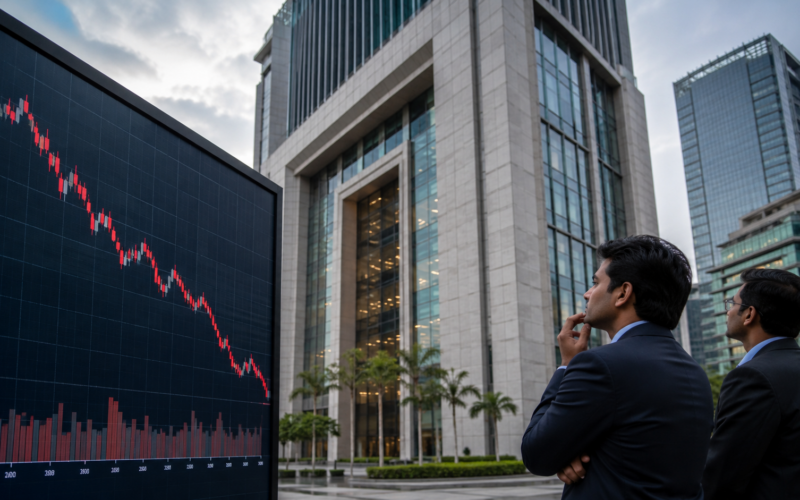
HDFC Bank Limited (NSE: HDFCBANK) remained under pressure on May 8, 2026, with the stock closing at ₹781.20 after falling 1.84 percent during a weak session for Indian equities. The decline came despite a Q4 FY26 result that showed profit growth, improved asset quality, and a ₹13 per share final dividend, keeping the retail investor debate focused on valuation, deposit growth, net interest margin, and post-merger earnings recovery. For investors tracking HDFCBANK after the latest dip, the next major catalyst is whether India’s largest private sector bank can turn steady balance-sheet growth into stronger return ratios through FY27.
Why did HDFC Bank shares fall on May 8 despite a stronger Q4 FY26 profit print?
HDFC Bank’s May 8 decline was not a dramatic earnings shock like some larger single-day banking selloffs, but it still mattered because the stock remains one of the most widely owned private bank counters in India. The stock closed at ₹781.20, down 1.84 percent, during a broader weak market session. For retail investors, the movement raised a familiar question: why does a bank with profit growth and strong scale still struggle to sustain momentum?
The answer sits in the market’s expectations. HDFC Bank reported standalone net profit of ₹19,221 crore for Q4 FY26, up around 9 percent from the year-ago period. Net interest income rose modestly, and asset quality remained stable. These numbers were not weak in isolation. However, investors are still waiting for clearer evidence that the bank’s post-merger balance sheet can deliver stronger profitability, better margins, and smoother growth.
The stock’s weakness reflects a valuation and confidence debate rather than a simple rejection of the Q4 result. HDFC Bank is not being judged like a small lender trying to survive. It is being judged like India’s largest private sector bank, with a market capitalisation above ₹12 lakh crore and enormous institutional ownership. When expectations are that high, even decent numbers can leave the market wanting more.

What does HDFC Bank do and why is its post-merger banking model important for shareholders?
HDFC Bank is India’s largest private sector bank by scale, with businesses across retail banking, wholesale banking, deposits, credit cards, payments, loans, treasury, commercial banking, rural banking, and financial services subsidiaries. The bank’s merger with Housing Development Finance Corporation transformed its balance sheet and made housing finance a larger part of the long-term investment case.
For shareholders, this post-merger model is important because it gives HDFC Bank a larger base of mortgages, retail customers, deposits, cross-selling opportunities, and financial products. The strategic logic is clear. A larger customer pool should allow the bank to deepen relationships across savings accounts, personal loans, cards, insurance, investments, and home loans.
The challenge is that bigger does not automatically mean more profitable in the short term. The merger expanded the balance sheet but also created pressure around deposit mobilisation, loan-deposit alignment, margin normalisation, and return on assets. That is why retail investors should view HDFC Bank as a scale-and-execution story. The franchise is strong, but the market wants proof that the larger machine can produce better profitability over time.
How is the market pricing HDFCBANK after the stock slipped below its 52-week high?
HDFC Bank closed on May 8 at ₹781.20, leaving it well below its 52-week high of ₹1,020.35. The stock’s position below that high shows that the market has not yet fully restored its earlier confidence in the post-merger story. At the same time, the bank’s market capitalisation remains above ₹12 lakh crore, which means it still commands enormous scale and institutional relevance.
This creates a slightly unusual setup for new retail investors. HDFCBANK is not a small-cap rerating story where one good quarter can change everything. It is a mega-cap compounder where the debate is about whether earnings growth, net interest margin, and return ratios can justify a fresh upward move. That means the stock may not deliver explosive gains quickly unless the market sees a meaningful improvement in profitability metrics.
Analyst sentiment remains broadly constructive, with consensus targets above the May 8 closing price. However, that upside has to be earned through execution. The stock has already been through a long period of investor patience after the merger. If FY27 shows better margins, stronger deposit growth, and steady credit expansion, HDFC Bank can rebuild confidence. If improvement remains slow, the valuation discount to its historical premium may persist.
Why are deposit growth and net interest margin so important for HDFC Bank in FY27?
Deposit growth is central to HDFC Bank’s FY27 investment case because the bank needs a strong, low-cost funding base to support loan growth without hurting margins. Average deposits for the March 2026 quarter increased strongly year-on-year, and CASA deposits also improved. That is encouraging because stable deposits give a bank flexibility, especially when competition for customer money remains intense.
Net interest margin is the second major number investors are watching. HDFC Bank’s net interest margin on assets stood around 3.4 percent for March 2026, while margin on interest-earning assets stood around 3.5 percent. These levels show stability, but they also explain why investors remain selective. The market wants evidence that the bank can move from stability to improvement.
The retail investor implication is simple. HDFC Bank does not only need to grow. It needs to grow efficiently. If deposits rise but at higher cost, margins may remain under pressure. If loan growth accelerates without better spreads, profit growth may look steady but not exciting. The stock’s next rerating will likely depend on whether the bank can improve the deposit mix while keeping credit growth healthy.
What are the next catalysts HDFC Bank investors should watch after Q4 FY26 results?
The first near-term catalyst is the ₹13 per share final dividend for FY26, which gives shareholders a visible return marker after the annual result. However, HDFC Bank is not mainly a dividend-yield story. It is a compounding and profitability recovery story, which means the dividend matters less than the direction of margins, credit growth, and return ratios.
The more important catalyst sequence begins with Q1 FY27 and management commentary on deposits, loan growth, margin stability, and integration benefits. Retail investors should watch whether the bank can continue expanding deposits without sacrificing too much on cost. They should also track whether loan growth remains broad across retail, commercial and rural banking, and wholesale segments.
Another catalyst is the performance of subsidiaries and the broader financial services ecosystem around the bank. HDFC Bank has exposure to businesses such as securities, general insurance, and non-bank lending through group entities. Stronger subsidiary performance can support the broader franchise story, but the stock’s core direction will still be decided by the standalone bank’s margin and return profile.
Why are retail investors debating whether HDFC Bank is a recovery stock or a slow compounder?
Retail investors are debating HDFC Bank because the stock has shifted from being an almost automatic quality compounder to a more complicated post-merger recovery story. The bank still has scale, brand trust, a large deposit base, strong retail reach, and deep institutional ownership. Those are not minor advantages. They are the reason HDFC Bank remains on almost every serious investor watchlist.
The debate is about speed. Bulls believe the market is underestimating the gradual benefits of the merger, deposit expansion, cross-selling, and balance-sheet normalisation. They see the current price as an opportunity to own India’s largest private sector bank before profitability metrics improve more visibly.
The cautious view is that the bank may take longer to return to its earlier premium valuation zone. A huge balance sheet can be harder to move quickly, and deposit competition can slow margin improvement. For retail investors, this means HDFCBANK may be less of a quick rebound trade and more of a patience test. The stock needs operating delivery, not just brand comfort, to regain stronger momentum.
What risks should HDFC Bank shareholders watch before expecting a stronger FY27 rerating?
The first risk is deposit cost pressure. If the bank has to keep paying more to attract or retain deposits, net interest margin could remain capped. That would make it harder for HDFC Bank to deliver the kind of earnings acceleration that investors want after the merger.
The second risk is slower-than-expected improvement in return ratios. HDFC Bank’s scale is powerful, but shareholders are ultimately looking for returns on that scale. If the larger balance sheet produces only moderate earnings growth, the market may continue to treat the stock with caution.
The third risk is opportunity cost. Indian equities offer several banking, financial services, consumer, industrial, and infrastructure themes competing for retail money. If HDFC Bank remains steady but uninspiring, some investors may prefer faster-moving names. That does not make HDFC Bank weak, but it can delay rerating if the broader market finds more exciting growth elsewhere.
Why does HDFCBANK still deserve a place on retail investor watchlists after the latest dip?
HDFCBANK still deserves attention because it remains one of India’s most important financial stocks. Its balance-sheet scale, deposit franchise, branch network, digital banking reach, and private-sector leadership make it a core indicator of banking sentiment. When HDFC Bank moves, retail investors notice because the stock influences both portfolios and market psychology.
The latest dip makes the stock more interesting rather than less relevant. The investment case is no longer just about owning a famous private bank. It is about whether the bank can convert post-merger scale into better margins, stronger returns, and renewed investor trust. That gives the stock a clear FY27 roadmap.
For retail investors, the cleaner approach is to track evidence rather than nostalgia. HDFC Bank’s past compounding record is important, but the next move will depend on current execution. Deposit growth, net interest margin, credit expansion, asset quality, and return ratios will decide whether the stock can move from patience mode back into leadership mode.
Key takeaways for retail investors tracking HDFC Bank (NSE: HDFCBANK)
- HDFC Bank closed at ₹781.20 on May 8, 2026, down 1.84 percent during a weak broader market session.
- The bank reported Q4 FY26 standalone net profit of ₹19,221 crore, up around 9 percent year-on-year, but investors remain focused on margin recovery and post-merger returns.
- HDFCBANK remains below its 52-week high of ₹1,020.35, showing that the market has not yet fully restored its earlier confidence in the stock.
- Deposit growth and net interest margin are the two most important FY27 indicators for retail investors tracking the bank.
- The ₹13 per share final dividend is a near-term shareholder event, but the bigger catalyst is whether Q1 FY27 shows stronger profitability trends.
- HDFC Bank’s scale remains a major advantage, but the market now wants proof that scale can translate into better return ratios after the merger.
- The stock remains a serious watchlist candidate for retail investors, but it may need operating improvement rather than brand strength alone to rerate.
Discover more from Business-News-Today.com
Subscribe to get the latest posts sent to your email.