
Eastern Europe is quietly becoming the epicenter of a new defense-industrial race. From Poland’s multibillion-euro contracts for South Korean and American tanks to Romania’s €6.5 billion proposal for over 200 main battle tanks, the region’s rapid rearmament is redrawing both NATO’s military posture and its industrial map. What began as an urgent response to Russia’s invasion of Ukraine is now evolving into a deeper, structural shift—one that could define who controls the next generation of European military production and how power within NATO is distributed.
This revival of heavy armor represents far more than a procurement spree. It signals a transformation in industrial dependencies, strategic influence, and alliance politics. For the first time since the end of the Cold War, Eastern European nations are not just consuming defense technology—they are shaping the market itself.
How did Eastern Europe’s tank modernization wave begin, and what are the key deals?
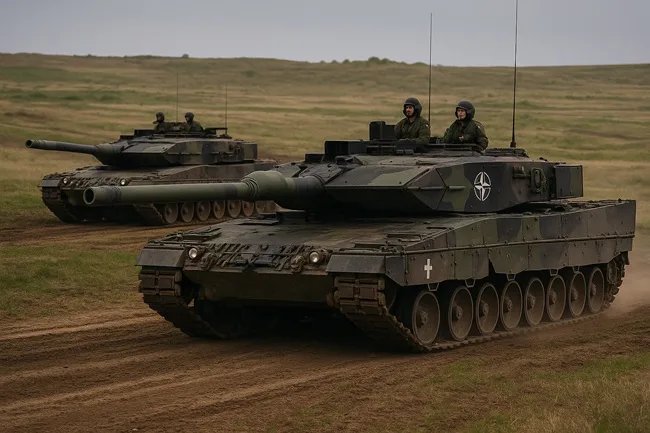
Poland fired the first major salvo in 2022, when it signed one of Europe’s largest arms deals with South Korea to acquire K2 Black Panther tanks and K9 howitzers. In August 2025, Warsaw expanded that deal, finalizing a fresh contract worth over $6.5 billion for additional K2s and armored vehicles, with partial assembly and production taking place inside Poland. That single move positioned Poland as Europe’s largest operator of modern tanks by 2030, overtaking even Germany in total planned units.
Romania followed suit. Its Ministry of National Defence has proposed a €6.5 billion plan to purchase 216 main battle tanks and derivative vehicles, including recovery and engineering variants. This new phase builds on its 2023 decision to buy 54 Abrams M1A2 SEPv3 tanks from the United States. While still awaiting parliamentary approval, the Romanian program would more than triple the nation’s heavy armor inventory and bring its capabilities in line with NATO standards.
Meanwhile, the Czech Republic, Hungary, and Slovakia have been upgrading or ordering Leopard 2 variants from Germany’s Krauss-Maffei Wegmann and Rheinmetall. Collectively, these programs amount to a regional transformation in land power unseen since the late 1980s. Across Eastern Europe, modernization has shifted from talk to execution, with budgets to match.
The combined effect is staggering. Between 2023 and 2025, Eastern European countries committed over €25 billion to new tank and armored vehicle programs—an investment that effectively relocates the industrial center of gravity within NATO eastward.
Why are Eastern European countries rushing to rebuild heavy armor fleets, and what geopolitical forces are driving this surge?
The motivations are layered—strategic, political, and industrial. At the strategic level, Russia’s invasion of Ukraine shattered long-held assumptions about modern warfare. Tanks, dismissed by some as relics of 20th-century conflicts, proved essential once again in both offense and defense. NATO analysts observed that armor, when integrated with drones and precision artillery, remains irreplaceable for ground dominance.
Politically, rearmament is a form of sovereignty. For countries once under Moscow’s influence, possessing cutting-edge armor means more than military readiness—it signals independence, deterrence, and equal footing within NATO. The Romanian government described its modernization as both a deterrent and a contribution to collective security, highlighting its position as a frontline state bordering Ukraine and the Black Sea.
Economically, defense spending is increasingly viewed as an investment in industrial renewal. Eastern Europe’s manufacturing base, eroded by decades of underinvestment, now has a new opportunity to reindustrialize through defense production, co-assembly, and offset agreements. Poland’s deal with Hyundai Rotem includes technology transfer and local manufacturing of hulls and components, while Romanian planners are pushing for similar arrangements to strengthen domestic capacity.
How are global suppliers competing for influence in the Eastern European tank market?
Three industrial blocs are battling for dominance: the United States, Western Europe, and South Korea. Each is offering more than just tanks—they are selling ecosystems of logistics, training, and political alignment.
The United States has entrenched itself as a leading supplier through the Abrams M1A2 SEPv3. Countries choosing this system gain access to a proven NATO-standard platform with deep interoperability advantages. Yet, the Abrams’ gas-turbine engine and high maintenance costs pose long-term challenges for nations seeking affordability and supply-chain independence.
Western Europe’s response centers on the Leopard 2A8, developed jointly by Germany’s Krauss-Maffei Wegmann and Rheinmetall. It remains the continent’s flagship tank and the foundation for future European joint programs. However, limited production capacity and long delivery timelines have frustrated buyers needing rapid deployment.
South Korea has seized that opening. Hyundai Rotem’s K2 Black Panther offers advanced digital fire control, mobility, and modular design, combined with flexible financing and faster production. More importantly, Korea’s willingness to localize production gives it a strategic edge over Western manufacturers. Its partnership with Poland—where K2 production is being localized under “K2PL”—has set a precedent that Romania and other nations may replicate.
For now, the result is a multi-polar procurement landscape that mirrors NATO’s political complexity. Each purchase reinforces alliances but also exposes industrial fractures within Europe’s defense sector.
Is Eastern Europe building autonomy—or just shifting dependencies?
The core question is whether these massive tank acquisitions are enabling self-reliance or deepening dependence on foreign suppliers. Co-production clauses sound promising on paper, but meaningful technology transfer is rare. Experts note that while Poland is assembling K2s locally, the high-value components—engines, electronics, armor systems—still come from abroad.
Romania faces similar challenges. While its defense ministry insists on domestic participation, its industry lacks the scale and specialization needed to handle complex tank assembly. The reality is that most Eastern European countries are creating jobs and limited know-how rather than full production sovereignty.
This asymmetry could entrench a new form of dependency—one that replaces Soviet-era supply chains with Western or Asian ones. In the long run, that may limit Europe’s ambition for defense autonomy, a goal repeatedly emphasized by the European Union since 2017 through the Permanent Structured Cooperation (PESCO) and the European Defence Fund.
Another challenge lies in interoperability. If Poland fields K2s, Romania fields Abrams, and the Czech Republic operates Leopards, NATO logistics could become increasingly complex. Spare parts, ammunition standards, and training regimes would vary, creating friction in joint operations.
Could Europe’s rearmament reshape NATO’s industrial power structure?
Eastern Europe’s spending spree is forcing NATO to rethink its industrial geography. Until recently, defense production was concentrated in Western Europe and the United States. Today, supply-chain integration, assembly facilities, and maintenance hubs are migrating eastward, closer to NATO’s front lines.
Poland already hosts joint facilities for tank assembly and artillery production. Romania is positioning itself as a logistics and maintenance hub for Black Sea operations. The Czech Republic and Slovakia have revitalized their armored-vehicle plants to support both domestic and allied contracts. The result is a decentralization of NATO’s industrial base—potentially increasing resilience but also introducing competition among allies.
For major defense contractors, this is both a challenge and an opportunity. U.S. firms such as General Dynamics and European players like Rheinmetall are expanding partnerships in the east to maintain market share. South Korea’s entry has added a disruptive, cost-efficient competitor to the mix.
Analysts suggest this could mark the start of “factory diplomacy,” where defense manufacturers act as geopolitical players in their own right. Their investments, partnerships, and offset terms now shape not only industrial strategy but also alliance politics.
How sustainable is Eastern Europe’s tank spending spree amid rising economic pressures and long-term defense costs?
While the tank revival bolsters deterrence, it carries financial and logistical strains. Tanks are among the most expensive systems to operate and sustain. Fuel costs, crew training, and maintenance cycles require recurring expenditure that can outstrip initial procurement budgets. For example, the Abrams consumes nearly three times the fuel of comparable European tanks, raising concerns about long-term affordability for countries with limited defense budgets.
Infrastructure is another hurdle. Eastern Europe’s transport networks were not built for 70-ton machines. Upgrading railways, bridges, and depots to handle the new hardware will demand billions in additional investment. Failure to do so could bottleneck mobility and readiness.
There’s also the political risk of fragmentation. As each country pursues separate supplier partnerships, Europe’s collective bargaining power weakens. Instead of a unified European defense market, the continent risks splintering into clusters tied to different supplier nations—U.S., German, or Korean—each with its own logistics ecosystems. This could undermine efforts to create a coherent industrial policy under EU frameworks.
Finally, the fiscal impact cannot be ignored. Even as defense spending reaches record highs, governments must balance social spending and economic recovery. Public sentiment may shift if taxpayers perceive that rising defense budgets come at the expense of education or healthcare.
What does this shift mean for NATO’s future and Europe’s defense autonomy?
For NATO, the rearmament of its eastern flank strengthens deterrence and operational depth. But it also complicates standardization—the alliance’s long-standing principle of interoperability. If industrial fragmentation deepens, NATO may struggle to coordinate logistics during crises. The alliance’s Conference of National Armaments Directors already faces difficulties harmonizing member states’ procurement choices.
For Europe, the dilemma is existential. The continent’s leaders have long called for “strategic autonomy” in defense manufacturing. Yet the very countries investing most heavily in rearmament are doing so through extra-European deals. Poland’s K2 agreement with South Korea and Romania’s proposed Abrams buy demonstrate a preference for speed and proven technology over joint European development.
By 2030, the outcome could be a NATO where industrial influence has decisively shifted eastward—but under the technological leadership of external partners. Europe’s defense economy would be more distributed but less cohesive.
Still, some analysts view this as a necessary evolution. They argue that decentralizing defense production enhances resilience, diversifies suppliers, and makes NATO less vulnerable to single-point failures. If managed wisely, Eastern Europe’s industrial awakening could complement, not fragment, the alliance.
How could Eastern Europe’s tank boom redefine NATO’s industrial geography and shift long-term power within the alliance?
Eastern Europe’s tank revival represents both opportunity and disruption. It is strengthening NATO’s eastern defense perimeter while simultaneously exposing the limits of European industrial integration. Whether this becomes a foundation for long-term industrial resilience or a patchwork of competing dependencies depends on how governments coordinate procurement and technology sharing.
The emergence of South Korea as a serious European defense supplier illustrates that alliances today are as much economic as military. The next decade will test whether Europe can reconcile fast rearmament with the slower, harder goal of building true industrial sovereignty.
In short, the tanks rolling out of Poland and soon, perhaps, Romania are more than symbols of deterrence—they are indicators of a new geopolitical economy within NATO. The factories that build them may decide the balance of industrial power for a generation.
Discover more from Business-News-Today.com
Subscribe to get the latest posts sent to your email.