




Constellation Energy Corporation (NASDAQ: CEG), the United States’ largest producer of carbon-free electricity, is emerging as a central private-sector figure in New York’s renewed embrace of nuclear power. Following Governor Kathy Hochul’s June 23, 2025 directive tasking the New York Power Authority (NYPA) with building a new gigawatt-scale advanced nuclear power plant, Constellation has moved into a leading role via its early site permit work at Nine Mile Point and its strategic public-sector collaborations.
The Baltimore-headquartered utility operator already manages three major nuclear facilities in upstate New York and has deep operational, regulatory, and labor linkages across the region. Analysts and institutional stakeholders increasingly view Constellation as a likely long-term anchor in New York’s evolving nuclear buildout, especially as the state balances grid reliability, clean energy goals, and rising industrial power demand.
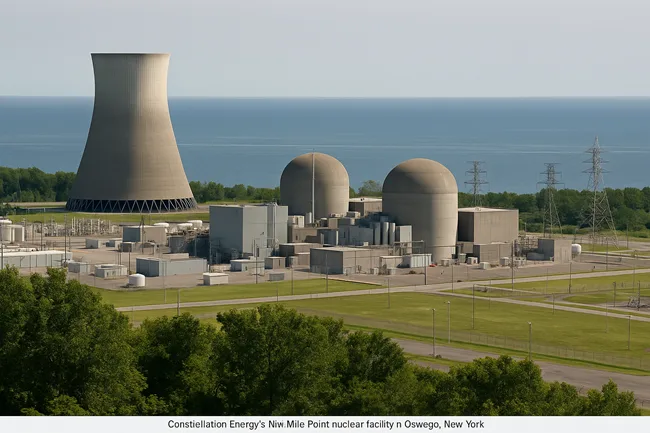
How is Constellation’s Nine Mile Point project positioning it at the center of New York’s nuclear redevelopment?
Constellation is currently seeking early site permitting from the U.S. Nuclear Regulatory Commission (NRC) for a potential advanced nuclear reactor at its Nine Mile Point site in Oswego, New York. That effort, supported by the New York State Energy Research and Development Authority (NYSERDA), aligns directly with the state’s broader roadmap to integrate next-generation nuclear power as part of its zero-emissions grid strategy.
The early site permit—one of the first of its kind in New York in decades—would allow Constellation to move quickly into licensing and construction phases once a reactor design is selected. Industry observers note that this site-specific work may substantially reduce permitting timelines for the NYPA-led nuclear project, giving Constellation a clear advantage over competing vendors and locations.
Moreover, Nine Mile Point’s existing nuclear infrastructure, transmission interconnects, and trained labor pool position it as a natural anchor for advanced reactor deployment. That could allow New York to avoid siting delays while building on community relationships already in place.
What are institutional investors and financial analysts signaling about Constellation Energy’s nuclear positioning?
Constellation’s stock (NASDAQ: CEG) reacted positively in the immediate aftermath of Governor Hochul’s announcement, rising roughly 2 percent as investors welcomed signs of state-backed nuclear investment. This followed an earlier June 2025 rally triggered by Constellation’s 20-year power purchase agreement with Meta Platforms to supply carbon-free electricity from its Clinton nuclear facility in Illinois.
Institutional investors have noted that long-term contracts such as the Meta deal provide steady cash flow, de-risking capital-intensive nuclear operations. Analysts suggest that a similar model—potentially involving NYPA or other public agencies—could emerge in New York, combining public sponsorship with Constellation’s operating expertise to build a stable revenue base for future reactors.
Despite broader volatility in the utility sector, Constellation has outperformed many peers, in part due to its strong nuclear asset base and its strategic pivot toward state-aligned, emissions-free power.
What operational strengths does Constellation bring to the table in New York’s nuclear expansion?
Constellation operates three nuclear power plants in New York State: Nine Mile Point Units 1 and 2, and the James A. FitzPatrick plant, all located along the southern shore of Lake Ontario. These facilities represent more than 2.5 gigawatts of generation capacity and support thousands of skilled jobs across Oswego County and the surrounding region.
The FitzPatrick plant alone provides more than $12 million in annual property tax revenue and supports approximately 600 full-time jobs. These existing facilities also benefit from deep regulatory familiarity with the NRC, longstanding community engagement, and union-backed workforces with certified nuclear safety training.
The operational track record of these plants—particularly during extreme weather and peak load events—demonstrates the resilience that nuclear power offers New York’s grid. Leveraging this expertise will be vital as the state attempts to integrate more variable renewable energy and retire aging fossil fuel generation.
What are the risks and constraints that could impact Constellation’s ability to lead New York’s nuclear build?
Despite its advantages, Constellation faces several uncertainties. The early site permit process—while strategic—still requires NRC approval, followed by reactor-specific licensing and financing arrangements. The ultimate choice of reactor design will also influence the project’s technical feasibility, cost structure, and deployment timeline.
Constellation is also balancing other strategic priorities. In early 2025, the company announced a $16.4 billion acquisition of Calpine Corporation, a major gas and geothermal power producer. While the deal diversifies Constellation’s generation mix, it has raised questions among some institutional investors about capital allocation and nuclear focus. CEG stock fell over 13 percent in the days after the Calpine announcement, reflecting short-term concerns around debt load and integration complexity.
Furthermore, NYPA’s master plan includes provisions for working with multiple vendors, potentially reducing Constellation’s exclusivity. While the early site permit may favor Nine Mile Point as a preferred location, the state has not yet committed to a single supplier or deployment model.
What milestones could further cement Constellation’s role in New York’s nuclear transformation?
The next 12 to 18 months will be pivotal. Constellation’s early site permit application is expected to advance into a public comment and review phase by early 2026. Concurrently, NYPA is conducting feasibility assessments and supplier evaluations, with a target to announce preferred partners and locations by the end of that year.
Constellation is also positioning itself to leverage federal funding. The U.S. Department of Energy’s Advanced Reactor Demonstration Program and Inflation Reduction Act clean electricity production credits could serve as catalysts for cost-sharing arrangements. If awarded, these funds would reduce the financial burden on both Constellation and NYPA while accelerating construction readiness.
By 2027, Constellation could potentially break ground on a new reactor project—either independently or in partnership with NYPA—marking a milestone in the reindustrialization of America’s nuclear sector and solidifying New York’s leadership in decarbonized base-load energy.
How will Constellation Energy’s leadership in advanced nuclear influence its long-term growth and U.S. energy policy?
If Constellation secures a lead role in New York’s advanced nuclear build, it will mark a significant shift in how clean energy infrastructure is developed in the United States. The model—public planning backed by private execution—could become a replicable framework for other states struggling to decarbonize without sacrificing grid reliability.
Moreover, Constellation’s position at the intersection of policy, capital markets, and operational excellence could help close the nuclear deployment gap left by the post-Fukushima pause and recent project cancellations. Its success in New York may set the tone for future projects in Illinois, Pennsylvania, and California, where grid resilience is emerging as a central planning theme.
From an investor standpoint, anchoring advanced nuclear builds with guaranteed offtake, federal credits, and operational synergies could unlock long-term earnings stability. That positions Constellation not just as a legacy nuclear operator, but as the engine of a new generation of clean energy infrastructure in the U.S.
Discover more from Business-News-Today.com
Subscribe to get the latest posts sent to your email.
