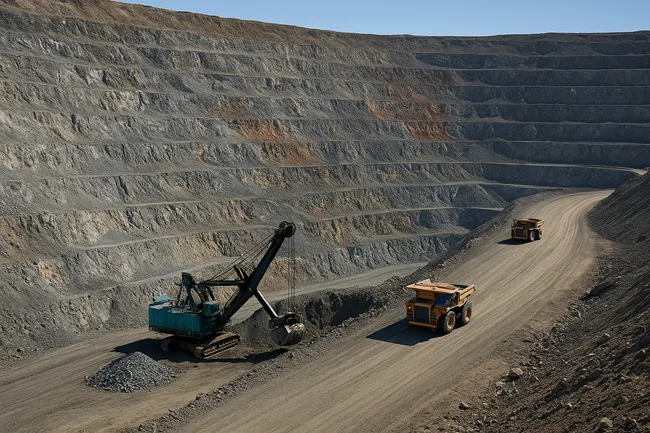
Teck Resources Limited’s (TSX: TECK.A, TSX: TECK.B, NYSE: TECK) $2.4 billion Highland Valley Copper Mine Life Extension Project (HVC MLE) has reignited debate over whether Canada’s regulatory framework can sustain investor confidence for future large-scale critical minerals projects. The Vancouver-headquartered miner secured all major permits for the life extension, enabling construction to commence in August 2025, but analysts caution that the project’s success reflects its brownfield status rather than a broad shift in Canada’s permitting efficiency.
Institutional investors now question whether Canada can replicate this momentum for greenfield copper, lithium, and rare earth projects, especially as global competitors like Chile, Australia, and the United States push to accelerate their critical minerals permitting timelines.
How does Canada’s permitting pace compare with other major mining jurisdictions?
Canada remains a top-tier jurisdiction in terms of resource stability, but permitting timelines are often viewed as a bottleneck for capital deployment. Analysts note that while Teck Resources benefited from an established operational footprint and long-standing community relationships at Highland Valley Copper, greenfield projects can still face approval cycles stretching five to seven years.
In contrast, Chile—despite political uncertainty over royalty reforms—has implemented faster environmental review processes for strategic copper and lithium projects, sometimes finalizing permits within three to four years. Australia, considered one of the most investor-friendly jurisdictions, offers clear timelines under its Environment Protection and Biodiversity Conservation Act, with average approvals for critical minerals projects taking three to five years. The United States, under the Inflation Reduction Act, is also moving to streamline federal reviews, although permitting remains complex due to overlapping state and federal jurisdictions.
Institutional sentiment suggests that Canada risks falling behind if it cannot demonstrate similar agility, particularly as global investors increasingly weigh time-to-market when allocating capital for critical minerals projects.
What are the main investor concerns about Canada’s regulatory framework?
While Canada’s regulatory stability is generally praised, investors highlight three recurring concerns. First, overlapping federal and provincial approvals often extend timelines, creating uncertainty around project financing. Second, community engagement processes, although critical for social license, lack standardized frameworks, leading to inconsistent timelines across provinces. Third, environmental assessments remain prone to delays due to evolving climate and biodiversity regulations.
The Highland Valley Copper life extension is seen as an exception rather than the rule, given its brownfield nature and the early, structured engagement Teck Resources conducted with Indigenous communities. Analysts argue that if Canada does not establish clear benchmarks for new projects, institutional capital may favor jurisdictions like Chile and Australia, where timelines are more predictable even if political risks are higher.
Could recent policy changes improve Canada’s attractiveness for future billion-dollar critical minerals projects?
The Canadian government’s Critical Minerals Strategy, launched to support energy transition supply chains, is beginning to address investor concerns. Federal funding for feasibility studies, tax incentives for exploration, and streamlined permitting for “strategic projects” are early signs of progress. Analysts believe that if these measures are implemented consistently, they could reduce average permitting timelines by 12 to 18 months.
Moreover, Teck Resources’ structured Indigenous partnerships at Highland Valley Copper—especially the governance model with the Citxw Nlaka’pamux Assembly—are being cited as a potential template. If adopted widely, such models could reduce community-related project delays while strengthening Canada’s ESG credentials.
However, investors remain cautious. For billion-dollar projects, including large-scale copper and lithium expansions, capital will likely flow to brownfield opportunities first, where permitting risks are inherently lower. Greenfield projects may continue to face slow adoption until Canada proves that its reforms can deliver timelines comparable to Australia or Chile.
What does this mean for Canada’s position in the global critical minerals race?
If Canada cannot accelerate regulatory processes, it risks missing the current window of high copper and critical minerals demand driven by electric vehicles and renewable energy infrastructure. Institutional analysts emphasize that time-to-market will be decisive over the next five years as supply chain diversification becomes a strategic priority for manufacturers in the United States, Europe, and Asia.
The Highland Valley Copper Mine life extension demonstrates that Canada can execute billion-dollar projects under the right conditions. But whether this momentum translates into a broader investment wave will depend on how quickly Ottawa and provincial governments can harmonize approvals and create clear, predictable permitting frameworks.
Discover more from Business-News-Today.com
Subscribe to get the latest posts sent to your email.