



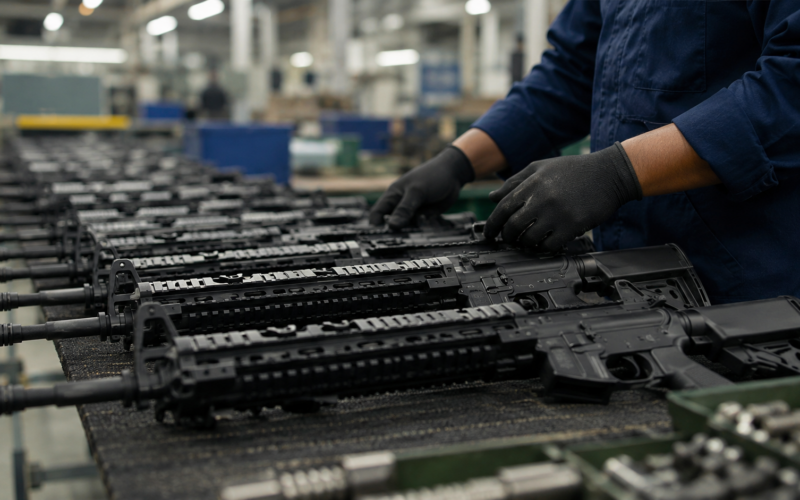
Bharat Forge Limited (NSE: BHARATFORG; BSE: 500493) is approaching an important execution phase for its ₹1,661.9 crore contract to supply 255,128 Close Quarter Battle carbines to the Indian Army. The Ministry of Defence awarded the five-year contract on December 30, 2025, making it Bharat Forge’s largest small-arms order and one of the most consequential private-sector infantry weapon programmes in India. Management has subsequently indicated that production of the CQB carbines is expected to begin during the second half of FY27, placing the programme among the company’s most important near-term defence growth catalysts. The order strengthens Bharat Forge’s transition from an automotive forging group into a diversified defence systems manufacturer with exposure to artillery, small arms, military vehicles, naval equipment and aerospace components. The central question is no longer whether the contract provides revenue visibility, but whether Bharat Forge can industrialise the programme at the required scale without compromising quality, delivery schedules or profitability.
Why does Bharat Forge’s ₹1,661.9 crore CQB carbine contract matter more as production approaches?
The Ministry of Defence signed contracts worth approximately ₹2,770 crore for more than 425,000 CQB carbines and associated accessories for the Indian Army and Indian Navy. The procurement was divided between Bharat Forge Limited and PLR Systems Private Limited, creating a two-supplier structure for one of India’s largest recent small-arms acquisition programmes.
Bharat Forge’s disclosed portion covers 255,128 carbines valued at ₹1,661.9 crore. That represents approximately 60% of the overall CQB carbine programme by both disclosed contract value and unit volume. The allocation gives Bharat Forge sufficient scale to establish a dedicated manufacturing base rather than treating small arms as an experimental or low-volume defence activity.
The order is also significant because its value exceeds Bharat Forge’s entire FY26 defence revenue of approximately ₹1,562 crore. This does not mean the company will recognise the full contract as revenue in a single year. The contract is scheduled for execution over five years, and actual revenue recognition will depend on production milestones, inspections, acceptance and delivery schedules.
Nevertheless, the comparison demonstrates the programme’s strategic weight. On a simple straight-line basis, the order would represent average annual revenue of around ₹332 crore. Actual execution is unlikely to be perfectly even, particularly because early periods may include production-line preparation, supplier qualification and initial batch approvals before manufacturing reaches a steadier rate.
A simple division of contract value by disclosed unit volume produces an implied average of approximately ₹65,100 per carbine. That figure should not be interpreted as the standalone selling price of the weapon because the contract may incorporate accessories, support requirements, taxes, inspection costs and other commercial terms that have not been publicly itemised.

How could CQB carbine production change Bharat Forge’s defence revenue mix from H2 FY27?
Bharat Forge ended FY26 with a defence order book of approximately ₹10,961 crore, compared with defence revenue of about ₹1,562 crore during the year. The CQB carbine award alone accounts for roughly 15% of that order book, illustrating why the programme could materially affect the pace and composition of defence revenue once deliveries begin.
The company has guided investors toward a broader acceleration in Indian manufacturing operations during FY27, supported by defence execution, aerospace growth, domestic demand and recovering exports. Within defence, management has identified two especially important milestones: the production ramp-up of the Advanced Towed Artillery Gun System and the commencement of CQB carbine production.
These programmes have different manufacturing and revenue characteristics. Artillery guns are complex, high-value platforms delivered in relatively small numbers, while carbines require the repetitive production of hundreds of thousands of standardised units. The carbine contract could therefore help Bharat Forge develop a more balanced defence revenue mix, combining large-ticket platforms with higher-volume manufactured products.
That balance matters because platform contracts can create uneven quarterly revenue depending on delivery schedules. A successfully industrialised small-arms programme may offer more regular production flows once the line reaches maturity. It may also create opportunities for replacement parts, accessories, maintenance support and future variants, although Bharat Forge has not publicly quantified any such follow-on revenue.
The contract could additionally support operating leverage if Bharat Forge achieves high utilisation across its production infrastructure. The benefit will depend on how much new capital expenditure is required, whether component sourcing remains stable and how efficiently the company can spread fixed manufacturing costs over the contracted volume.
The order therefore improves visibility, but visibility is not the same as profitability. Investors will need evidence of actual deliveries, revenue recognition, cash conversion and segment-level margin resilience before concluding that the programme has achieved its full financial potential.
Why is indigenous design ownership strategically important for India’s small-arms supply chain?
The 5.56 x 45 millimetre CQB carbine was jointly developed by Bharat Forge and the Armament Research and Development Establishment, which operates under the Defence Research and Development Organisation. The procurement falls within India’s indigenous design, development and manufacturing framework, aligning the programme with the government’s objective of reducing dependence on imported defence equipment.
For India, the strategic value extends beyond the assembly of a domestically branded weapon. Indigenous design ownership provides greater control over engineering changes, product upgrades, manufacturing documentation, testing procedures and future localisation. It can also reduce exposure to foreign export controls, licensing negotiations and geopolitical supply interruptions.
For Bharat Forge, participation at the design and development stage creates a different commercial position from contract manufacturing under a foreign technology licence. The company gains experience in product engineering, productionisation, quality assurance and integration with military acceptance processes. Those capabilities can potentially be applied to other small-arms programmes or export opportunities, subject to government approvals and customer requirements.
The procurement can also deepen the domestic supplier ecosystem. Large-volume small-arms manufacturing requires dependable supplies of barrels, precision-machined components, springs, polymers, surface treatments, magazines, sights and related accessories. Bharat Forge’s challenge will be to create a supplier network that can meet military specifications consistently rather than simply source the cheapest available components.
This is where the programme’s industrial significance becomes clearer. A contract covering more than a quarter of a million carbines can create demand visibility for component manufacturers and specialised micro, small and medium enterprises. However, localisation will only become strategically valuable when domestic suppliers can achieve repeatable quality, traceability and delivery performance across large batches.
Indigenous production does not eliminate execution risk. It moves responsibility for resolving those risks into the domestic manufacturing system. The success of the programme will therefore be measured not merely by the Indian origin of the product, but by whether the resulting supply chain proves dependable over the full contract period.
What operational tests must Bharat Forge clear before the five-year order becomes dependable cash flow?
The first major requirement is production-line readiness. Bharat Forge must translate an approved weapon design into repeatable manufacturing processes capable of producing thousands of units without unacceptable variation. That involves tooling, machining accuracy, heat treatment, assembly procedures, inspection systems and detailed quality documentation.
The second requirement is batch acceptance. Defence contracts generally involve structured inspection and testing before products are formally accepted for delivery. For a small arm, performance consistency, reliability, safety and durability are central. A manufacturing defect affecting even a relatively small percentage of a large batch could delay acceptance and disrupt delivery schedules.
Supplier control is equally important. Bharat Forge may manufacture critical components internally while relying on external suppliers for other parts and materials. Any inconsistency in metallurgy, coatings, polymers or precision components could affect the performance of the finished weapon. The company must therefore extend military-grade quality systems beyond its own factories into the wider vendor base.
Working capital will provide another test. Large defence orders can require manufacturers to purchase materials and build inventory before receiving milestone or delivery-linked payments. The public announcement does not provide a detailed payment schedule, meaning the cash-flow profile cannot be determined from the headline contract value alone.
The five-year delivery window reduces the pressure to manufacture the entire order immediately, but it does not remove the importance of an efficient ramp-up. Delays during initial production can compress the remaining execution period, creating pressure to increase output later. Rapid acceleration can in turn make quality assurance more demanding.
The strongest evidence of progress will be a combination of confirmed production commencement, completed initial deliveries and increasing defence revenue without a disproportionate rise in working capital. Management commentary will remain useful, but recurring financial and operational disclosures will provide the more meaningful test.
How does the carbine order support Bharat Forge’s wider move into artillery and naval systems?
The CQB programme sits within a much larger transformation of Bharat Forge’s defence portfolio. The company has secured an order to supply 184 Advanced Towed Artillery Gun Systems to the Indian Army, representing approximately 60% of the broader ATAGS procurement programme. Management expects ATAGS production and CQB carbine manufacturing to become major contributors from the second half of FY27.
The combination gives Bharat Forge exposure to two distinct levels of military procurement. ATAGS places the company in sophisticated artillery systems with substantial engineering, integration and testing requirements. The CQB carbine programme adds high-volume infantry weapons, expanding the company’s addressable market and manufacturing experience.
Bharat Forge has also broadened its naval exposure. In June 2026, the Ministry of Defence signed a contract worth approximately ₹425 crore for 12 sets of 1.25 megawatt marine gas turbine generators for the Indian Navy. The systems are required to contain at least 60% indigenous content and will support onboard power generation for naval combatants.
These programmes show that Bharat Forge’s defence strategy is not dependent on a single product category. The portfolio increasingly spans artillery, vehicles, small arms, underwater systems, unmanned platforms, naval power equipment and aerospace manufacturing.
Diversification can reduce dependence on individual programmes, but it also increases execution complexity. Different products require different production methods, certification procedures, supplier networks and customer relationships. Management must ensure that expansion across defence categories does not dilute engineering focus or capital discipline.
The company’s broader industrial base provides certain advantages. Bharat Forge has decades of experience in metallurgy, precision manufacturing and safety-critical components. Yet success in defence systems requires more than transferable manufacturing competence. It also demands programme management, testing discipline, documentation, configuration control and long-term customer support.
Why is Bharat Forge stock trading near record levels while carbine execution remains ahead?
Bharat Forge shares closed at ₹2,175.30 on July 23, 2026, leaving the stock approximately 2.8% below its 52-week high of ₹2,238. The shares had gained around 3.4% over the preceding five trading sessions, approximately 3% over one month and more than 78% over one year.
The strength of the share price cannot reasonably be attributed solely to a carbine order announced nearly seven months earlier. Market sentiment reflects a wider combination of defence order visibility, expected ATAGS and CQB production, aerospace expansion, recovery in export markets and expectations for stronger Indian manufacturing growth.
The current price nevertheless indicates that investors are already assigning substantial value to the company’s strategic transition. Bharat Forge is no longer being assessed only as a commercial vehicle and forging supplier. Its defence and aerospace businesses are increasingly influencing expectations for long-term growth, revenue quality and reduced automotive cyclicality.
This creates a higher execution threshold. When a stock trades close to its record high, fresh order announcements may provide less incremental support unless they translate into earnings. Investors may place greater emphasis on production commencement, delivery volumes, margin contribution and cash generation than on additional headline order-book growth.
The CQB programme is well positioned to become an important proof point because its scale is visible and its production timeline has been discussed by management. A successful ramp-up would demonstrate that Bharat Forge can move beyond engineering development and contract acquisition into repetitive, high-volume defence manufacturing.
A delayed or inefficient ramp-up would not erase the long-term strategic opportunity, but it could expose a gap between market expectations and near-term operating evidence. The next phase is therefore about conversion rather than credibility alone.
What will determine whether Bharat Forge converts the CQB programme into durable defence growth?
The ₹1,661.9 crore contract has already improved Bharat Forge’s order visibility and established the company as a major private-sector supplier within India’s small-arms ecosystem. The programme’s indigenous design base, large volume and five-year duration create a meaningful platform for manufacturing scale.
What remains unresolved is the quality of execution. Public disclosures do not yet establish the final production cadence, contract margins, payment profile or timing of the first material revenue contribution. Those factors will determine whether the order produces attractive returns rather than simply adding volume.
The next measurable proof point will be the confirmed commencement of CQB carbine production during the second half of FY27, followed by initial deliveries and visible growth in defence revenue. The strategic thesis would strengthen if production ramps without significant delays, defence margins remain resilient and operating cash flow keeps pace with reported earnings.
The thesis would weaken if initial approvals take longer than expected, manufacturing costs exceed assumptions or working-capital requirements absorb a disproportionate share of cash. Bharat Forge has secured the scale needed to make small arms a meaningful business. Its next task is to prove that the industrial system behind the order can deliver that scale reliably.
What are the key takeaways from Bharat Forge’s CQB carbine production opportunity?
- Bharat Forge Limited secured the ₹1,661.9 crore CQB carbine order on December 30, 2025, meaning it should not be presented as a new July 2026 contract.
- The five-year contract covers 255,128 carbines for the Indian Army and represents Bharat Forge’s largest small-arms order.
- Bharat Forge received approximately 60% of the broader ₹2,770 crore CQB carbine procurement programme by disclosed value and unit volume.
- The contract value exceeds Bharat Forge’s FY26 defence revenue of approximately ₹1,562 crore, highlighting its potential significance once deliveries accelerate.
- Management expects CQB carbine production to begin in the second half of FY27 alongside the ramp-up of Advanced Towed Artillery Gun System manufacturing.
- The programme represents roughly 15% of Bharat Forge’s approximately ₹10,961 crore FY26 defence order book.
- Indigenous development with the Armament Research and Development Establishment provides strategic value through domestic intellectual property, localisation and supply-chain control.
- Production readiness, military acceptance testing, supplier quality and working-capital management will determine the pace of revenue conversion.
- Bharat Forge shares remain close to their 52-week high, suggesting that investors already expect meaningful progress from defence and aerospace execution.
- Confirmed production commencement, initial deliveries, defence margin resilience and cash conversion will be the next measurable tests.
Discover more from Business-News-Today.com
Subscribe to get the latest posts sent to your email.