




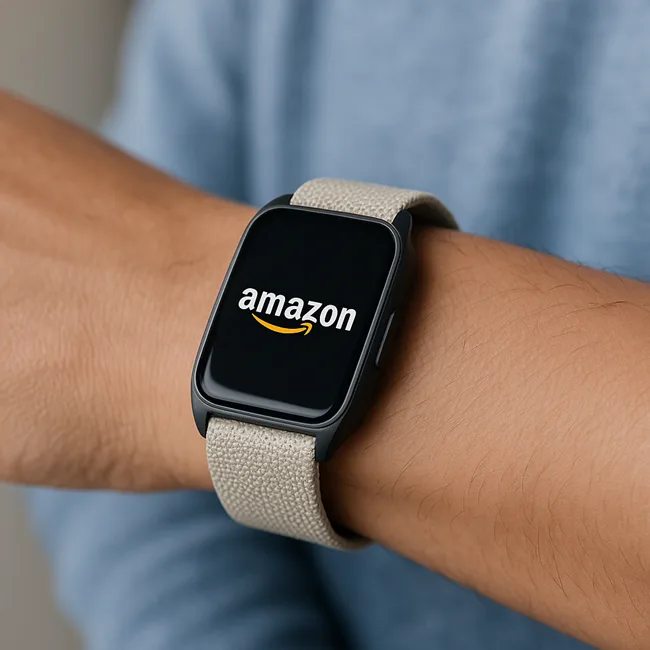
Amazon.com Inc (NASDAQ: AMZN) has signed an agreement to acquire Bee, a San Francisco-based startup developing an artificial intelligence-enabled bracelet designed to continuously listen to and transcribe conversations. The acquisition, announced on July 22, 2025, marks Amazon’s return to the wearables market two years after discontinuing its Halo fitness tracker. Bee’s flagship device, priced at US $49.99 with a US $19 monthly subscription, captures ambient speech, converts it into searchable text, and generates summaries and actionable to-do lists.
Financial details of the acquisition remain undisclosed, but Amazon has extended employment offers to Bee’s approximately 20 employees. The deal, subject to regulatory approval, is expected to close by late 2025. Market watchers see the acquisition as a strategic bet on ambient intelligence at a time when Big Tech rivals are racing to integrate generative AI into consumer hardware.
Institutional investors initially reacted positively, interpreting the transaction as a low-risk entry into AI wearables. Analysts suggest that Bee’s lightweight, privacy-centric hardware could complement Amazon’s existing Alexa ecosystem, creating new user engagement opportunities across retail and cloud-linked AI services.
Why is Amazon making a renewed push into wearable AI and how does Bee fit into this strategy?
Amazon’s decision to re-enter the wearables market reflects a strategic realignment after the mixed success of its Halo fitness devices, which were discontinued in 2023. Bee’s AI bracelet offers a fresh value proposition—continuous transcription and context-aware intelligence rather than fitness or health tracking.
The device uses dual microphones and advanced noise-filtering technology to capture conversations and transcribe them into real-time logs. Users can link the bracelet to calendars, email, and contact apps, enabling proactive assistance such as automatic meeting reminders or action item tracking.
For Amazon, the acquisition supports its broader ambition to build a seamless, hands-free AI assistant experience across devices. Analysts believe Bee’s hardware will eventually be integrated with Alexa+, Amazon’s next-generation voice assistant, allowing users to add grocery items to shopping lists or trigger home automation commands without requiring a wake word. This ambient computing model, which anticipates user needs rather than responding to explicit commands, is seen as key to Amazon’s next growth cycle in consumer AI hardware.
How does Bee’s technology compare to competing wearable AI devices in terms of price, utility, and adoption potential?
Bee operates in a highly competitive space that includes premium devices such as Apple Watch, Meta’s Ray-Ban AI-enabled smart glasses, and Google’s Gemini earbuds. Unlike these multifunctional devices, Bee focuses on a single use case—transcription and conversation logging—allowing for a significantly lower price point. At US $49.99, Bee is far more affordable than Humane’s AI Pin, which launched at nearly US $700 but struggled with battery performance and consumer skepticism.
Its always-on listening capability differentiates Bee from competitors. Whereas most wearables rely on wake words or manual activation, Bee’s bracelet passively captures every conversation within microphone range, then filters and transcribes the data locally. This utility positions the device as a practical productivity tool rather than a lifestyle accessory.
Institutional observers suggest that this narrow, utility-driven approach improves adoption potential in productivity-focused segments, including remote workers and professionals. However, they also caution that mainstream adoption will depend on addressing privacy and legal concerns associated with continuous recording.
What privacy and regulatory challenges could threaten Amazon’s integration of Bee’s bracelet technology?
Privacy is emerging as the most significant hurdle for Amazon’s wearable AI strategy. Bee’s bracelet operates continuously, raising questions about consent in jurisdictions with strict two-party recording laws, including California and New York.
Bee has attempted to address these concerns by processing audio entirely on-device, converting speech to text without storing raw audio files. Users can manually mute the device or delete transcripts. Amazon has publicly committed to maintaining Bee’s privacy-first architecture, emphasizing that customers will “have complete control of their experience.”
Legal experts believe Amazon will need to expand Bee’s compliance framework to align with GDPR in Europe and similar privacy regimes globally. Analysts also highlight that public trust—already strained by past controversies involving Ring doorbell footage sharing—will be critical. Institutional sentiment suggests that successful integration of transparent privacy policies could mitigate potential backlash and regulatory scrutiny.
What are the financial details and how significant is the investment for Amazon’s wearable ambitions?
Although the transaction price has not been disclosed, Bee previously raised approximately US $7 million in funding, indicating that Amazon likely acquired the startup for a relatively modest sum compared to other hardware acquisitions. This low-cost entry provides Amazon with proprietary AI transcription technology, engineering talent, and an established consumer product, all at minimal financial risk.
Bee’s team will join Amazon’s Devices division, overseen by Panos Panay, the former Microsoft executive responsible for Surface hardware. This integration is expected to accelerate development of Bee-powered wearable products under the Alexa hardware umbrella. Analysts estimate that Amazon could launch rebranded Bee devices within 12–18 months, possibly bundled with Alexa+ subscriptions or tied to Amazon Web Services’ edge AI capabilities.
How are investors interpreting Amazon’s acquisition of Bee in terms of stock sentiment and long-term valuation?
Investors view the acquisition as a strategic move to diversify Amazon’s revenue streams beyond e-commerce and cloud computing. Given its relatively small size, the deal is not expected to materially impact near-term financials but could strengthen Amazon’s perception as an innovator in generative AI hardware.
Institutional investors are cautiously optimistic, citing the acquisition’s potential to expand Amazon’s ecosystem and increase user retention. However, they remain watchful of potential regulatory and reputational risks linked to privacy issues. Analysts note that any future growth in Amazon’s hardware segment will depend on the company’s ability to convert Bee’s technology into a mass-market product that aligns with consumer privacy expectations.
What is the long-term outlook for Bee’s technology within Amazon’s AI ecosystem?
Analysts expect Amazon to use Bee’s technology to pioneer new ambient intelligence use cases. The likely roadmap includes integrating transcription features into Amazon’s productivity tools, enabling third-party developer APIs, and exploring enterprise-facing applications such as meeting summaries or real-time language translation.
Future regulatory filings may also reveal patents for advanced context-aware wearables and extended battery technologies. With wearable AI projected to grow at a compound annual rate exceeding 25% globally through 2030, Amazon’s early entry via Bee could provide a first-mover advantage in affordable, context-driven wearables.
However, success will hinge on maintaining consumer trust and delivering clear value beyond existing smartphone apps. If privacy safeguards hold and Amazon delivers compelling use cases, Bee’s technology could evolve from a niche productivity device into a key node in Amazon’s broader AI assistant network.
Discover more from Business-News-Today.com
Subscribe to get the latest posts sent to your email.