




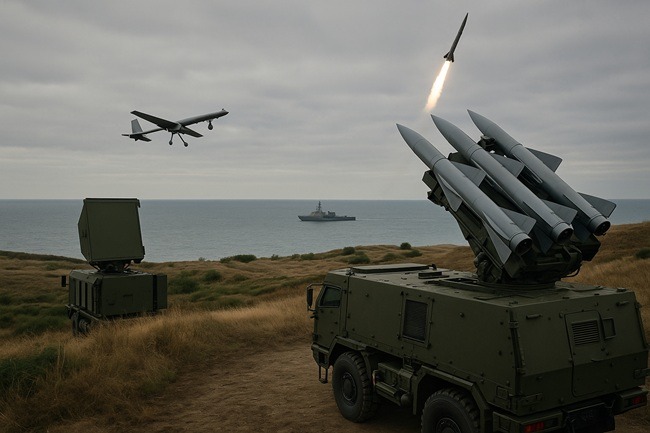
For decades, defence planners have wrestled with the growing imbalance between offensive capabilities and the cost of defending against them. Hypersonic missiles, autonomous drone swarms, and coordinated cyber-kinetic attacks have created a battlefield where attackers can overwhelm even advanced air defence systems. But a new wave of military AI, focused on threat detection, tracking, and interception, is quietly shifting that dynamic. For the first time in years, defence firms and analysts are asking whether AI can finally give defenders the upper hand.
At the heart of this shift is a new generation of algorithms built not just to automate traditional processes, but to rewire how threats are perceived, prioritised, and neutralised in real time. From NATO’s battlefield networks to Israeli counter-UAV systems and European multi-domain defence platforms like Leonardo S.p.A.’s Michelangelo Dome, the race is no longer about faster missiles. It is about faster decisions.
How AI-powered sensor fusion is transforming the defence response loop
In conventional defence systems, threat detection typically involved sequential steps. A radar picks up a signal, an operator confirms its threat level, and a countermeasure is assigned. That process, even at its fastest, is often too slow for low-flying drones, hypersonic glide vehicles, or simultaneous multi-axis attacks.
AI-enabled systems collapse that sequence into milliseconds. Using neural networks trained on vast sensor libraries including radar, lidar, infrared, acoustic, and electromagnetic signals, these platforms can classify, track, and forecast threat trajectories with limited human input. Systems like Israel’s Sky Dew and Rafael’s Drone Dome, as well as the U.S. Army’s AI integration under the TITAN program, already use these models in live operational theatres.
Leonardo’s Michelangelo Dome architecture, unveiled in Rome in late 2025, takes this a step further. By integrating AI into its sensor fusion and decision logic, Michelangelo acts as a central nervous system. It interprets multi-domain telemetry and autonomously coordinates effector systems across land, sea, air, and cyber domains. The platform was designed explicitly to counter emerging threats like drone swarms and hypersonic weapons, where time-to-intercept is measured in seconds, not minutes.
Why drone swarms have become the AI stress test for modern defence
The proliferation of low-cost, commercially modifiable drones has created one of the most pressing tactical challenges for modern militaries. Swarm attacks, often involving dozens or even hundreds of drones programmed to attack in waves or unpredictable patterns, are designed to overload traditional command and control systems. Manual or rules-based systems simply cannot keep pace with the number of decisions required to defend effectively.
This is where AI’s pattern recognition and decision autonomy come into play. Advanced counter-drone systems such as Anduril Industries’ Lattice OS and the European PROMETHEUS project integrate swarm-specific AI that models swarm logic, identifies leading units, and optimises countermeasures dynamically.
AI-enabled systems can prioritise threats based on speed, proximity to high-value assets, or jamming resistance, then assign kinetic or non-kinetic responses accordingly. Whether deploying soft-kill solutions like directed energy beams or hard-kill interceptors, these platforms reduce kill chain latency and maximise the efficiency of limited defensive assets.
As Rafael Advanced Defense Systems has highlighted in recent demos, the goal is not to destroy every drone. It is to degrade swarm cohesion, force dispersal, and neutralise mission success. That kind of fluid, context-based targeting is only feasible with machine learning models trained in both real and simulated combat scenarios.
What makes real-time interception viable in an AI-defined battlefield?
The ability to intercept fast-moving or low-observable threats depends not just on speed, but also on context. AI systems can ingest and cross-reference thousands of variables simultaneously. These include sensor confidence levels, terrain masking, enemy signature libraries, atmospheric conditions, and previous engagement outcomes. All of this helps calculate the highest probability intercept solution.
DARPA’s Air Combat Evolution and U.S. Space Force AI fusion initiatives are focused on exactly this type of battlefield inference. In Europe, Thales Group is pushing forward with AI-enabled fusion engines as part of its Nexium Defence Cloud, while Saab AB’s GlobalEye updates now include predictive threat scoring tied to deep learning inference layers.
Leonardo’s Michelangelo Dome architecture builds on these principles with predictive modelling that automates effector selection based on threat profile and system readiness. Whether the answer is a vertical launch missile, an electronic countermeasure, or a laser pulse, the system’s AI engines calculate not just the optimal response, but also its cascading effects across the wider mission domain.
Analysts believe this shift from reactive defence to predictive interception may be the most transformative change since the introduction of integrated air defence networks during the Cold War.
How are militaries managing AI trust, escalation, and control in threat detection?
One of the core tensions in deploying autonomous AI for defence is the human trust factor. Defence ministries and commanders remain wary of granting full kill-chain autonomy to machines, especially in politically sensitive environments. However, most modern platforms use what is often referred to as human-on-the-loop control, where AI recommends or preps a response, but final authorisation remains human.
That control architecture is now being tested in new ways. In live battlefield conditions where drone swarms or hypersonic weapons leave a five-to-ten second decision window, human review can become the bottleneck. Defence forces in Israel, the United States, and parts of Europe have begun authorising constrained autonomy within specific rulesets. For example, AI can neutralise radar-confirmed drone signatures within 300 meters of a high-value target, but must escalate anything outside that rule for human validation.
This tiered autonomy approach is also being embedded into NATO’s ongoing Project DIANA accelerator, which is trialling rapid-response AI modules for threat detection and electronic warfare. The same logic applies to counter-UAS platforms used by Ukrainian forces, where human operators now rely on AI filters to prioritise targets among signal-heavy battle environments.
Trust, analysts say, will depend less on source code transparency and more on real-world results. As AI proves itself in contested airspace and kinetic engagements, rules of engagement will likely evolve to accommodate a greater share of machine-led decision-making.
How are defence OEMs repositioning around AI-first product development?
For defence prime contractors and fast-moving startups alike, AI is no longer a bolt-on feature but a central pillar of platform design. Original equipment manufacturers across Europe and the United States are repositioning their product roadmaps to emphasise algorithmic advantage, not just sensor count or payload versatility.
Saab AB, for example, is embedding tactical AI in its upcoming electronic warfare subsystems and manned-unmanned teaming concepts. Thales Group has opened new AI training centres to develop algorithms specifically tuned for European threat environments. Rheinmetall AG has expanded its collaboration with artificial intelligence companies for both offensive and defensive applications, including passive detection and automated cueing.
Leonardo S.p.A., in its recent investor communications, has described AI integration as critical to competitive advantage in the current and next product cycles. The Michelangelo Dome was explicitly framed not as a weapons platform but as an intelligent defence ecosystem. By centralising AI in the architecture, Leonardo aims to future-proof its relevance across both domestic defence budgets and international joint ventures, such as its ongoing partnership with EDGE Group in the United Arab Emirates.
What lies ahead as AI becomes central to future defence ecosystems?
Looking ahead to 2026 and beyond, AI in threat detection will move beyond reaction and toward preemption. Research is already underway to use AI not only to respond to threats, but to model adversary intent, simulate conflict scenarios, and forecast points of instability in a given theatre.
This left of launch approach, identifying patterns and weak signals before a kinetic threat manifests, is being tested in U.S. Cyber Command, EU strategic planning centres, and emerging AI labs in India and the Gulf.
With the rollout of modular defence architectures such as Michelangelo Dome, Nexium Cloud, and AI-linked AEW&C platforms, the industry is moving toward a future where threat detection is continuous, contextual, and autonomous. The focus is no longer on building bigger missiles or thicker armour, but on winning the data and decision-making war before the first shot is fired.
In that future, the defender’s edge may finally come not from firepower, but from foresight.
Discover more from Business-News-Today.com
Subscribe to get the latest posts sent to your email.

