


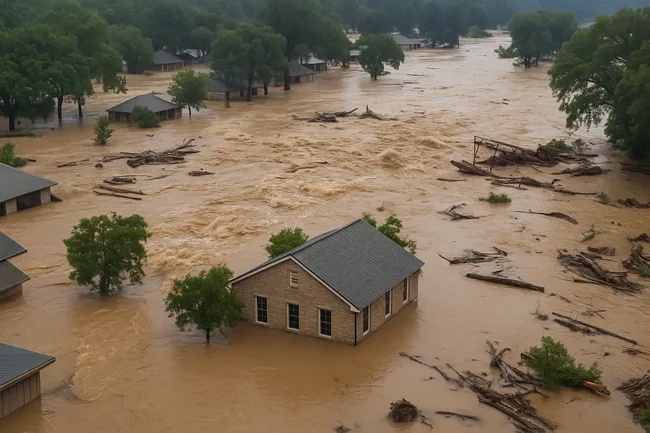
What institutional, historical and climate factors contributed to the deadly floods in Kerr County?
The confirmed death toll from the catastrophic Texas Hill Country flooding has climbed to 129, with at least 103 lives lost in Kerr County alone. Officials say the majority of the victims were children, teenagers, and camp staffers who were caught off guard by rapidly rising waters over the July 4 weekend.
Central Texas is historically prone to flash flooding due to its unique topography—thin soils, steep inclines, and narrow waterways that channel water with little warning. Referred to by meteorologists as “Flash Flood Alley,” this region has experienced at least a dozen major floods since 1921. Despite repeated natural disasters, local authorities in some counties have been slow to modernize their flood warning systems.
Scientific analysis indicates that the storm system responsible for the recent flooding—supercharged by atmospheric instability and high moisture from tropical remnants—was intensified by climate change. Rainfall exceeded 20 inches in several parts of Kerr and Gillespie counties, overwhelming the Guadalupe River basin and causing the river to rise more than 35 feet in a matter of hours.
One of the most devastating flashpoints was Camp Mystic, a century-old private summer camp near Hunt, Texas. At least 27 individuals—primarily young girls and staff—were confirmed dead after a wall of water swept through the site during the early morning of July 6. Among the deceased was camp co-owner Richard “Dick” Eastland, who had long advocated for upgraded flood alert systems in Kerr County.
Why did warning systems fail in Kerr County despite known flood risks and federal alerts?
While the National Weather Service issued timely flash flood warnings starting July 4, the local infrastructure to relay those alerts to residents failed in Kerr County. Sirens that had once served river communities were phased out in favor of digital alerts, which many residents never received due to cell tower outages and gaps in signal coverage.
Kerrville Fire Chief Eric Newhouse confirmed that these lapses were under investigation. According to state officials, even the county’s centralized emergency management portal failed to deliver real-time guidance to affected households. In contrast, neighboring towns like Comfort and Bandera that retained analog siren systems saw significantly fewer casualties.
Environmental experts have pointed out that funding for flood resilience projects, including sirens, river gauges, and public education campaigns, was often deprioritized at both the state and county level over the past two decades. Climate scholars have called the tragedy in Kerr County an outcome of “policy amnesia” in the face of mounting scientific evidence.
How have federal and state agencies responded to the Central Texas flood disaster?
On July 6, President Donald Trump approved a federal disaster declaration for Kerr County, unlocking emergency aid, FEMA support, and Department of Defense search operations. Texas Governor Greg Abbott had declared a statewide emergency the day prior. FEMA Task Forces from multiple states, including Arkansas and Colorado, were deployed within 48 hours, while the U.S. Coast Guard and National Guard provided helicopters and air support.
President Trump visited Kerrville on July 11 alongside First Lady Melania Trump and praised local first responders and community volunteers. He pledged continued federal support and announced that eight additional counties would be included in the disaster relief framework. Trump stopped short of directly addressing the alert system failures, though he signaled that “a full review” of emergency preparedness would follow the recovery phase.
Over 2,000 volunteers joined official search teams, many from nonprofit groups like Samaritan’s Purse, All Hands and Hearts, and the American Red Cross. Mobile food kitchens, temporary medical units, and bottled water distribution hubs have been set up in Ingram and Hunt. The Texas Division of Emergency Management confirmed that more than 700 homes were either destroyed or rendered uninhabitable.
What are local and national reactions to the tragedy, and how are communities coping?
The tragedy has sparked intense public grief and calls for accountability. Vigils are being held across Kerr County, with Camp Mystic alumni from across the country expressing outrage that known risks were not addressed. Families have begun submitting DNA samples to expedite victim identification as search teams comb through riverbanks, downed trees, and collapsed structures.
Institutional sentiment has been largely critical of preparedness failures. While state leaders have focused on immediate rescue and relief, environmental policy researchers, former emergency planners, and even retired NWS officials have highlighted the long history of underinvestment in flood resilience. A bipartisan group of Texas legislators is now pushing for a special session focused on disaster infrastructure.
Public health officials have also raised concerns about contaminated water, mosquito-borne illnesses, and mental health trauma among survivors. The Texas Department of State Health Services has deployed mobile teams to provide first aid, counseling, and sanitation kits.
What future risks and climate-related threats remain as the region recovers?
While the Guadalupe River has receded to below flood stage, forecasters warn that the region remains highly vulnerable due to saturated ground and upcoming storm systems. The National Weather Service has issued flash flood watches for areas stretching from the Hill Country to the Texas Panhandle. Even moderate rainfall could trigger new disasters in weakened zones.
Meteorologists say that extreme rainfall events like this are increasing in frequency and intensity due to climate change. Studies estimate that the July 2025 flood was at least 7% more intense than it would have been without anthropogenic warming. As Texas enters peak hurricane season, the risk of similar events remains elevated.
State planners have begun reevaluating floodplain maps and warning infrastructure. There are growing calls for statewide siren mandates, enhanced river gauge networks, and AI-based predictive flood modeling. Local counties are also exploring new zoning regulations to prevent future development in high-risk riverfront areas.
What investigations are expected into the disaster and how will accountability be handled?
Kerr County Judge Rob Kelly extended emergency powers through July 17 to allow for uninterrupted rescue, relief, and investigation. An independent commission is expected to review all emergency response processes, including the failed alert system, inter-agency communication, and use of real-time data tools. Sheriff Larry Leitha has pledged full cooperation and transparency, stating that no official would be shielded from scrutiny.
In Austin, the Texas Legislature has signaled bipartisan support for a funding package focused on climate adaptation, river safety, and disaster management reforms. Federal agencies, including the Department of Homeland Security, are likely to be involved in the review, especially given criticisms of FEMA’s phone-line overload during the initial survivor intake.
Community leaders have also asked for a formal memorial designation at Camp Mystic and support for affected families in the form of long-term counseling, housing assistance, and scholarships for the victims’ siblings.
Discover more from Business-News-Today.com
Subscribe to get the latest posts sent to your email.